Propecia and the 15% Risk of Side Effects Myth

NOTE: The following comes to us from a longtime reader that wishes to remain anonymous. He’s gifted us with some insightful posts in the past about the FDA, LLLT, and clinical trial regulations. His email is as follows:

The Journal of Sexual Medicine recently published an article that has been the source of several Balding Blog posts, including one that answered a reader who wondered if, “the study suggests up to 15% of men taking the drug might experience some form of sexual dysfunction” in context of “the warning label on Propecia (that) … only 2 percent of men might experience erectile dysfunction while using the drug…”.

As a fan of the Balding Blog and a clinical trialist (someone who interprets clinical trial data), and one who has no relationship to Merck or financial interest in finasteride use, I have reviewed the article:

  • Dr. Rassman has correctly pointed out that this article is not a study per se, but a review of data in the literature from completed and published finasteride studies that included placebo groups.
  • The review included 3 studies of men using finasteride (1 mg daily) for alopecia, 15 studies of men using finasteride (mainly 5 mg daily) for benign prostatic hyperplasia, and 2 for “none” listed as the condition.
  • The 3 studies of men using finasteride for alopecia included a combined total of 1196 men receiving finasteride, and 1035 men receiving placebo.
  • As Dr Rassman has nicely emphasized before, the “true” incidence of an adverse event (attributable to a drug) is the percentage of men who experience a side effect receiving an active drug minus the percentage of men who experience a side effect via placebo. It is important to emphasize that this equation implies no causality (i.e., if a man receiving a drug gets a side effect, it is attributable to his active drug or placebo regardless of other factors – such as diabetes – that may be causally involved).
  • The largest incidence of sexual side effects among the 3 studies involving men with androgenic alopecia is from the smallest study involving only 286 men who received finasteride and were a considerably higher age (41-60 years) than men in the 2 other studies (ages 18-40 years). In older men, factors that contribute to sexual side effects (diabetes, coronary artery disease, and aging) are considerably more frequent. In this small study of 286 men, changes in sex drive were observed (over a period of 1 year of treatment and 1-year of follow-up) in 4.9% receiving finasteride and 4.4% receiving placebo (treatment effect of 0.5%). In the same study, erectile dysfunction was observed in 3.8% of men receiving finasteride and 0.7% of men receiving placebo (treatment effect of 3.1%). In the two larger studies – involving younger men – the incidence of erectile dysfunction was 0.5% (1.4 minus 0.9) in one study, and 0.75% (0.75% minus 0) in the other study.
  • Taken together, these results are consistent with the incidence of sexual side effects noted in the finasteride (Propecia) US product label: decreased sex drive (1.8% finasteride vs. 1.3% placebo) and erectile dysfunction (1.3% vs. 0.7%).
  • The “15%” figure contained in the Balding Blog post by a reader was based in part on the cited (and misleading) newspaper commentary from a business reporter that stated ”…up to 15% of men taking (Propecia) might experience some sort of sexual dysfunction.” Indeed, The Journal of Sexual Medicine article cites a study of 613 men aged 45-80 taking 5 mg finasteride daily for benign prostatic hypertrophy for 2 years. In this study, 15.8% of men receiving finasteride (compared with 6.3% of men receiving placebo) reported erectile dysfunction. This is 5 times the recommended dose for treating hair loss, though. The largest study, involving 2315 men aged 45 years or older (with prostate hypertrophy), showed the next largest effect on erectile dysfunction: 8.1% (finasteride) vs. 3.8% placebo. This latter figure is almost identical to the incidence of erectile dysfunction noted in the finasteride (Proscar) US label.

In summary, one can’t properly mix “apples and oranges” involving clinical trial data involving different doses of drugs with different patient populations and for different indications. The journal article offered no major insights to me but is a nice review of currently published work. To me, a significant issue of side effects is reversibility. Even a minor headache is devastating if due to an active drug and is not reversible.

Despite anecdotes from blogs, I have seen no case histories published in the medical literature of men using finasteride for androgenic alopecia who have developed irreversible erectile dysfunction that has been attributed to use of finasteride. I am not saying that such a phenomenon does not exist; I just have not read any well-documented case history. A newspaper commentary from a business writer that references a blog where a 32-year old man developed erectile dysfunction (“had pretty lousy quality erections otherwise”) of unknown duration 12 years after starting finasteride and who cites “(recent) experiences with a new sexual partner” is not compelling (to me).

Propecia (finasteride 1mg) Cost Varies

We called around the Los Angeles area.
Only Costco appears to have lowered their prices to an affordable rate.
Costco and Target still offer a year supply of 5mg pills for $27 (90 pills, or $9 for #30) This works out to 360 day supply or less than $3 a month.
Finasteride 5mg is still the least expensive option for those who are willing to cut the pill in equivalent dosing.

All prices below reflect generic 1mg finasteride as of October 2014

Costco:
#30: $16.37
#90: $36.89

Target:
#30: $83.00
#90: $249.00

Ralphs:
#30: $59.29
#90: $177.79

Walgreens:
#30: $81.99
#90: $233.89

Rite-Aid:
#30: $72.00
#90: $186.00

CVS:
#30: $69.99
#90: $209.99

Do Body Hair Transplants Work?

Body hair transplants work, but the body hair has a short growth cycle. This means that for every 10 hairs that are transplanted, they will cycle about every 6-8 months meaning that only half of the hairs are growing at any one time as the sleep (telogen cycle) is also long. If you don’t have enough scalp hair, the beard is a better donor source, as its growth cycle is like scalp hair.


2020-01-07 07:29:55Do Body Hair Transplants Work?

Propecia Peaks at 2 Years?

hi dr,
just had a few questions about propecia and why its peek results are reached at 2 years. is it possible that it could continue the de-miniaturization process beyond that point for a young man such as myself at 21? i began taking it at an early 20. thank you for this informative blog and your response in advance.

We don’t know why results from Propecia (finasteride 1mg) peaks at the first 1 to 2 years, but it is an observation many doctors and patients have made. With that said, it does not mean the medication stops working or is less effective after that time frame.

For the few who see more balding after years on Propecia, I have been advising that they consider increasing the dose to 2mg daily provided that there are no sexual side effects. Of those whom I’ve given this recommendation, none have reported sexual side effects. Please remember, I’m not your doctor and I’m not recommending this to anyone here.


2009-09-10 09:25:36Propecia Peaks at 2 Years?

Do I Have a Juvenile or Mature Hairline at 26 Years Old? (with Photo)

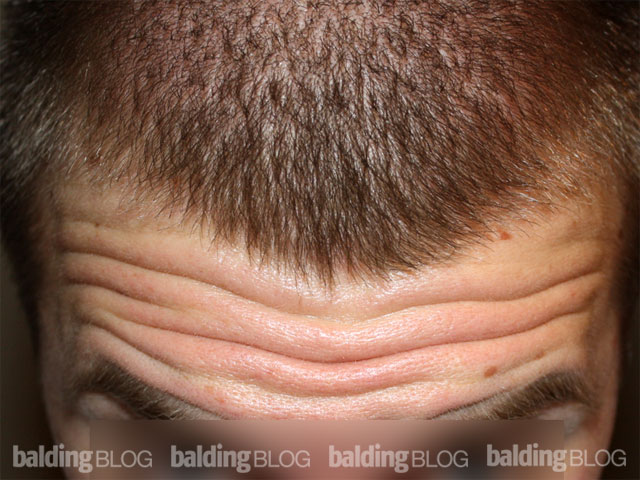
Hello, I’m 26 years old and was curious if I have a juvenile or mature hairline in my photo. My hairline has been the same since I was 16 or so by looking at past photos and I’ve had no hair loss or recession in other areas. The current length of it is 1/2in.

You have my permission to use for the site.

Thanks for your permission to post this. Click to enlarge:


This is a great picture because you wrinkled your brow, as I always ask my patients to include in their photo, is touching the highest wrinkle. If you follow the highest crease, that is where your hairline was when you were 7-9 years old. The corners are rising very slightly, but this is still in the Norwood class 1 category and I would consider this a juvenile hairline still.

There is a wide range between when your hairline hugged the highest crease to a fully mature hairline. What is noteworthy about your present hairline is that the mid-line ‘kisses’ the upper crease, which is clearly the same hairline you had in the middle when you were between 7-9 years old.

Propecia Thickens Hair

I have a question for you … on merck site it says hair mass can thicken up to two yrs… but I was told it can thicken up to three yrs… is that true??? and when is the best time to take propecia am or pm???please let me know your answer… thanks

Propecia is best taken in the morning. The thickening of the hair shaft will, almost certainly, vary with the patient. In some patients the best fullness may be obtained in one year, in others it could take two years, and in some possibly three or more years.

Do I Need a HairDX Test to Truly Know if Finasteride is Working?

Hello Doctor. I took minoxidil and finasteride for about a year then switched to minoxidil and avodart. i have no side effects but i can’t understand tell if finasteride or dutasteride is working on me, because i still am shedding. Some hair is growing, some hair is minimizing, and i think the medications haven’t stopped miniaturising progress. Is the only way to understand that finasteride or dutasteride works on me is to do the Hair DX test?

Thank you

The HairDX Test for Finasteride Response should be able to tell you if you are a good responder to the medication, but the best test to find out if finasteride or dutasteride is working is to get a bulk measurement of the scalp hair in 4 different locations. It should’ve be done before the drug is taken and then at about a year after. This test (HairCheck) is the most sensitive test available today. Good documentation should include progressive photographs with the hair length the same.

With all the medication switching, what has your prescribing doctor had to say?

Proscar Packaging Says I Need to Use a Condom Now?

Hi Dr. Rassman,

I’ve been taking finasteride (1 mg tabs of propecia) for 3 years with great success. Recently however I switched to Procar with a pill cutter and am horrified to read from the proscar finasteride package information for users leaflet:

“If you partner is pregnant or planning to become pregnant you should use a condom or other barrier method of contraception when taking proscar. This is because your semen could contain a tiny amount of the drug and may affect the normal development of the baby’s sex organs.”

This is news to me after 3 years of using fin. I know of the dangers of women handling tabs but have never read anything about this. Is it only relavent to the 5mg doses of proscar? Your professional opinion is highly respected. Please advise.

Kind regards

This is news to me, too.

We have known about problems arising from a fetus exposed to finasteride — the US leaflet for Propecia states, “If a woman who is pregnant with a male baby absorbs the active ingredient in Propecia, either by swallowing or through the skin, it may cause abnormalities of a male baby’s sex organs.” — but this is a warning for women that want to take finasteride or handle crushed pills.

As I’ve understood it, finasteride does not have any significant concentration in a man’s ejaculate. In my searching, it appears that this line about a condom is only in the UK Proscar leaflet. This wording is not seen in the US or UK Propecia leaflet, and I’ve not seen this in any of the literature before. Although it is the same drug (finasteride), Proscar is 5 times the dosage of Propecia. Merck’s official word is that Propecia poses no risk to unborn children.

I will have to ponder this one for a while, as it is against what has been revealed to me in the past.


2010-12-02 11:52:52Proscar Packaging Says I Need to Use a Condom Now?

Do Propecia and a Hair Transplant Compliment Each Other?

I really never believed in hair growth products. But after you mentioned Propecia I tried it. It took a while but I eventually saw a great difference in the thickness of my hair! Then, when I stopped using it, the hair went back as it was before using Propecia. I knew this would happen but I wanted to know if I was just imagining the change.

Hence, my question: You advised using Propecia prior to having the HT procedure. Its seems I must use it before the HT and also before the full effects kick in or how will we know how much density is normal and how much is density is due to Propecia?

If I had a choice I guess I would rather have the great results of a HT without the added cost of meds. But if they compliment each other, well, it may be worth the prescription price. Thanks

I believe that every young man should be on Propecia/finasteride if they have genetic balding. This drug will also offer some protection against shock loss that would be common with a hair transplant, and you should be on the drug at least a couple of weeks prior to having a hair transplant. If your thinning is early, then Propecia may be enough (just as you described), but if you lost hair in the front, it would be unlikely that the drug will return it. So these two modalities (transplant and drug) work nicely together and yet they do compliment each other.