
I Think My Donor Scar Is too High and Will Show Soon

I’m concerned that one of my donor scars is too high and that eventually it would show as well as the grafts taken from the area will die. I’ve had three procedures. The first was in 1997. I had 800 micro/mini grafts. Then in 1998, I had another 1000. This time the doctor seemed to place the incision in the donor area high. My third procedure was in 2007. I had 2000 FU’s placed. I think I’m a class 5 or 6 (not completely sure). During my last consultation before my procedure, the doctor told me that the scar from the previous procedure looked high.

It is 2″ above the bump at the base of my skull – about the height of my eyes and the top of my ears. I’m not sure if it was higher before my last procedure. Is it possible that it now appears a little lower given that 2000 FU’s were taken below it? Does this sound too high? Would hair mapping help me to know with greater certainty? If so, where can I go to have my hair mapped?

I appreciate your time in reading and responding to my question. I’ve read several of your blog comments, etc. and I’m considering using your services in the future.

Thanks again

Perhaps your donor scar is higher than normal, but this can be a normal thing as the doctor will make subtle judgment calls during the procedure. It may bother you cosmetically, but there is not much you can do other than to grow your hair long enough to cover the scar. From a long term point of view, if the donor hair was taken too high, it may not be in the area of permanent hair, in which case you risk losing the hair that was transplanted from that area.

You should start off with a good examination and consultation for a second opinion. That will address your concerns above. You must have a worst case scenario managed with a Master Plan for future hair loss, as you are suggesting in your questions. I don’t have a list of every doctor that will map your scalp, but you can find a transplant doctor in your area by using the physician search at ISHRS.org.
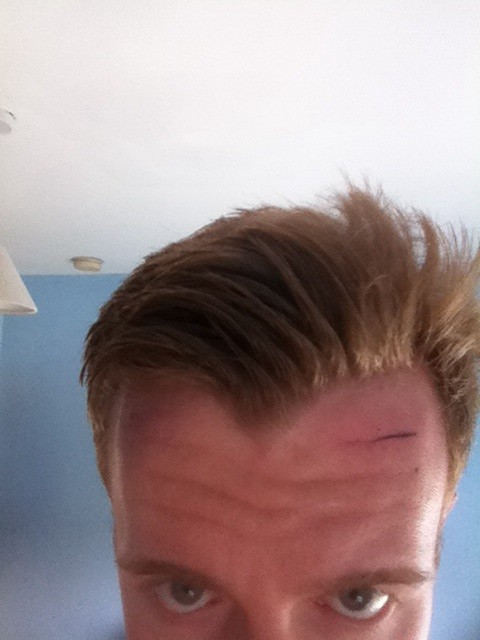
I Turned 27 And I Am Concerned About My Hair Line Because Someone Commented On It

I have just turned 27 and I am concerned about my hairline . I have never really given it much thought but then someone commented on it and I noticed it is a triangle shape. I am concerned that I am going bald but have heard of the term mature hairline. I have drawn in a line to show my highest wrinkle. I am thinking about getting a hair transplant as the hairline looks rather odd. My crown is fine I think ! I have attached photos which may be of use. There are no bald people on either side of my family which is why I find it strange that I could be.

Any help or guidance would be much appreciated.

image2

If you are concerned about your hair line and considering a hair transplant, you should see a hair transplant surgeon. I don’t mean to sound obvious but there is not much I can say here. Balding occurs in the 20s for most men. From your picture there are two things happening: (1) your forelock comes down to the highest crease which indicates it is located where it was when you were 5 years old, and (2) you hairline on the corners is certainly receding upwards giving you a bizarre shape to the hairline that that makes it look pointed. If you transplant the frontal corners, you can move to a different hairline that better fits with your look. You are in your 20’s and that is when such frontal recession appears.

I Want My Hair to Fall Out Faster So I Can Get a Transplant Sooner

I am currently taking finasteride and it has been helping me in slowing down my hair loss but not stopping or regrowing anything. If I am losing hair still, wouldn’t finasteride be a bad thing for me to take because I would want my hair to fall out faster so I can get a transplant right away instead of waiting to see my final hair loss pattern.

Wouldn’t this also avoid me risking shock hair loss if I get a transplant in areas I still have a bit of hair in which was being saved by finasteride?

Love the website.

Oh boy. Why in the world would you want your hair loss to progress faster?! Please read about building a Master Plan.

If you are ready for a hair transplant, I would think you would want your existing native hairs present as long as possible for a better result. Shock loss may be an issue, but that is something you discuss with you surgeon for its risks in relation to the aforementioned Master Plan.

I Want to Slow My Hair Loss Without Drugs

I am 18 year old male and im starting to notice my hair loss its not that bad but im afraid it might get worse.My dad is 50 and he’s completely bald but his dad is not as bald.Im not taking any drugs but im using this shampoo called Loreal paris thickining shampoo it helps a little. is there any thing i can do to prevent or slow down the process? whithout drugs like Propecia or Rogaine.

No.

Male pattern hair loss is genetic. It is due to a hormone called DHT (dihydrotestosterone). Despite media hype and mass marketing promoting “DHT blockers”, there is no cure for balding. Even drugs such as Propecia and Rogaine have limitations, yet they are the most effective and proven medical regimen for androgenic alopecia (AGA), also known as male pattern balding (MPB). Another option is hair transplantation.

If you lived near the ocean and your car was rusting, you could say that you don’t want to do anything, because you want to keep your car ‘natural’ and you can watch it rust away. Get the message?


2007-09-21 14:31:54I Want to Slow My Hair Loss Without Drugs

I was asked this week if I was really a doctor

I addressed the question by suggesting that they check me out in the medical board offices of the States of California, New York and Florida where I am licensed. I thought I would share some of my recent awards with you in case you have any doubt. These include Best Doctor in the United State for hair transplantation by Castle Connolly (see here:https://www.castleconnolly.com/about/NomProcess.cfm ) for 10+ consecutive years, the Golden Follicle Award (see here: https://newhair.com/wp-content/uploads/2018/11/nhi-newsletter-2005.pdf), Two Life Time Achievement Awards presented in 2019 (by South American and European Societies).

I guess the answer to the question is that I must be licensed to practice medicine or I am a hell of an impostor.

I was told not to do a hair transplant!

I was told that I haven’t lost enough hair to fill in the highlighted areas where I’ve been balding (see outline of my thinning). Do I need to loose more hair to become a better candidate? I consulted two clinics about the number of grafts for my hairline. One said 2000 the other said 2500-2800. Above 2000 seems like too much to me, but I’m not sure. Any feedback is appreciated.

Why undergo a hair transplant if you don’t need it? Hair transplants accelerate balding, especially in younger men. You would likely lose much of the hair presently on your head if there is significant miniaturization present, so maybe a transplant would be switching from what you have to transplanted hair with marginal gain other than the surgeon making money at your expense. There are great medical treatments for your hair if you think you are thinning. Get a doctor that knows how to treat you medically.

If Exercise Increases Testosterone, Wouldn’t it Also Increase DHT and Hair Loss?

I noticed your recent post about protein powders and how they have no effect on DHT and hair loss. I’ve seen some posts on your site, but I feel that exercise and supplements (other than steroids which obviously impact hair loss) have not been adequately addressed.

For example, many studies indicate that creatine increases testosterone and DHT. Also, generally speaking, exercising increases testosterone levels. Therefore, wouldn’t exercise and working out increase DHT and therefore hair loss? Also, maybe we can get a more straight forward answer on certain common supplements such as Creatine and Glucosamine. Thanks

I do not believe that working out will increase hair loss, but the straight forward answer is that we don’t know for sure. If you search the web, many talk about creatine and how it may relate to increased DHT, and ultimately hair loss. I do not know of any well constructed, reliable, or definitive studies about it, though.

In the world of genetic male pattern hair loss, the keyword is genetic. I suppose there are extraneous things you can do or take (anabolic steroids – a drug/hormone – not a supplement) to make the genetic trait worse or accelerate it. But in the end, even if you don’t do anything, but you have the genes for it, you will lose hair.

If taking creatine or glucosamine or other supplements worries you, then consider not taking them. Prioritize your goals. If you are taking these supplements to enhance your workout and gain muscle etc, nothing beats actually working out (an extra day per week or an extra 10 minutes in the gym is better than any supplements in my personal opinion).

If I Haven’t Seen Improvement After 2 Years on Propecia…

I have been on Propecia for 2 years; I am 45 years old and have seen no improvement in my hair. I am somewhere between a NW 2 and a NW 3. The fontal forlock has thinned significantly while on Propecia. In your practice have you seen any patients quit Propecia and not get any worse or do most people experience increased hair loss once they go off the medication?

Also, I would do a hair transplant immediately if I was confident that I could go back to work undetected after 2 weeks. It would be a big help to get your thoughts on this as I think this is probably the biggest reason people do not get transplants. Perhaps post some pictures of patients at 14 days. Your blog is great and NHI would be my choice once I decide to take the plunge

Assuming that you have the balding gene and a HairDX finasteride response test indicates that you have an average sensitivity to Propecia, then I would expect that you, like many other men, had their hair loss stabilized on the drug. If that is the case, then you can assume that you may very well lose hair by stopping the Propecia. The series of steps and events are important in the building of a good Master Plan so that whatever happens, it will be planned for. I am sure you can see a series of potential scenarios here, so a good working relationship with your doctor is all important.

Here are some previously posted examples of patients just days after surgery:

If I Stop Propecia After 2 Months, Will There Be Sudden Negative Effects?

I have been taking propecia for 2 months. I haven’t had any side effects yet but reading about gynecomatia and the sexual side effects have me worried. Also I read on your site that proscar in 5mg has had some connection to breast cancer. So I was wondering if I stopped using it will I lose any hair? I am not sure if it has slowed down my hair loss but will there be any sudden effects on my hair?

If you have been taking Propecia for 2 months without side effects, I suspect you probably will not have the side effect you’ve read about. 2 months is a relatively a short span of time and I suspect you will not have much negative effects on hair. For example, you will not lose hair suddenly if you stop the medication because the medication has not been taken long enough to work. It goes without saying, please speak to your doctor before starting or stopping any medications and express your concerns to him/her (I am not your doctor).

Propecia will not cause breast cancer, but in a very small number of men, it may cause breast enlargement (less than 1:500).


2007-07-10 15:19:31If I Stop Propecia After 2 Months, Will There Be Sudden Negative Effects?

If My Dermatitis is Active, Can I Still Get a Hair Transplant?

(female)
Does contact dermatitis affect my chances of having hair implanted. Over the past two years, my dermatitis has caused my hair to fall out and I want to get implant hair. Can I? That’s the question. Please let me know.

Thank you.

At NHI, we have performed surgery on many patients with dermatitis or even psoriasis. Each and every patient is different and if you are interested in surgery, you need to be evaluated by a competent hair transplant surgeon.

There are cautions with regard to the pretreatment of active areas of local dermatitis or psoriasis for example, as complications do occur with such findings as a Koebner phenomenon in the areas where incisions are made in active areas of psoriasis or dermatitis.