More reviews of finasteride pills, dutasteride and topical finasteride

More details keep emerging that address the sexual side effects that have been well documented. Here is another review medical article for those of your who read this. The topical form of the drug finasteride seems to have fewer sexual side effects, but they are still present.

https://www.practiceupdate.com/journalscan/39062/2/3?elsca1=emc_enews_daily-digest&elsca2=email&elsca3=practiceupdate_uro&elsca4=urology&elsca5=newsletter&rid=NTYwMzM3MDM4NTkS1&lid=10332481


2020-09-15 09:10:34More reviews of finasteride pills, dutasteride and topical finasteride

Body Hair Transplantation

In reply to my post titled Hirsute Men and Head Hair Loss, Duke writes…

That is fascinating but it prompts a few thoughts. Why not use body hair for transplant processes?

More research into the Red Indian genetic heritage us surely required.

And why does the balding gene only impact on the top of the head and not the sides.

This is a fun question. First, why the top of the head. Leonard Shlain’s book, “Sex, Time and Power: How Women’s Sexuality Shaped Human Evolution,” had an interesting insight into the cause of balding. He postulates that our tribal heritage arose when man lived amongst his peers constituting 100-150 people. When looking at that the hunters (the healthy and fit men) in the light of certain qualities, there was a distribution of 4 traits that would pencil out to an 8% rule. He believed as animals learned to be afraid of man, the 8% of the hunters who were bald did not frighten the animals because they did not have the typical framed face of a hairy man, so animals would not run from them. They fulfilled the role of the spotter in the hunting party. Likewise, 8% of men were color blind and could see the animals in the bush missed by normal color visioned men, 8% were left handed and they threw the spear from the left side of the hunting group and 8% were gay so that they would stay home with the women and become more involved in their activities yet retain the strength to protect them. Fathering of children, while the heterosexual man were away hunting, was therefore not a concern.

If you take the 100-150 tribe hypothesis into the Red Indian, it would be relatively easy to see that with a small band of Indians that moved over from the Alaskan Bridge and down the Canadian countryside (they initially migrated to what would become the western American territory) it is possible that selective extermination of a sub-set (based upon the balding trait for example) of Indians over some generations during hard times, might have wiped out that genetic characteristic. This hypothesis for the Red Indian has been made by some, but without the presence of a written language or other documentation of their history, such assumptions might be a dangerous precedence to be proposed by a hair transplant surgeon.

Now, regarding body hair transplantation:

Experimentation is presently occurring on the use of body hair in some transplant centers (they just do not call it experimentation). As body hair grows in singular numbers (not follicular units of more than 1 hair each as in scalp hair) and length is not as long, and the hair cycle is possibly much shorter and the sleep cycle much longer, the use of body hair for transplantation might leave much to be desired.

Multi-Bladed Knives and Dilators

I just visited a doctor who took me into a surgery and showed me nails in the head of a patient. He said that these kept the wounds open and makes the graft placement easier and produced less damage to the skin and hair. He also told me that he used a multibladed knife to harvest the grafts. I thought I read somewhere that these instruments cause damage. Can you explain what I am being told?

These nails that you are describing are something that was invented by Dr. Manny Marritt in the mid-eighties to make the placement of smaller grafts easier. Within a year, he abandoned the use of these dilators as his staff built the skills to not need them anymore. He concluded that these dilators did not have great value to anyone other than the novice. I did try them early on in my practice, but I quickly abandoned their use within a month. For more information on dilators, including a photo of what they look like, please see this dilators page.

After I designed the 2 bladed knife with the offset of 30 degrees, I built a multi-bladed knife with variable settings to it. I eventually found that when I used the final design on the first 9 patients, the results were decent (I estimated the loss at about 15%). Then on the 10th patient, I had a follicular holocaust with a loss factor of 70%. Fortunately, on these first 10 patients, I only used it on a limited area, but the high transection rate on this 10th patient said to me that inconsistency was going to be the problem. If I could do it 9 times right and then 1 time wrong, the technique was flawed.

This clinical research was done by me in 1992-1993 when cutting was a manpower problem that I eventually solved with a larger and better trained staff. The multi-bladed knife was the wrong answer to this problem and that is my final opinion on the subject. With multi-bladed knives, the labor that the doctor saves does not offset the hair that is killed off. I believe anyone who uses such instruments today are subject to the same type of variables.

Botched hair transplant reported by patient on Reddit

I have helped many patients through this problem. The doctor should give you what you asked for, as it is reasonable. I would hesitate to have the doctor do another procedure if the first one was done poorly, as the second one may turn out that way. You can tell the doctor that if they do not negotiate fairly with you, that you will report the doctor to the medical board. In California, as in many states, the medical board (which control the doctor’s license) MUST investigate every complaint. The doctor will not want this to happen and should be happy to negotiate with you.

Botched Hair Transplant-try to negotiate with Dr, or see a lawyer? from tressless


2019-08-09 11:40:54Botched hair transplant reported by patient on Reddit

My Beard Hairs Fuse Together

Hello,

Some of the individual hairs on my beard get really thick and seem to fuse together with other hairs. These hairs are clearly visible upon close examination of my stubble, at least to me … I hunt these bizarre hairs like wild game then extract the bounty, mercilessly, with a shiny pair of unforgiving tweezers. If I rub the follicular carcass between my powerful digits, individual hairs separate from the seemingly single, thick, shaft. Moreover, when I pluck these wild beasts, there is no pain, whatsoever – they submit to my attack and exit the follicle, without fight or protest. If I pull a regular beard hair out, it screams in protest and fights ’till the bitter, painful end.

Are you familiar with the hairs I’m describing? If so, what’s going on?

I’m a 32 year-old male and I’ve been on Finasteride for almost three years. I break a 5mg pill into four pieces. I take one piece in the morning and one piece at night so I always have some in my system.

Thank you very much.

You’re taking 2.5mg of finasteride daily after only 3 years? That’s higher than the recommended dose for treating hair loss, but hey, if it works for you and your prescribing physician is fine with it, more power to you.

Some hairs grow out in 2’s or 3’s. It can be normal to see those on your beard, chest, or pubic area. You’re probably not seeing your facial hairs become symbiotic, attacking each other in a fight to death. Give your hairs some “mercy”.

By the sound of what you describe, you seem like someone who battles not only with hair loss, but perhaps an obsessive compulsive disorder. I will give you points for a highly creative email, though.


2011-01-25 08:55:34My Beard Hairs Fuse Together

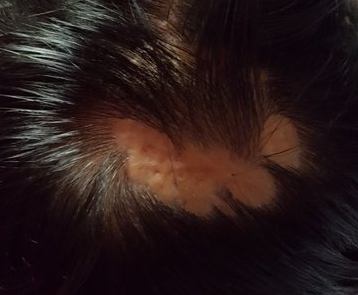
My Daughter Has Been Losing Hair Since She Was an Infant

My daughter started losing hair across the back of her head as an infant (like many do, from turning their head in their crib). It was breaking as much as it was falling out. It continued to break and be brittle. I was told by her pediatricians that she would grow out of it, and that nothing could be done. 4 years ago a dermatologist could not diagnose her either. She is 13 years old now and her hair has never been 100% haelthy, although she has had times when it was better than others. A week and a half ago she tried using Head and Shoulders shampoo, thinking it might help. As of last night, on the top and across the back of her head there is nearly no hair. She is not “bald” back there per se, but the hair there is less that 1/8 of an inch long. Another trip to a different dermatologist this morning revealed nothing. He had no idea, other than that it was “extreme, and apparently rare” and he did not know what the cause was. He suggested a peanut oil treatment and biotin. I’m considering asking her pediatrician to run some blood tests, but am not sure what to request. Hormones, vitamin deficiency, thyroid? Any insight you can give me would be much appreciated. Obviously at the age of 13 this is devastating for her. Thank you.

I can appreciate that it is very devastating to your child. Unfortunately, I really have no input here aside from the fact that you seem to be taking the right steps and seeing specialists. You may benefit from still another opinion with another dermatologist or a hair transplant doctor who might give you a different perspective after an examination. I would like to help, but I am not her doctor and the blog is not an appropriate medium for such.

My Doctor Advised Against Washing Recipient Area for 2 Days After Surgery

i had a procedure done at another clinic yesterday. they advised against washing the recepient (graph) sites for two days. essentially allowing scabs to heal and fall off two weeks later. I am in the public eye(professional speaker) and had to have a thorough celeaning today. So i di wash my scalp today against there written directions. i was able to see the removal of 75% of the one day old scabs and it looked like 8-10 graphs came out as well. I did not sit under the shower i used the cup pouring method and the gently rubbed the scabbs with my figertips..am i alright or did i maybe wash away my follicles unknowingly? again i saw about 8-10 in my scalp dislodged after the shower. did not look like many came out…no bleeding whatsoever by the way. your thoughts?

I always have the hair washed within the first day after surgery and offer that process in my office for our patients. The key to a fast recovery is to get the scabs washed off fast. The longer they stay in, the longer you must be gentle with the wash. In the hands of a professional wash, the wounds will be very clean by the very next day. We also wash it vigorously at the end of the procedure to get all of the crusts off quickly. Unfortunately, many doctors do not focus upon getting you looking spiffy in a day after the surgery.

This patient below came in one day after surgery and the pictures were taken immediately after he had his hair washed. The recipient area has an obvious pink hue against his white skin. His native hair was long enough (I told him not to cut his hair prior to the surgery) to cover the entire transplanted area when he combed it forward. White skin shows pink clearly and had his skin color been tan, the pink hue would not show much or at all. As you zoom into the picture, you can see the transplanted grafts and the hair contained in those grafts clearly without any crusts to increase the detection of the transplant in the bald scalp. People who have native hair with grafts transplanted between the hairs have automatic coverage from the native hair and the transplants can be completely hidden. Within a few days, the only evidence of a transplant will be the beard that appears in what is now the pink area. Click the photos to enlarge.


2006-09-16 10:59:19My Doctor Advised Against Washing Recipient Area for 2 Days After Surgery

Can a Hat Cause Hair Loss and Fungus?

Can you get fungus on your head from wearing a hat all the time for too long that results in your hair falling out?

A fungus spreads from person to person. A hat worn by a person with a fungus could transmit the fungus as the hat is shared with another. Fungal infections love warm, moist environments and if you sweat from the hat that is carrying a fungus, you may get it. Depending on the fungus, hair loss could result. These are all longshots, but they are possibilities.


2008-08-20 15:01:05Can a Hat Cause Hair Loss and Fungus?