Trichotillomania-by-Proxy?

My neighbor is in his 50s with no known history of hair loss until about 5 years ago when he first noticed he was developing gray hair. He had his wife pull out every gray hair he could see daily, and it could’ve been as many as 20-30 hairs a day over the years! His daughter researched the condition of trichotillomania and does not feel he fits the diagnosis as the pulling was not done by him.

He claims he is not compelled or driven to have his hair plucked, and that as soon as he realized he was visibly thinning, he had his wife stop doing it. At that time he began to color his hair at the suggestion of his daughter. He states there has been no plucking for the past 2 years now and he has more hair on his head now than 2 years ago, when the plucking was stopped.

This sounds like maybe trichotillomania by proxy (like Münchausen syndrome by proxy, a well known phenomenon)… but I’m not sure that would fit either.

It usually takes quite a few “pulling sessions” to produce the traction required for permanent hair loss, often over years. So if his hair has regrown over the past 2 years, it sounds like he was lucky that the loss wasn’t permanent.

Hair Mildew?

I keep hearing of “hair mildew”. I can’t find it anywhere on the net.

I was wondering what HAIR MILDEW is,exactly, how do you get it and what would be the symptoms? And, is there any cure for it or would you have to cut out all of your hair?

Thanks alot

I’m sure each of us has been near someone who doesn’t dry their hair, which can sometimes develop an odor to it. Perhaps that is what one is talking about with the term “hair mildew”. If this mildew is a problem for someone, using a hair dryer after a wash should eliminate the problem. I’ve never heard this term used before, though, so I’m just assuming this is what you mean.


2007-11-21 10:32:52Hair Mildew?

Police closed down Turkey Clinic this week

An Istanbul hair transplant clinic was raided by the police and all of the technicians were arrested. There was no doctor in the clinic. The technicians ran a clinic with 10 surgery rooms. There are hundreds of such clinics in Turkey. I am not sure why this particular one was selected.

Hair Regrowth After Waxing Scalp

I recently had a minor accident with hair removal wax. Well to make a long story short, it ended up in my hair on my scalp. It has been five weeks and the regrowth has been pretty sparse and not at all in some areas. I was wondering what the chances are that it will still grow back, and if not what I can do about it. thanks

Wax only removes the hair shaft, not the entire root. Thus, your hair should grow back. It may take up to a few months for hair regrowth unless there is more to the story which I am not understanding.

Two post operative patients (photos)

I periodically show photos of patients after their surgeries because so many people are afraid of what they will look like right after the surgery. There are visions or war wounded heads in the minds of many people who think that after their hair transplant, they will announce to the world what they had done and have a full invasion of their privacy. As you can see in these picture, there is nothing much to see and styling can easily hide even the one man on the right who is just one day after the surgery by combing his existing hair forward. The man on the left is one day after surgery and had 1500 FUE grafts and we are showing both the recipient area and the donor area which should be completely undetectable in two more days. The man on the right had 2125 grafts by strip surgery and is 4 days post surgery with some mild pinkness still evident to the camera, not so much on looking at him face on. To see what terrible post-op care looks like, see here (https://baldingblog.com/2017/10/18/now-2-weeks-hair-transplant-cant-go-public-photo/) which is the results of poor washing techniques used immediately after surgery.

PAK50110 PAK50114PAK50116

Hair Thickness vs Density in a Hair Transplant

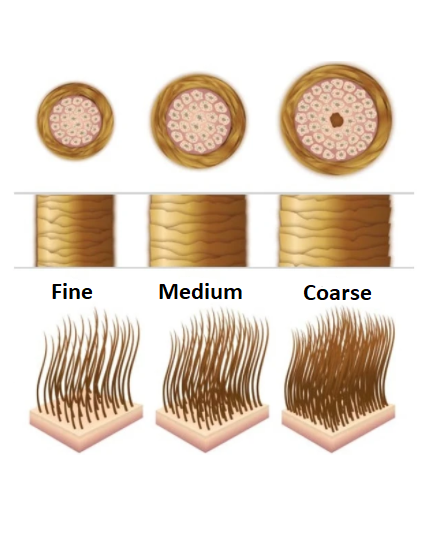
When estimating the number of grafts a person needs, I always want to know the hair thickness (hair bulk) of the donor area. Hair bulk is not hair or graft density. I initially saw the graphic at the bottom of this post on Reddit.com. For a visual representation, the graphic artist kept the number of hairs the same and changed the thickness of the hair shafts to show the value of hair thickness in producing coverage. Dr. Sharon Keene nicely demonstrated this with real hairs and got the same result as the graphic demo below. So you see, if your hair is fine, it will take a lot more hair to get the fullness of a person with medium-weight or coarse hair. This is why people with fine hair often get a second hair transplant. Fine hair is clearly better than no hair, but when a person with fine hair gets a hair transplant, they should accept that they will never have the look of Brad Pitt’s hair, while a person with thicker hair shafts, a Brad Pitt expectation may be realistic. The chart below shows the value of thicker hair shafts very nicely.

Let’s drill down on an example: Look at the chart below; let’s suppose that a balding man has medium hair (50microns thick). His friend had a hair transplant and had fine hair in his donor area, with a hair thickness of 30 microns. His friend had a hair transplant, and it doesn’t look like he has a full head of hair after the transplant despite getting 4000 grafts. He is concerned that he might not be happy with the type of results his friend had. If he does the analysis, he will find that he has 7.1 times the hair bulk as his friend with fine hair whose donor hair thickness had 30-micron hair shafts (50/0.7 = 7.1). I would tell him that if I were his surgeon, he would get much fuller-looking results than his friend, not because I am a better surgeon than his friend’s surgeon but because his hair thickness will produce more hair bulk than his friend’s fine hair gave him. The amount of hair bulk is a simple math calculation reflecting the area of a circle [ Pie (r)² ]. If you want to run the calculations, you will know the value of your hair thickness, and everyone having a hair transplant should do this to establish realistic expectations.

In my 35 years performing hair transplants, I have transplanted many men with fine hair. They were generally pleased because they got back the hair they always had, which was fine hair. A fine-haired man getting a hair transplant for balding doesn’t have the expectation that his hair would look like Antonio Banderas’s hair because they never had it.

In the late 1980’s. Dr. Manny Marritt had a light-skinned Caucasian human volunteer with black, medium-weight hair (~50-micron hair thickness) agree to have half the hairs on one side of his head plucked out. Then, Dr. Marritt brought in independent observers and photographers to see if the lower-density side could be detected. The answer was NO! That told me that in the worst situation possible (black, medium-weight hair on white skin), 50% density produced the same fullness as 100% density. With that being the case, a person with medium-weight hair that is blonde with a blondish skin color or a brown-haired, brown-skin colored man would require less than 50% of their original density to get a full look from a hair transplant. I have found that to be true, and that is the art of what a good hair transplant surgeon offers. When the hair transplant surgeon combines this knowledge with proper hair distribution, the best results are produced with the least amount of hair and cost to the patient.

For those readers who want to know where they stand about hair thickness, to get some realistic expectations for a hair transplant, you can purchase a micrometer for under $25 on Amazon, cut 10 of your donor area (back of your head), and measure the thickness by averaging their width of those 10 hairs. Use the chart below to understand the measurement and consider Dr. Marritt’s simple experiment. The micrometer can be purchased here: https://www.amazon.com/dp/B09964YBMF?ref=ppx_yo2ov_dt_b_product_details&th=1


The illustrations below show the same number of hairs, but the hairs are thicker. Please note the HUGE visual difference between fine, medium, and coarse hairs regarding the fullness each group produces.


You can contact me at williamrassman33@gmail.com

UNETHICAL Hair Transplant Surgery

HERE IS A LETTER I SENT TO A PATIENT: “You have had previous hair transplants done by Dr. XXX with 3400 grafts in the front of your head. You were very frightened about the prospect of being bald at that age of 23. Now you are 31 years old and started Propecia 4 months ago. You want to know the status of your balding situation.

Today’s we used the HAIRCHECK instrument on your head. Measurements indicated that you hair bulk in the frontal 3 inches of your scalp that exceeds the hair bulk of the donor area by 30%. Comparing the crown and the back of your head, the measurements were comparable.
This tells me two things:
  1. You are not presently balding
  2. Your hair transplant done years ago was done on a young man that probably was not balding but driven to have a hair transplant out of fear of balding. Frankly, you were taken advantage of for the money. I am ashamed that doctors in this field would take advantage of your youth and naivety.You agreed with me that in hindsight, you were driven by fear, not balding
The good news is that you should stop the Propecia and if you are ever concerned again about balding (which i believe will be unlikely for your future), please come back and let me retest you with the HAIRCHECK instrument.”
I wrote this to a patient and sent it off to be published because in the hair transplant community, this type of behavior is not unheard of, even today. Too many doctors practice this type of surgery, because for them, every patient has a ‘bucket’ of money that they can tap. Some of these doctors are predators, who think that it is easy to manipulate their patients, set them in a panic mode, so that they can push them to have a surgery, needed or not, often more than less. There is no such thing, in my opinion, as hair transplants that are done to prevent what hair loss might occur in the future by transplanting areas behind the balding pattern that needs transplants. So what doctors do far too often, is that if a person needs 1500 grafts, the doctor will recommend 3000 grafts (double the grafts and double the fee) and put these extra grafts into the normal, non-balding area. What makes it worse, these grafts into non-balding areas may kill normal hairs. Who could challenge these doctor, certainly not the patients who believe that doctors are not crooks but sort-of god like. Patients often don’t know any better, so they believe the doctor who tells them that they need 3000 grafts when in fact, only half of that is needed. Don’t get me wrong, when a patient needs 3000 or more grafts, I will do it. The overall warning here is LET THE BUYER BEWARE. Don’t trust your doctor if for any reason, you think that your doctor is not being honest with you. You can always get a second opinion and therefore protect yourself by shopping around. You will pay $$$, in the short term and valuable donor hair in the long term and unfortunately there is no going back, no recourse.

Hair Transplant Density

what is the most you pack per cm2 when you do a transplant????? please let me know .. thanks

Density of the average person is about 200 hairs per square mm. A doctor can transplant as high as 10-50% of the original density. It is important to focus more in the issues of fullness. This is not a ‘weight lifting contest’, which is unfortunately what some doctors are pushing for. I could transplant as much as 50% of the original density, but the real issues are:

  1. Will it grow? There are many factors that will determine this: the health of the skin, the amount of atrophic changes in the skin caused by sun damage and the advanced level of balding, scarring that is present, etc. We generally expect that growth will approach 100% of what is transplanted, but that is only true when everything is right-on — and that rarely happens.
  2. What is needed? This is the most important question that must be asked. People with low hair to skin color contrast, good texture, good hair thickness, etc. do not generally require the greatest densities to achieve the look of fullness.

Hair transplantation is as much an art as it is a surgical process. The judgments of a good surgeon with years of experience will make the correct decisions that are in the best interests of the patient.

Hair Transplant — Multiple Procedures or One Large Procedure?

Hello Dr. Rassman,

With regard to future donor density/yield, what is the better option:

Several small strip procedures or one very large procedure?

What I’m basically asking is which one would be more detrimental to your donor supply for future transplants (possibly affecting laxity)?

I have to speak in generalities, something that I do not like to do as every situation is different. Generally speaking, the less the number of surgeries the better for the donor supply, but as larger and larger sessions are tackled, the surgical team is as critical as other items such as donor density and laxity. Each surgery has a built in waste factor (I estimate it in a good doctor’s hands at about 4-5% in a strip surgery) so two surgeries will produce more waste (a relatively small amount of waste). In the hands of a surgical team not designed for very large sessions (over 2000-2500 grafts), the larger session might cause a longer surgical time, more time for the grafts to be out of the body, and more time for dessication (drying of grafts causing graft death). Longer surgeries require more anesthesia and a skill in managing the anesthetic requirements is critical for larger sessions. In the rush to keep pace among the field’s leaders, many groups try to offer larger sessions (3000-5000 follicular unit graft range) even though they are ill prepared for this service. Some groups dishonestly sell these larger sessions and do not deliver on them, yet do charge for them… causing a fraudulent transaction (more common than most doctors will admit to, i.e. “It’s the other doctor, not me!”).

You were right to ask about the future donor supply. Very large sessions may reduce your donor supply very significantly when they are done, so it is good to understand what the session will do to the Master Plan for the patient. Running out of donor supply could be a critical error if it is done in one session. Look at today’s 12:31pm post (2 down from this post) and look at the real donor supply. Any hair taken outside this rim of hair is not permanent so if the doctor goes too high or too low, you may find out in the long term that what you received is not permanent.