Scalp Tattooing that Looks Like Hair?

Hi Dr Rassman,
Since I like the close cropped look and I am probably a Norwood 4 leaning towards 5, I am considering getting cosmetic hair tattoos to the scalp. What do you think about this place? The results look great in the photos, but I’ll ask to see some patients in person of course (thanks for putting that in my head!). Here’s the place. They are in the UK, but I’ve got family there and have been wanting to visit anyway.

HIS Hair Clinic

I would definitely want to see some real patients up close before deciding on tattoos like this. As I’ve written before, I have seen scalp tattoos that try to mimic hair, but what I’ve seen has been unimpressive and some even seem to have a greenish tint as well (maybe it is the ink or the artist — I have no idea, as I am not a tattoo expert). I understand tattoo technology has evolved, but drawing what looks like hair on the scalp can be tricky.

The photos presented by the clinic you linked to are quite nice, I will admit. I’m sure these results look fine from a distance, but I wonder if you’re sitting across from someone at dinner would it look like someone drew on their scalp with a pen? If the light hits your head wouldn’t it still shine like a bald head? Over time, tattoos with fine lines will blur… so how will that change on the scalp? I know there’s at least one scalp tattoo place that posts comments on this site from time to time, so perhaps they can post below to inform us about that.

I do recall one patient who did draw (non-permanent) individual hairs on his bald head to mimic a close shaved look, but it took many hours, special artistry, and skill. He eventually went on the have a hair transplant procedure.

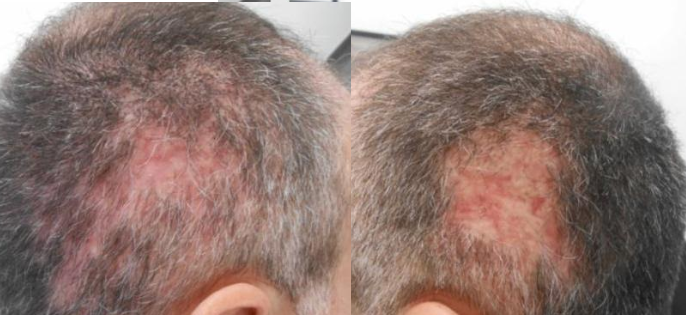
Scarring from necrosis in the donor area secondary to poor FUE (photo)

This patient had too many FUEs performed too close and possibly with instruments that were too large for the process. Necrosis (skin death) is a complication seen in the inexperienced, over ambitious hands of inexperienced doctors or technicians who should not be doing FUE. I expect this complication to be more and more common in the coming years and more and more providers enter the FUE business without adequate training. The only tre)atment for this is Scalp Micropigmentation, which will work well provided that the patient keeps his hair very short (see: https://scalpmicropigmentation.com/scar-covering/

scarring from necrosis

Email Response from Managing Director of HairMax LaserComb

Earlier this month, I posted an entry titled Analyzing the Results of the HairMax Laser Comb. The extensive email that I received (posted below) shows the great care that the HairMax folks went through to try to be objective. I do not doubt that objectivity was the intent, but upon reviewing the images that were presented, my counts came up differently than the counts of the researcher(s). I know how to count, and since densitometry was my invention (so to speak), I think that my expertise in counting hairs stands for itself. The conclusions of my previous writing still stand (see link above). Nothing written below changes that. The scientific study was put together properly, but it failed on the simplest level, counting hairs. All is wasted if the counts (which our readership can do) failed to be what the researchers counted. I will present the impressive piece written by David Michaels of Lexington International (makers of HairMax LaserComb), because it is fair to do so. Remember, there is no substitute for good marketing, but the success of a product should not infer that the product does as represented, nor does it make counting numbers different than what they are.

Greetings Dr. Rassman,

Firstly, I would like to thank you for taking interest in low-level laser therapy and fielding questions on your blog about our device, the “HairMax LaserComb.” Open discussions like this one can only help to further the advancement of LLLT. I spoke to our chief medical advisor, Dr. Matt Leavitt, about your remarks regarding the LaserComb on your blog and Dr. Leavitt spoke very highly of your professionalism, commenting especially about your intellectual brilliance.

We reviewed your blog page that contains comments about our clinical study’s macro photos and we encourage you to post this message as a follow up to your comments.

We would like to outline some of the background about the clinical study we concluded.

Our experience with using low-level laser therapy for hair dates back to the mid-80’s in Sydney, Australia. Our founder operated a laser clinic where he successfully treated thousands of people. I was one of these laser patients and had significant results. We then worked closely together to develop a hand held laser device for the international market that can assist individuals suffering from problem hair. The HairMax LaserComb has been on the market for five years and is in use in over 74 countries.

In 2005, we concluded a clinical study protocol entitled “A RANDOMIZED, DOUBLE-BLIND CLINICAL TRIAL TO EVALUATE THE SAFETY AND EFFICACY OF THE HAIRMAX LASERCOMB FOR THE TREATMENT OF ANDROGENETIC ALOPECIA IN MALES”. The primary efficacy endpoint was: Change in terminal hair counts, which are non-vellus hairs, in the target region between baseline and endpoint, utilizing macro images.

This is our second clinical study; unfortunately, we had bad professional direction for our first study as it was only a single site without a control. Despite this, we used the results of this initial research as a pilot study to help develop our new protocol.

Our goal was to conduct this study scientifically and in accordance to Good Clinical Practices (GCP). We utilized four clinical research facilities, three of which participated in many of the Minoxidil studies. Each facility had a primary investigator with extensive experience in Androgenetic Alopecia. All study protocols were approved by an IRB. Professional independent site monitors were employed to verify all case report forms and data managers were used to ensure that all recorded data complied with the protocol and with all applicable section of 21 CFR as required by the FDA. A biostatistician was retained to independently analyze the resulting dataset.

The equipment in use was a Fuji S2 6 megapixel digital camera with a Canfield epilume attachment. The same location was photographed every time, marked by a tattoo and the hair counts, centered around this tattoo, are well documented using Canfield Mirror DPS 6.0 software which stores a image on each individual hair counted over the original macro image for verification.

While conducting our study, we sought to show that the HairMax LaserComb had an effect on the number of non-vellus hairs present on the scalp. In an effort to eliminate any potential bias, independent medical professionals were commissioned to perform the hair counts. These professionals were blinded to the treatment assignments thus removing any bias towards the subjects’ treatment. The data from these medical professionals was then monitored and sent directly to the data management team removing and potential for us to review the data or interact with it.

All terminal hairs were marked and registered in Canfield’s Mirror DPS software using a 19 inch computer monitor. They were evaluated and counted by two independent hair professional reviewers. We are sure you can appreciate that counting many hundred macro images is a laborious task and can be very tiring on the eye. For this reason, we ensured that all hair counts were not performed consecutively. The counts were split up over a reasonable period of time in an effort to eliminate any uncertainty introduced from reviewer fatigue. Although the reviewers may have missed one or two hairs, we are confident that our macro counts represent a fair and accurate assessment of our study.

Our macro images were carefully reviewed by numerous professionals including many of your peers; all have complemented us on our fair evaluation of the data and our methods used in the study. We are unaware of what standard Dr. Rollins and you used in reviewing these images and where the difference exists in our hair counts. However, all the hairs that were counted are marked and we consider these counts to be an objective evaluation.

We will be bringing our clinical images with us to the ISHRS conference in San Diego; we invite you and Dr. Rollins to further review our images up close and hopefully once you see the standard of the images and documented counts you may have a different assessment of our macro images.

Kind regards,

David Michaels, Managing Director
Lexington Int LLC
Developers and Manufacturers of the HairMax LaserComb

Seasonique and Female Hair Loss

Up until last week i was on inderal (for about two months) and went off of it becuase I noticed my hair starting to fall out recently. I also started taking seasonique (birth control) a month ago. Assuming it was the inderal, will my hair grow back? Im also still losing some hair and wonder if it was in fact the seasonique causing it. How long should i wait and see if it was the inderal. If it was the seasonique will it grow back?

Your birth control Seasonique (levonorgestrel / ethinyl estradiol) does have hair loss listed as a side effect — though it also has increased hair growth as a side effect (see Drugs.com). I really couldn’t say for sure if your hair loss was caused by the your birth control or the hypertension medication Inderal (propranolol), though hair loss is a side effect of many beta blockers (see WebMD). I wouldn’t know if your hair will grow back to its normal state, and though I realize that this answer may sound frustrating, regrowth is not a guarantee for each person. Each person reacts slightly different to each medication.

You need to discuss these issues with the doctors who prescribed these medications to you, and you should not stop or start any medication without discussing it with your physician.


2008-05-08 10:35:48Seasonique and Female Hair Loss

Erectile Dysfunction with finasteride

I took fin for 11 days, stopped because i was afraid of the sides. Then four days later i tried to have sex with my gf, but i couldn’t get it up at all. After some days it went back to normal. But some weeks later i tried to have sex again, and my penis didn’t get up. I had this on my mind before the act, so that may have been the case. We had sex later that day, and i felt better, and the next day we had sex three times.

I maybe suffer with PFS? Going to an neurologist soon. I have also tried a quarter pill of viagra, but that doesn’t help much. Is this just me overthinking?

Yes, you are focusing too much on your penis and performance. That, by itself, can give a man ED.


2021-03-26 06:32:16Erectile Dysfunction with finasteride

Selecting a Hair Transplant Doctor | WRassman,M.D. BaldingBlog

In This Section

  1. Selecting a Hair Transplant Doctor
  2. How to Avoid Dishonest Doctors
  3. Why Should You Visit Us?

Selecting a doctor for any medical need has many common rules. You should look for a doctor who:

  1. Is caring and compassionate.
  2. Takes an interest in you as an individual.
  3. Takes the time to learn about your problem, listens to you and does not lecture you by imposing his/her views upon you.
  4. Is willing to educate you and bridge the gap between his/her knowledge and yours.
  5. Has excellent credentials in the specialty field you need.
  6. Has built a reputation of excellence in the field based on their results, and are recommended by family, friends, patients, or a physician that you trust.


ChecklistWhen these attributes are applied to selecting a hair doctor, the same rules apply:

  1. Caring and compassionate– This starts when you first contact the office. How are you treated by the doctor’s staff on the phone? When you come to meet with the doctor, what is your first impression? Is the office clean and the staff friendly and organized? A caring doctor will meet with you and does not send a salesman in to gather information on your needs as his first bonding experience with you is in taking your history and learning about your concerns. The consultation agenda should be set by you with the purpose of establishing a basic patient/physician relationship. Good communication between both parties is key.
  2. Taking interest in you– Does your doctor care about you by showing real concern? Does he look into your eyes when speaking with you? Does he treat you with respect? Do you get the opportunity to share who you are and what you do with him? Does he want to learn about your lifestyle, your family, your culture?
  3. Time– The time the doctor schedules for you will tell you much about how he values you as a patient. For all new patients, I usually schedule a full hour for getting to know the patient, so I get enough time to examine the patient and listen to their concerns.
  4. Education– The doctor should educate, but not lecture, the patient during the consult once the issues have been presented. The first step in educating the patient is making sure that a detailed history of the patient is taken, understanding what has brought the patient to the office, followed by an examination of the affected areas. Just like a visit to your primary care physician, the examination is crucial. Your doctor should look closely at your hair, use a video magnifier to determine how far the thinning extends and this should lead him to an assessment of the point where the balding is advancing to.
  5. Credentials in the field – A heart surgeon should be well trained with years of experience before he works on your heart, just as a hair surgeon should be well trained and have substantial experience in the hair transplant field before they work on your head. What credentials should you look for? There is no Board Certification in hair restoration that is recognized by the American Board of Medical Specialties (ABMS). Only physicians who have met the standards of one of the 24 specialties recognized by the ABMS boards can call themselves “Board Certified”, and you can check on the ABMS website if they are indeed ‘Board Certified’ and in what specialty. You can also check with your state medical board to verify license status and education.
  6. Reputation based on results and personal recommendations– Talk to your friends and family to see if they have had any experience with physicians in the specialty that you need. Often there is an internet forum that discusses personal experiences with physicians, but you need to be careful that the site treats all posters the same (not just those that discuss advertisers or sponsors). Some forums may allow fake or misleading postings in order to promote particular physicians. Keep in mind that many people only post when they have something negative to say, but a physician that has many negative postings may in fact deserve their reputation. It is often said that a bad heart surgeon buries his bad results, but in the hair transplant field in particular, assessing the skills of a hair surgeon is easier since everything that is done by the surgeon sits on the head of the patient for the world to see. You can not hide a bad hair transplant. The best way to determine the quality of a surgeon’s work is to meet many of the surgeon’s patients, look carefully at the results from all angles, and ask yourself if those are the type of results you’d want on your head. By meeting patients directly, you can see not only what you are going to get from a hair transplant, but you can speak one–on-one and get the inside scoop on the doctor’s character, integrity, and skills.


Black Mold and Hair Loss

Everyone in My House Is Losing Head and Body Hair. We Just Found out That There Is Black Mold in the House, Could This Cause It?

Black mold can cause multiple health problems and it is common in many homes, more common than most people realize. I don’t have any real experience with Black Mold other than what I read. Best to start off with your family doctor as both your living quarters must be addressed as well as the health of everyone exposed to the black mold.

Severe Pain at the Donor Area Months After My Hair Transplant

Hello doctor. My question is an honest one and one that hasn’t been asked before.

I had a hair transplant 2 and a half months ago but I still have a lot of pain above the linear scar (when I press it) and also the sensitivity on the top of my head in terrible and is constant. It’s like my hair is being pulled. My surgeon said in 17 years he has no idea what is causing it and never had this problem before. There is also a gap of about 10mm where the scar is and said he said to me he can do a scar reduction in a year. I am so sorry I had this procedure done as the pain is not letting up.

It sounds like you may have a scar entrapment (nerves squeezed by scar) or damage to the occipital nerves in the scarred area. I have had patients report symptoms like what you’re describing when they had a nerve entrapment. Sometimes, a scar will form around the occipital nerves just from the strip surgery, or the nerves could be mechanically damaged, or even partially or completely cut.

Doctors who will examine you will look for something we call a Tenels’s sign, which simply produces some of the symptoms as the doctor taps the area above the nerve. Surgery is a last resort to fix the problem if it is just induced by the scar. If the nerve is cut completely, a surgery most likely wouldn’t help.


2013-12-05 10:06:54Severe Pain at the Donor Area Months After My Hair Transplant

Exercising After a Hair Transplant

First of all, a great blog – so thanks and I hope you get lots of patients from it!

I’m a 35 year old male. I had a hair transplant 10 days ago (1400 grafts) and am due to have my stiches out on day 12 (the doctor said that 10 days is ideal – but today’s a Saturday).

I’m a regular gym-goer and would like to know when I can hit the gym to my usual intensity. My doctor said that I should exercise only lightly initially. But I’d like to get back to my usual heavy weights. When would you generally say is safe to lift heavily?

Many thanks!

Exercise after hair transplant surgery is a concern for many people who are physically active and want to get back to their normal routine. You are facing two risks after a hair transplant:

  1. The risk of losing new hair grafts from scratching or rubbing the skin of the recipient area. If the hair and scalp are washed well after surgery, the risk of graft loss after 3-5 days is small, as the risk occurs as long as the scabs are present.
  2. The incision in the donor area, which is primarily closed by sutures or staples. The body takes 3 weeks on average for the wound to be reasonably secure. The healing of the incision of the donor area follows a general wound healing process that is standard no matter where the wound occurs. The process of healing starts from the moment the wound is closed. The body lays down the supportive infrastruture of fibrin from which the stroma for a secure would builds. Any vigorous activity should be avoided within the first week and then any aerobics can be done as long as the wound is not stressed (no heavy weights at all). After 2 weeks, the strength of this newly healed skin is not anywhere close to its final level, but between weeks 5 and 6 it reaches better than 80% internal strength. You can probably start your regular aerobic activities after the first week (the sutures should hold the wound together), but no weight lifting should be undertaken for 4-6 weeks. The process of wound maturation takes up to six months after the surgery.


2006-12-13 14:44:01Exercising After a Hair Transplant