The Pros and Cons for FUE / Strip Harvesting

I’ve put together a nice list of things to consider if you’re interested in having a hair transplant, particularly when comparing the Follicular Unit Extraction (FUE) technique and the Follicular Unit Transplant (FUT / strip) technique.

FUE pros

  • There will not be a detectable scar in donor area. Of course the scar will be present after every skin incision, but since scars are very small and scattered in a larger area, they are not detectable even on a head with a close crew cut.
  • There are no sutures or staples to be removed. The small pointy wounds on the back of the head will be left to be closed on their own with no sutures or bandages.
  • There is minimal or no pain in donor area after the removing the grafts.

FUE cons

  • Not everyone is a good candidate for this procedure. We always test our patients before doing the actual procedure with several biopsies with different methods and view the grafts under microscope to see whether we can harvest them without damaging the hair follicles. If we see a lot of transected (damaged) follicles, we can not proceed with this procedure.
  • It is more expensive (almost double the cost compared to the strip procedure). Follicular Unit Extraction is very tedious and every graft should be individually extracted by the surgeon as opposed to the strip method where skin is removed first and grafts are harvested under a microscope.
  • It takes more time, sometimes up to twice the time when compared to a strip procedure for the same number of grafts. A procedure to harvest one thousand grafts may take six to eight hours.
  • A large area of the scalp needs to be shaved or clipped very short. This is not acceptable for many patients.

There are a few issues that are important to look at and understand. Hairs within a graft can be killed by improper harvesting (e.g. drying, cutting it at a critical point in the anatomy of the hair follicle within a follicular unit). This can happen if there is poor cutting techniques in strip harvesting, or in actual transection of hairs within a follicular unit during an FUE procedure. I personally do not believe most of the doctors who claim 95+% successful hair counts from FUE and I would love to pay a visit to some of these doctors and actually do the hair count from their FUE extracted grafts.

Thick grafts (those that are transplanted with fat around the follicular unit) can tolerate air exposure longer than a skinny graft (which can dry in seconds when exposed to the air). But tolerating air exposure for longer than 10-20 seconds suggests to me that hair follicle death may occur and the staff do not have strict quality control process implemented. What is important is not how many hairs are extracted successfully and anatomically intact. The important question to ask is, “Will they grow?”

The best part about strip harvesting is that there is a very high yield with the experienced team. The risks of scar formation that is detectable (greater than 3mm wide) is about 5% with the first procedure, 10% with a second procedure, and higher with a third procedure. Other than the scar possibilities and a slightly more painful recover period of a day or two, the strip procedure is more cost effective and more efficient from a time and yield point of view.

Theaflavins from Black Tea Extract and the Ability to Reduce Serum DHT?

Hi dr

I really like your site as you seem very genuine and take a considered approach. I am 26 and have been losing my hair for a few years now and am probably a Norwood 2 with a slight thinning all over. I have been hesitant about taking propecia due to the side effects and even freaked out after taking one pill as I thought my member was going to turn black and fall off (or something awful).

Luckily it didn’t but before embarking on a course of propecia I would like your opinion on the study regarding theaflavins from black tea extract and soy isoflavens and their ability to reduce serum dht by an amount equivalent to propecia. Granted the study was done on mice but as probably most of the readers on here are, I am rather desperate for a natural solution to hairloss. The study was done in 2003 which makes me think there’s nothing to it but would like to hear your opinion in any case. If a reduction in dht is the mechanism by which propecia works, couldn’t this work in theory?

Sorry for the rather long post but one other interesting study looked at a combination of capsicum and soy isoflavens and their ability to increase hair growth. I am reluctant to give citations or links to the website I found them on as it looks like a bazaar for snake oils and im sure your team are fully aware.

Many thanks, and if I do end up taking propecia I am confident that your honest appraisal of the incidence of side effects will go along way to reducing the placebo effect.

I hate to project what was reported in mice as transferable to humans, but our readership can draw their own conclusions that there may be value in theaflavins for reducing DHT. More research needs to be done to prove it would actually be effective in humans for treating hair loss, of course. The studies I’ve seen about this have continued to be limited to just mice and rats.

It does sound like if there was something to it from a decade’s worth of research, we’d be seeing more in the news about black tea extract being the hair loss treatment we’ve all been waiting for. Alas, that doesn’t appear to be the case at this point.

We’ve actually written a little about this before here, where I pointed out that black tea is extremely common in the UK, where hair loss is still seen just like in other parts of the world.

Graft loss after a hair transplant

How often does someone lose grafts when washing their recipient area where the grafts were placed. I lost some grafts after my hair transplant, about 10 the very next day even though I followed the advice of my doctor. I used my fingers to gently rub the blood off. About 10 grafts came out. Maybe I was not gentle enough.

With proper washing techniques there should be no graft loss. The recipient area requires daily washes as well to keep the recipient area free of crusts. I generally recommend daily washing and if you washed it properly, there will be no crusts on it, even the very next day. We use a surgical sponge which we supply our patients, a surgical sponge to fill with soapy water and press on the recipient area daily. The shampoo and water squirt though the pores of the sponge and with these small jets of squirting liquid, the blood and crusts come off easily without disturbing the grafts as the sponge is pressed against the recipient area. By repeating this daily, all crusts can be washed off without any fear of losing grafts. If any crusts are present, use a Q tip and dip it into soapy water, and roll it on the crusts and that will lift the crusts off without dislodging the grafts, but never rub them, just roll the Q tip on the recipient crust. I like to see no evidence of any crusting in the recipient area and the crusts from the donor area gone in 7-10 days with daily washing.


2017-11-02 10:08:25Graft loss after a hair transplant

Thin Skin Patients

Hi Doc,
During hair transplant, are thin skin patients more prone to damage to dermis when incisions are made or is the thickness of epidermis layer same in everyone.

The epidermis is about the same size in everyone. Some people have large amounts of dermal and subdermal fat making their scalp appear thicker. With good surgical techniques, damage should not be a problem for those with “thinner” skin.

Great demonstration of a Maturing Hairline! (photos)

I rarely see a juvenile hairline in evolution as I did today. This 25 year old man saw a dermatologist last year for this problem and as the dermatologist didn’t understand what he was seeing, he put the man on finasteride to stop that is unstoppable, the evolution of a mature hairline. Unfortunately, this man developed sexual side effects, weight gain, more stress, a dropping testosterone and he didn’t feel good. That is bad medicine as far as I am concerned. Finasteride should never be prescribed for a maturing hairline.
The photos that he allowed me to used today have been labeled as follows: (1) shows where the rounded juvenile hairline still persists but it is clearly weak and disappearing, (2) shows where the juvenile hairline appeared on the left side, (3) shows the right side which is more advanced and the mature hairline is starting to appear, and (4) shows the patient with his eyebrows lifted high and his forehead wrinkles showing where the hairline originally was, slightly below the widow’s peak that he still has. Many of the Reddit readers have experienced this, so seeing it in such a dramatic presentation will help all of you understand what you are experiencing when your hairline matures. This is not BALDING and finasteride will have no impact on this process!


2020-12-13 10:20:48Great demonstration of a Maturing Hairline! (photos)

I have thinning and I am only 24. I have been fully evaluated and no doctor gave me a solution (photo)

Sometime we doctors don’t come up with a solution for thinning in women, even with extensive blood testing. A simple cosmetic approach is the use of Scalp Micropigmentation, something that I performed on my own family with great success. The cosmetic approach works well for men and women when surgery or drugs just will not help the situation as shown here: here: https://scalpmicropigmentation.com/thinning-hair-gallery/


2018-01-08 01:42:03I have thinning and I am only 24. I have been fully evaluated and no doctor gave me a solution (photo)

Growth Hormones in Milk

I emailed a professor at Colorado State who knew about growth hormone and IGF-1. He said there is a difference between GH that is injected and turns into IGF-1 and IGF-1 that is consumed orally. GH that is consumed orally is orally inactive and is a protein hormone that is digested completely by the stomach, while GH that is injected into the bloodstream is the only way for GH to take effect on one’s body. And theoretically even if GH was not digested by the stomach, he said there is not enough GH in milk for example to cause any difference. He did not know about anything related to GH and balding though.

Good point and your diligence is appreciated. The stomach does inactivate many things that we eat because of the high acid content. I don’t know what else I can add to this. For those curious about the growth hormone / milk saga, see DHT and Milk.


2008-06-16 16:38:28Growth Hormones in Milk

Is this a Classic Mature Hairline?

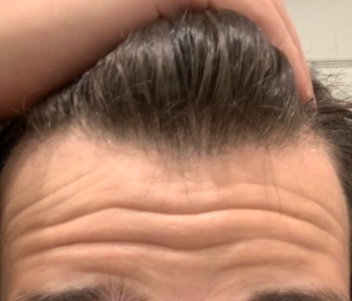
Note that he wrinkled his brow so that the creases showed. His hairline in the midline is less than one finger breadth above the highest crease. I don’t see the corners so I can’t tell if the corners are receded or not. Certainly, a large center forelock is taking up most of the frontal hairline real estate if there is some corner recession. Without more photos, I can’t answer the question.


2021-10-15 21:16:52Is this a Classic Mature Hairline?