Where can I get Finasteride? None of the doctors I visited will prescribe it!

Yes, doctors are shy because of class action law suits brought on by men claiming that the doctors prescription of Finasteride made them impotent. Many young men seem to be hopping on that bandwagon but it seems that most of these suits are being tossed out. I still prescribe it with proper waivers signed.


2017-09-16 14:23:46Where can I get Finasteride? None of the doctors I visited will prescribe it!

If I stop my finasteride and minoxidil

If I stop fin and or minox, is the rate of balding accelerated to greater than it would have been without trying treatment or just go back to pre treatment levels? thanks

When you stop these drugs you go back to point zero, where point zero is the amount of hair that you not only saved with these two drug but the amount of hair that you would have lost without taking these drug.

Finasteride shedding

I started using a higher dose of topical finasteride about a month ago and ever since then I have been noticing more hairloss. I do know the so-called “finasteride shed” (initial period where hairloss temporarily increases) but I am surprised that it started literally the day after my first application (I thought it should take some time to start working). I have been monitoring the amount of my hairloss (after washing my hair) for months and nowadays I see about twice as much hair in the bathtub than before. I know that this is probably happening due to finasteride and that it should be a good sign but a part of me still worries that it might be just my hairloss getting more aggressive.
Could you please advise me on how long the increased shedding period should approximately last
Finasteride shed should stop within another month or so. It rarely lasts more than 3 months, and if it approaches 3 months, it may be your balding is accelerating and the finasteride is not stopping it. Will will know which one it is by month 4.

Stopping Finasteride (photos)

I call that catch up hair loss which means that you lose all of the benefits and revert to what would have happened had you never taken the drug


2021-08-12 21:11:20Stopping Finasteride (photos)

Finasteride Was Eaten by Pseudohermaphrodites?

doctor,
in this article back in 2005 you mention that the pseudohermaphrodites had a diet high in finasteride? I am kinda confused here. so pseudohermaphrodites ate finasteride due to them having low DHT?

here is the article

I think you misread the post. A diet that was high in a finasteride-like substance caused pseudohermaphrodite characteristics in children of a mountain village in the Dominican Republic. These people did not know of finasteride. It was just a part of their diet. In the end, this was how finasteride was discovered. That is why finasteride is not to be taken by women who are pregnant and especially in the first trimester of pregnancy when the sex of the fetus establishes the gonads.

Please note the taking finasteride itself does NOT cause pseudohermaphrodites. These tidbits of information can sometimes be misconstrued into a wild tangent and taken out of context.

Stress, anxiety and hair loss, an important subject, as written by Baldingblog reader

Anxiety and Hair Loss

You look in the mirror, and you don’t know how it happened. You comb through your hair after your shower, and several thick hairs fall out, settling within the bristles of your comb. You are experiencing hair loss and going prematurely bald. It’s not necessarily genetic. You have family members who have full bodies of healthy hair, so you don’t know how you ended up with hair loss. You feel like the black sheep of the family and feel less than confident because of your hair loss.

What could be causing your hair loss? While some men who experience premature hair loss, balding and thinning may attribute the causes to genetics, poor diet, illnesses or varying testosterone levels, your hair loss could be due to stress and anxiety. Hair loss can occur from six weeks to three months after you undergo a stressful event in your life, such as financial woes, the death of a loved one, a divorce, a work-related event and more.

If you are prone to panic or anxiety attacks, one of the triggers during an attack could be grabbing your hair. You may not even know that you are doing this, but it could be causing the following types of hair loss, according to The Calm Clinic:

  • Trichotillomania: When you pull out hairs because of stress and anxiety; this is a habitual action.
  • Alopecia Areata: You lose larger clumps of hair around your scalp.
  • Telogen Effluvium: More hairs that normal fall out because your body is telling more hairs to fall out (the usual growth cycle is two years, and hairs fall out two months after that). Your hair is weaker than normal.

Your anxiety is usually severe if you experience hair loss, but that isn’t always the case. So, how can you combat hair loss when you have anxiety, depression or another mental health disorder? Get help to manage your mental health condition as best as you can. Talk with a mental health professional near you and read advice columns on BetterHelp. Licensed professionals on BetterHelp can also aid you as you try to find solutions to your hair loss caused by anxiety, as well as other issues.

In addition, some other ways to reduce your overall anxiety and hair loss, thinning and balding could be the following: meditation, belly laughing, connecting with those you love, exercising, eating a balanced diet, playing your favorite types of music and more. Just talking about what stresses you out could help you immensely and prevent one of the three types of anxiety-related forms of hair loss. Do what relaxes you and helps to reduce anxiety; thus, this could help you curb hair loss.

If you attempt to reduce your stressors, then your hair could come back. If you would like to supplement your hair loss, consider taking a hair growth supplement, using a scalp serum or getting a hair transplant to boost your self confidence and decrease your anxiety levels.

Marie Miguel (mariemiguel830@gmail.com)


2017-08-16 05:35:43Stress, anxiety and hair loss, an important subject, as written by Baldingblog reader

First Ever Skull & Scalp Transplant Performed In Texas

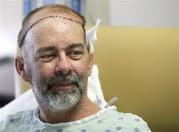
Opening a new frontier in transplant surgery, Texas doctors have done the world’s first partial skull and scalp transplant to help a man who suffered a large head wound from cancer treatment.

In this photo taken on Wednesday, June 3, 2015, James Boysen is interviewed in his hospital bed at Houston Methodist Hospital in Houston. Texas doctors say he received the world's first skull and scalp transplant from a human donor to help heal a large head wound from cancer treatment. (AP Photo/Pat Sullivan)

In this photo taken on Wednesday, June 3, 2015, James Boysen is interviewed in his hospital bed at Houston Methodist Hospital in Houston. Texas doctors say he received the world’s first skull and scalp transplant from a human donor to help heal a large head wound from cancer treatment. (AP Photo/Pat Sullivan)

I would guess that he received radiation for a brain cancer and that his scalp and skull had necrosis (death) that left him with no or a poor cover for the top of his head, leaving the skull and brain potentially exposed. This can be onerous. Assuming that I am correct, something like this would be lifesaving. This would not be a substitute for a hair transplant so for our readers, I wouldn’t rush to Texas to have this done. It is, nevertheless, interesting to read about.

Study Says Alcohol in Teens Damages the Brain, But Marijuana Use Doesn’t

Snippet from the non-hair-loss article:

The researchers, from the University of California, San Diego and the University of Pittsburgh Medical Center, performed the study on 92 16- to 20-year-olds. The scientists scanned their brains both before and after an 18-month period. Over the course of the 18 months, half of the teens, who already had an extensive track record with alcohol and marijuana, continued their vices as they had before. The other half continued to abstain or drink a minimal amount, like they too had done before the study.

In addition to the brain scans, the study also required a detailed toxicology report and substance use assessment. The teens also were interviewed every six months. Researchers did not check the teens’ cognitive ability, but simply took brain scans.

The researchers found that, after the year and a half was over, kids who had drank five or more alcoholic beverages twice a week had lost white brain matter. That means that they could have impaired memory, attention, and decision-making into adulthood. The teens that smoked marijuana on a regular basis had no such reduction.

Read the rest — No, Teen Marijuana Use Doesn’t Cause Brain Damage, But Alcohol Does

I’m not advocating marijuana or alcohol, but I thought it was interesting research in light of the pot legalization in Washington state and Colorado. The study will be published in the journal Alcoholism: Clinical and Experimental Research.


2013-01-07 19:19:38Study Says Alcohol in Teens Damages the Brain, But Marijuana Use Doesn’t

Flying in a Small Plane After a Hair Transplant

Dear Dr!
First, excuse my “not so good” English as I am not native English speaking. I had a FUE (1500 grafts) hair transplant done 3 weeks ago. Today, I joined a short flight (half an hour) with a small (2 seats) air-screw-plane with my brother in law who is an enthusiastic hobby-pilot.

i know that there is no problem to fly with a regular (big) commercial airplane. but these planes have cabins with controlled air pressure and so on. what about these small planes where there is no hermetic cabin and no controlled air pressure? we were flying as high as 3000 meters and during the descent i experienced some headache behind my front (the space right above my eyebrows). now I am worried that the change of air pressure during the flight only 3 weeks after the

transplant could have damaged my grafts due to changes of the vasculature. are these worries without any reason or not? I am very concerned about this.

Thank you very much for your answer. kind regards.

Hair transplants should be considered fully healed by the third week after the procedure, which means that nothing that you would reasonably do can negatively impact the growth of the grafts… even flying, as you have described.