If Propecia Takes Months to Start Working, Why Did My Loss Stop After Only a Month? – Hair Loss Information by Dr. William Rassman

Dear Dr. Rassman,

I’ve now been on Propecia for a little over a month and a half and it appears that I’ve noticed a slow down in shedding since before I started taking it. I know that on average we lose 50/150 hairs a day and I’m positive that I don’t notice all of the hairs that I lose over the course of the day (that would be impossible), but I am almost certain I’m not losing 100 a day, and it appears I’m shedding much less than before.

Is it pretty common for Propecia to start working noticeably a month and a half into treatment? I’ve read that it takes three months at least for it to start slowing down hair loss. I still have a pretty full head of hair (with some thinning at the crown and slight recession in the front. Not seeing as much hair shedding has me feeling really good that Propecia might work really well for me. Thank you, Dr!

Many people will report a reduction in shedding within the first month of taking the drug. I don’t know the hows or whys of it, but the medication doesn’t work exactly the same for everyone. In your case, it sounds like you’re seeing a positive result in a short amount of time. That’s good news!

Balding Forum - Hair Loss Discussion

Paid advertisements (not an endorsement):


Hair Loss from Herbal Essences Hello Hydration Shampoo? – Hair Loss Information by Dr. William Rassman

Hi, I recently tried out a new shampoo and conditioner set called Herbal Essences Hello Hydration. It has silicone in it, and can help improve shine quality in your hair, so I gave it a shot. I noticed afterwards more hair coming out after I rinsed the shampoo and conditioner out, but thought it was just natural. I switched shampoo and conditioner for a bit, came back to the Hello Hydration set, and when I rinsed out a clump of hair immediately came out between my fingers.

Is this coincidence, or do you think there is a relation??? Please help!!!

Maybe it is a coincidence. If the shampoo actually causes hair loss, I am sure it would have never been introduced/sold. I have personally used the shampoo before and did not experience anything different. If you believe there is a relation, then I would suggest not using it.

Balding Forum - Hair Loss Discussion

Paid advertisements (not an endorsement):


Hair Loss and Replacement for Dummies — The Reviews Are In! – Hair Loss Information by Dr. William Rassman

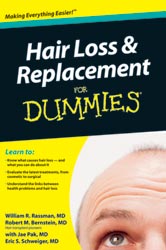
Hair Loss and Replacement for DummiesI know this will just sound like a plug for my new book, Hair Loss and Replacement for Dummies, but I haven’t mentioned it nearly as much as I should. There’s a reason for this post aside from the obvious — renowned hair transplant surgeon Dr Richard Shiell, author of many article and classic books in the field has written his review, which I’ve posted below. It serves as a good overview of what you can expect from the book, which I might add is sold online for under $12 at Amazon.com, and makes a great gift for those that are essentially looking for a handy, printed version of BaldingBlog.

P.S. It’s now also available on your Kindle e-book reader (and iPhone), in case you’ve given up on printed books!

Dr. Shiell’s review starts here:

—

Apart from the textbooks, written for professional, there have been many books on hair loss and replacement written for members of the public. I have read at least a dozen of these over the past 30 years and they are all quite informative and, for their time of publication, reasonably accurate and helpful.

Hair Loss & Replacement is no exception in this but it is a considerable cut above the rest. Firstly it is very up-to-date and contains a vast amount of information all exceedingly well organized in 7 sections containing 18 chapters:

  1. Getting to Know your Hair
  2. The Root of Hair Loss
  3. Creative Techniques for Concealing Hair Loss
  4. Pharmaceutical, Laser and Topical Therapies
  5. Advanced Hair Loss Solutions (60 pages about hair transplantation)
  6. The Part of Tens (10 myths about hair loss, pros and cons for wigs, hair treatments and transplants)
  7. Appendices- this include a Glossary of scientific terms used in the book. In addition the reader is provided with the addresses of all the well known hair-loss websites and support organizations and many more. There is also an outstanding Index running to 16 pages.

Throughout the book important points to remember are clearly marked with an icon in the margin, as are tips and warnings. The reader is even alerted by another icon to technical paragraphs that he can safely skip without losing the thread of the chapter.

Now a warning. Although this book is designed for those with little prior knowledge about hair, it is certainly not recommended for “dummies”. It is a very well written and technical book, authored by two of the acknowledged “gurus” of our field, Bill Rassman and Bob Bernstein, The previous scientific writings of these two men are already at the top of any reading list on hair replacement surgery. Far from being a text for the “everyman” the book would be an ideal primer for any doctor wanting to know more about hair loss and its replacement, before committing many months to a specialized training course in hair replacement surgery.

Every aspect of hair growth, hair loss and hair replacement is covered concisely in this book in reasonably simple language and I could find few faults within the text. Perhaps even then, they were just minor differences of opinion between experts, rather than faults.

There is no attempt to “talk down” to the lay reader and in fact the only concession to the layman is that each of the 18 chapters is fairly well self-contained and if he only wants to know about, diseases that cause hair loss, hair transplantation or hairpieces, then he can be well informed in a self-contained section.

Summary
This is a really outstanding book for the beginner who has a considerable degree of education but no place for a true “dummy” to be browsing. Perhaps someone will do a 50-page comic-book version for these individuals who, judging by popular book sales and TV ratings, make up a considerable proportion of our population.

–
Reviewed by Dr Richard C. Shiell, M.B., B.S., Melbourne, Australia

Balding Forum - Hair Loss Discussion

Paid advertisements (not an endorsement):


FUE2 vs FIT – Hair Loss Information – Balding Blog

I’m 32 years old with near norwood 4 loss and am still confused over both these techniques. There were two previous posts that you replied stating that both procedures are identical but according to Dr. Coles website he claims that FIT is much better than FUE.

My personal search has led me to either pursue your new FUE² or Dr. Coles but I’m at a standstill and not sure which path would be better. IF both procedures are the same then the only criteria left for me in my decision would be $ cost per graft. My last question would be how much you charge per graft for a shaved head for a FUE² procedure? Thank you!

Block Quote

Follicular unit extraction (FUE) is the core terminology that I used to define the surgery when it was first published and is the recognized term worldwide. Could there be marketing hype used here? I would think so (my opinion). The tools have been overblown and unless the technique is substantially different, an FIT is an FUE. The FUE² is different from the FUE in the basic technique deployed, because it uses a dissecting technique with high pressure fluid to assist in the extraction.

Our fees for FUE are as follows:

  • $10/graft for procedures done by Dr. Pak
  • $15/graft for those done by me (Dr. Rassman)

Some doctors charge more if the head hair is not allowed to be clipped close (shaved), though our fees are the same. At the moment though, by not allowing us to clip the hair, the total number of grafts available will be less.

Receding Hairline Corners – Is It Just a Mature Hairline? (with Photos) – Hair Loss Information – Balding Blog

Dear Mr Rassman,

First of all thank you for your very informative and helpful site.

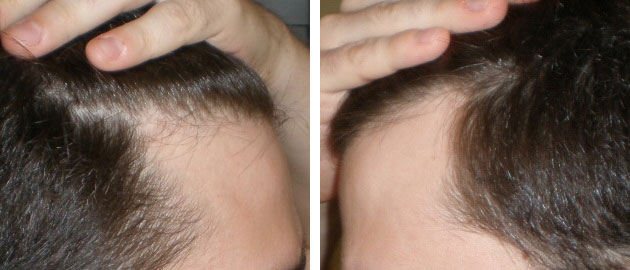
I am 30 years old and lately I started worrying about my temples. I have a feeling that I have rececing temples and want to take action in case this is the case. Unfortunately I do not have old photos taken from the right angle to compare. Could you please tell me what you think and my Norwood class according to the attached photos. I do not have any balding or thinning on top.

By the way, you can use my photos on your blog if you please.

Kind regards

Block Quote

Click the photos to enlarge:


First of all, thanks for allowing me to publish these. What I believe you’re talking about are the corners of the hairline, not the temples. The temples are below the corners (above the ear) and those look fine in the photos you provided. People seem to get the temples and corners confused all the time when labeling them.

It appears that your hairline is now convex in shape and the central area does meet the side areas, suggesting that the maturing hairline is locking into place. If there is no miniaturization present, I would do nothing other than observe your hairline yearly. This is a Norwood Class I or II.

Some Months My Transplanted Hair Looks Thick – Hair Loss Information by Dr. William Rassman

I had a hair transplant nearly two years ago now. every 6 months or so it looks thick and occasionally some months it doesnt. Now becuase the transplant to place maybe as the rest of my hair was at a resting phase, could the hair transplant section and the rest of the hair always be at a different rate of growth as in resting phase. I was wondering whether this was the reason for certain months it looking thick and more hair and other months lacking as much hair. Also as the transplant section isnt as dense and compact could it be that when some hairs fall out in order to be replaced it just isnt as thick?

Thanks NHI TEAM

The general hair cycling is somewhat random when we look at it. I can not imagine why your hair looks better sometimes than other times. We’ve all heard of a “bad hair day,” so maybe that is what you are talking about. Are you doing anything different with your hair during the periods in question?

Balding Forum - Hair Loss Discussion

Paid advertisements (not an endorsement):


Prilosec (Omeprazole) and Hair Loss – Hair Loss Information by Dr. William Rassman

I too am taking omeprazole and finding that my hair is thinning severely. I want to weigh in on this because I see other comments to this effect on your site and others. I think you should not be too hasty to dismiss the connection.

On researching this, I did find references to a rare connection between Prilosec (omeprazole) and hair loss. As I’ve explained before, it is difficult to conclude whether omeprazole is the cause of your hair loss, as hair loss is quite common due to genetics. Hair loss reported from the medication is in less than 1% of cases. See eMedTV for more.

Balding Forum - Hair Loss Discussion

Paid advertisements (not an endorsement):

Folliculitis and Hair Loss in the Crown – Balding Blog

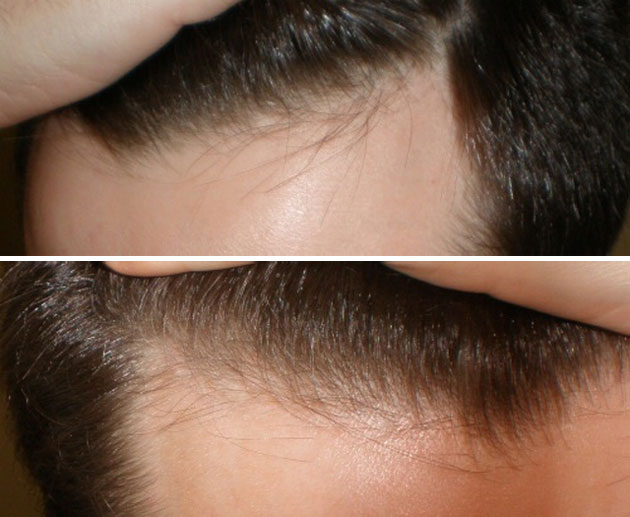
I have folliculitis which has caused hairloss at the crown. Will minoxidil regrow this hair? If it does, will the hair be lost once application has stopped or will the hair continue to survive on its own as my dermatologist says I have no MPB only the folliculitis.

There is a condition called folliculitis decalvans, which is an autoimmune disease that often reflects extensive hair loss. First, one would have to make a diagnosis (something I can not do without seeing you myself). If it is just a small patch from the infection of a few hair follicles that caused hair to fall out and does not reflect an underlying disease, then it might regrow. Minoxidil may help. I can’t say much more without knowing much more about you, what it looks like, and more of your history with the folliculitis. There’s a lot of info and photos of folliculitis decalvans here.


Related Posts Plugin for WordPress, Blogger...

Balding Forum - Hair Loss Discussion

Paid advertisements (not an endorsement):

Does Sensitive Skin Mean Sensitive to DHT? – Hair Loss Information by Dr. William Rassman

Hello Dr. Rassman.

I have a theory, can the type of skin (texture, etc) determine if a person will go bald? Sensitive skin equals sensitive to DHT? For example a Caucasian male can freckle easy and have allergies easily.

Thanks.

I suggest that you scrap that theory. I assume by “sensitive to DHT” you’re equating it to mean genetic hair loss. What is below the skin and what is above the skin (what it looks like) are very different things.

Balding Forum - Hair Loss Discussion

Paid advertisements (not an endorsement):


Surgeons and Multi-Blade Scalpels, Part 2 – Hair Loss Information by Dr. William Rassman

This is a follow-up to Should I Avoid Surgeons That Use a Multi-Blade Scalpel?

Your explanation makes perfect sense to me, but what does the “other side” say? Surely, a surgeon who would use a multi-blade knife (even an 8 blade) has some justification for its use. He would also have to have a reason ready to give to prospective patients to justify his selection if asked about it.

If I went to Doctor X who is using an 8 blade scalpel, for example, and said to him “Doctor, with all due respect, why are you using that? Doesn’t it cause unnecessary damage?” I don’t think he would say “well, I use it to save time.” I’m sure he would have a valid reason, if only in his mind, of why it’s really better. Do you know why their camp thinks the multi-blades are better and choose to use them besides “saving time?”

ScalpelThe only reason to use a multi-bladed knife above 2 blades relates to the time efficiency of the work, the need for less well-trained technicians, and the surgeons ability to do more grafts with less staff. The real expense however, is in the damage done to the hair and the hair that is lost. There are no patient benefits when using an 8 bladed knife (for example) over visual dissection of the scalp under a high-powered microscope.

One surgeon (about 15 years ago) presented a paper before the ISHRS which essentially was titled, “How to do 1500 grafts in under 10 minutes“. What I saw was akin to a sushi knife carving up the scalp with no respect for the hair. I asked myself if a ‘blender’ that I use to chop onions with would work as well? I would guess that the kill rate for hair exceeded 50% using this “method”. The surgeon was somehow content or fooled himself into believing that what he produced was quality grafts. I am afraid that the answer to your question is that there is no rational explanation for use of multi-bladed instruments unless there is some unique breakthrough.

Balding Forum - Hair Loss Discussion

Paid advertisements (not an endorsement):