Levothyroxine, Hypothyroidism, and Female Hair Loss – Hair Loss Information by Dr. William Rassman

(female) I’ve been diagnosed with hypothyroidism, and have been taking Levothyroxin 75 mcg for about two years now. I just recently had lab work done, which indicated that my thyroid levels are low again, which means I will have to increase the amount of Levothyroxin I take daily. I have about 30 ongoing medical conditions, and I do take many medications along with this one. I asked my pharmacist about hair loss (as mine has been thinning and coming out for over a year now, but it’s really bad now though), which of my meds could be causing it, and what vitamin(s) I could take to combat it. He told me that my hypothyroidism was most likely the cause of my hair loss, and suggested I take 200 mg of selenium everyday to stop the problem. Is he correct? What kind of doctor would I need to see for this problem? What more can I do? Help me, PLEASE!! There is no pattern baldness in my family. I used to have a nice long full head of hair and now it’s so thin. I cry everytime I wash my hair because so much comes out at once. This problem is making my depression worse as well. Where can I go and what can I do? I’m on disability so I do not have a lot of funds to combat this problem so yet another issue with which to deal. HELP!!!!!
Thank you so much for your help!

Hypothyroidism is a cause of hair loss and thinning. First you must get your thyroid problem regulated. Best to see a good medical doctor who feels that this problem falls without his/her expertise, possibly working with a dermatologist to follow your hair loss. An endocrinologist may be a good choice for a specialty. You also asked about taking selenium — it should not be harmful and actually may help.

HairDX for Women – Hair Loss Information by Dr. William Rassman

From the press release –

HairDX, LLC (www.hairdx.com) pioneers of consumer-friendly genetic tests for hair loss, today introduced the first meaningful test using genetic markers strongly associated with Female Hair Loss (Female Androgenetic Alopecia). The easy to understand test provides an accurate and understandable genetic analysis of a woman’s likelihood of developing this common type of hair loss.

The HairDX test for Female Hair Loss provides women with a score, called the CAG repeat score. A smaller CAG repeat score is associated with a higher risk for significant hair loss (Ludwig grade II or III hair loss) while a larger repeat score is associated with a lower risk for hair loss. To be tested, a woman swabs her mouth (inside cheek) for several seconds and returns the swab to the HairDX lab. The results are delivered confidentially and anonymously via a secure and private Web site.

HairDXFull article — Revolutionary Genetic Test For Women’s Hair Loss Launched

Like the HairDX test for men that was announced earlier this year, this is an exciting finding, but it may be difficult to understand how to use it since there is not a one-to-one ratio between the presence of the gene (the score) and the connection to female hair loss. As we all know (or hopefully know, since I’ve written about it many times before), the hair loss evaluation for women requires many tests, because there are many potential causes of hair loss in women that are not genetic. I certainly will evaluate the value of this test in the diagnosis of female hair loss.

Bald Spot Started Growing Dark Hair Amongst Blonde Hair! – Hair Loss Information by Dr. William Rassman

My son is 19 years old he had a spot the size of a half dollar on his head that went bald. after a few months the hair started growing back, but its real dark. His hair is Blonde.

Patchy spots of hair of a different color may be associated with a genetic predisposition or a mole or can be just normal. He may have had ring worm and the regrowth of the hair came in pigmented differently. You may want to have your son follow up with a dermatologist.

3 Days After Hair Transplant, My Eye Is Swollen and Bruised! – Hair Loss Information by Dr. William Rassman

Hi Dr. Rassman,

I had my hair transplant 3 days ago and I was told that i’m a bleeder. so my head was wrapped for 2 days and after washing off the wrap i looked swollen but after the 3rd day after waking up my eye is swollen and bruised is this normal?

The bruising is rare, but it is normal to have swelling after a hair transplant procedure if your surgeon did not use large dose steroids to prevent it. It should be found in the pre-operative or post-operative handout you hopefully received — and more importantly in your operative consent form. Most of the swelling should be gone by the 5th day.

Part of me is honored that you would be turning to me for hair transplant aftercare advice, but the other part of me is shocked that you would not be asking this question to the doctor you trusted to performed your surgery. You really should have an open line of communication with your surgeon. I really can’t stress enough how a good doctor/patient relationship is so very important.

Hair Loss InformationWhat Caused Sudden Female Hair Loss – Chemical Relaxer or Psoriasis? – Hair Loss Information – Balding Blog

A client I have serviced for almost one year accuses me of causing her hair to fall out after a relaxer I gave her. She called me two days after the relaxer saying her hair was shedding. I am very thorough with my rinsing of chemicals and the shampoos that follow. She said her hair was coming out in strands and that her scalp itched a little. I suggested she see a dermatologist. Her dermatologist told her that there was nothing showing in her bloodwork that would cause her hair to fall out. He prescribed her Luxiq which as you know is for psoriasis of the skin and scalp. Would’nt that not mean that she had a skin condition which caused her hair to fall out and not the relaxer?

Block Quote

It sounds like you may be looking for potential legal advice. I do not know your client or the entire circumstance involving her hair loss. This sounds like an acute episode of hair loss happened within a couple of days of the treatment you gave her. There seems to be a direct link between the use of chemicals and the hair loss, based on what you’re telling me. As I’ve written before, psoriasis will not cause hair loss unless you pick at it enough to develop traction alopecia. This does not seem to be a traction alopecia case, though.

There are many possible reasons for female hair loss, ranging from medical illness to genetics to hormonal to stress. Moreover, even with modern advancement in medical technology, the exact cause and/or cure for female hair loss is still elusive. Your client’s hair loss may have been related to the chemical stress or it may just also be coincidental. I really cannot say.

Hair Loss InformationFemale Hair Loss Continuing After Serious Surgery a Year Ago – My Doctor Dismissed My Concerns – Hair Loss Information – Balding Blog

(female)
Hello,

I’m having a hard time with hair loss since a serious surgery in May of 2007 (it lasted approximately 6 hours). It is now April of 2008 and I’ve noticed a steady and very noticeable loss in hair (I can see my scalp from the back- very little coverage of hair).

I have no known genetic hair loss in my family (that I’m aware of) my grandparents and parents have full, very thick, heads of hair and I had a full head of healthy hair prior to my surgery. My Dr. dismissed my concerns as attached to the surgery in May, however, I have not seen any return of hair since then, but rather a continuing loss.

When should I expect the hair to regrow? Is it unusual for hair loss to continue 10 months after surgery (note: the loss didn’t start until a few months after surgery and it was dramatic loss all of a sudden rather than slow shedding). Sometimes I find that my scalp hurts- it’s a hard feeling to explain. It is not severe pain, but rather a dull sort of sensation all over my scalp. I’m very concerned and have tried one treatment (oil and shampoo system -the oil treatment was twice a week for three months-that was supposed to stimulate growth). It did not seem to help at all.

What do you recommend I do? Is this normal or the sign of something irreversible? Thank you for your help. I do hope you can answer my question. I’m desperate to find some solution.

Block Quote

Hair loss after a surgery or from a severe stress is called telogen effluvium. If it lasts less than a year as it normally does, it will reverse after the stress abates. Some people go on to a chronic telogen effluvium. Both forms may be treated with minoxidil while you are waiting for it to reverse. More information about telogen effluvium can be found at eMedicine.

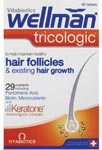
Wellman Tricologic Tablets – Hair Loss Information by Dr. William Rassman

Hello NHI team,
I have recentaly bought Wellman tricologic tablets, are for helping to maintain healthy hair follicles and existing hair growth. The tablets utilises Keratone, a combination of ligans, amino-acids, PABA(para-aminobenzoic acid) and pantothenic acid for the maintenance of natural hair colour. Here is some of what the tablets contain and this is what the box says and their website:

KeratoneTM includes;
• Standardised Lignan Extract – lignans (including the special compound Secoisolariciresionol Diglucoside) have been shown to help to naturally balance the conversion of testosterone to Dihydrotestosterone (DHT) which is implicated in the male hair growth cycle.
• N-acetyl-cysteine – this amino acid supports hair growth, and hair shaft diameter for fuller hair.
• L-cystine – this amino acid dimer of cystine is integral to disulphide bonding in the keratin of the hair, supporting its strength.
• L-methionine – an essential amino acid that must be provided from the diet and participates in a wide range of hair related biochemical reactions.
• L-lysine – as essential amino acid.
• Choline – a constituent of lecithin in cell membranes. A lack of choline can influence hair growth and hair pigmentation
• Inositol – a constituent of lecithin in cell membranes and a growth factor for rapidly dividing hair cells. A lack of inositol can influence hair growth and skin health

Silicon – Silicon is the third most abundant trace element of the human body and is important in the structure of hair.
Iodine – Iodine plays a role in metabolism and required for hair growth to proceed at optimal levels.
Antioxidant vitamins C, E and Beta-carotene – help to protect against the damaging effects of free radicals, which can lead to premature ageing. Vitamin C is also essential in forming the connective tissue of the skin while Vitamin E may help support skin repair. Beta-carotene provides a source of vitamin A, which helps support scalp oil production and skin health.
B-vitamin complex – Essential in the health and growth of rapidly dividing cells such as those present in the hair follicle

Recognising the concerns many men have about hair growth and hair condition, Wellman Tricologic® has been developed by leading scientists. Each specialist formula tablet provides 29 bio-active ingredients including essential vitamins, minerals and nutrients designed to nourish hair by maintaining healthy hair follicle metabolism.

My question is, what are your views on these tablets and how effective would they be. Would they be good if used with propecia/avodart. What is your opinion. Please, please reply. Thank you NHI team.

Wellman TricologicThe list of ingredients excluded the kitchen sink, but I doubt that adding it would help with genetic hair loss. If there were deficiencies in diet in any of these areas, it would impact your overall health, of which your hair is clearly an important element. The problem with many of these ingredients is that the scientific connection between their availability to your body and hair loss or hair regrowth is just not there.

For those interested, a list of how much of each supplement is available here. This product appears to only be sold in the UK and/or European markets.

My Dermatologist Said That Telogen Hair is Supposed to be Miniaturized – Hair Loss Information by Dr. William Rassman

Hi Dr. Rassman,
I went to see a dermatologist today about my diffuse hair loss, and I asked him if the thinner hairs that are falling out now (as opposed to the thicker hairs that fell out before) necessarily pinpointed miniaturization. He said that a telogen hair is supposed to be miniaturized compared with a anagen hair. Now, I’ve done quite a bit of research on this topic, and I’ve never heard that a telogen hair was supposed to be miniaturized. Can you give some insight into why he might say this? Thanks so much!

I agree with you. Telogen hairs, when they fall out, are normal width. I have no idea why your dermatologist would say otherwise.

Facial Hair Doesn’t Fall Out Like Scalp Hair Does? – Hair Loss Information by Dr. William Rassman

I have been told, by a colleague, that under normal circumstances, facial hair does not ‘fall out’ as does hair on your head.

Can you tell me if this is true or false?

Facial hair is different than scalp hair, but ALL hairs go through the growth cycle, resting cycle, and shedding (falling out) cycle.

I am not clear what you are asking. Do you have loss of facial hair or are you asking an academic question? The most common cause of scalp hair loss in men is due to genetic causes, and it is often referred to as androgenic alopecia (AGA), male pattern baldness (MPB), or just genetic balding. About 50% or so of the male population will have some degree of genetic balding at some point in their lifetime. Keep in mind that this does not mean 50% of men will go bald. Facial balding patches may not be genetic and you need to see a dermatologist.