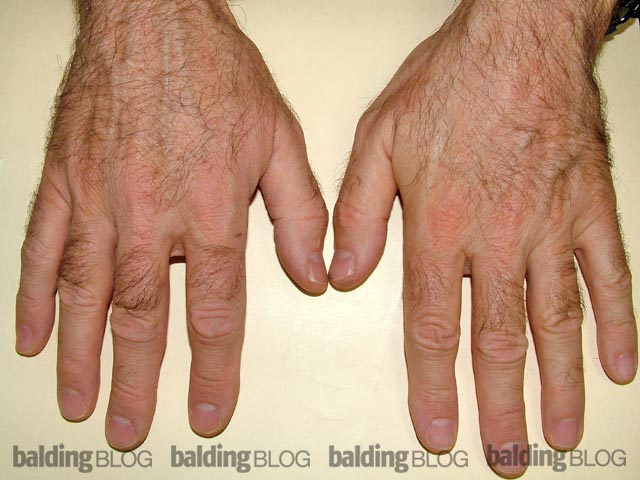
Can dry skin in the mustache area clog the pores in which it stops the hair from growing or cause it to delay?
Clogged pores do not cause delay in hair growth.
Can dry skin in the mustache area clog the pores in which it stops the hair from growing or cause it to delay?
Clogged pores do not cause delay in hair growth.
Dr. Rassman
It is not my intention to be a “naysayer” or to engage in a continued point-counterpoint debate regarding the Lasercomb. I don’t have any ax to grind. But, in your wonderful site, your readers may not have the background to fully appreciate unusual statements in the Lasercomb response.
As a physician who is an experienced clinical trialist (I negotiated and presented clinical data resulting in drug approvals at the FDA for two major biotechnology companies over a period of 15 years) and a balding patient, the Lexington statement is not entirely forthright for your readers and does not fully address major concerns. It comes across to me as if it’s written by marketing folks rather than scientists involved in analysis and presentation of clinical data. Specifically,
It’s wonderful that “GCP”, “IRB approval”, etc was part of their clinical trial. For your readers, that means that the data was “real” (i.e., not fake or compromised), which of course is important when submitting data to regulatory agencies (FDA). But, the compelling question and real issue is presentation of data and accurate statements. For example,
- Great that the single pivotal study is being written up for publication. This should have taken 1 week and been done a long time ago. It is highly atypical that a device or drug is approved without the study being published (before approval) in a peer-reviewed, scientific journal. This is truly the only way for physicians and patients to understand the effectiveness and safety profile, and make an educated decision. It is so atypical not to publish such data that the absence creates skepticism, whether deserved or not.
- It is misleading for those not privy to drug/device approval processes to say that approval was based on the same statistical scrutiny as minoxidil and finasteride. What they mean is that statistical superiority had to be shown over a placebo control. The number of patients used, number of studies conducted, and duration of treatment, follow-up, and extent of the number of patients exposed paled in comparison to the aforementioned drugs. There is nothing wrong with this per se as a medical device should not be held to the same standards as a drug with potential systemic toxicity. But, again, it speaks to the clarity by which the company attempts to educate readers.
- In the absence of publication of data in a peer-reviewed journal, the company gives only “partial data” on their web site and omits critical information (number of patients in the study, mean compliance, etc) that raises suspicion (even when no suspicion may be warranted). The presentation of clinical data on their web site is so poor that it appears to have been done by those not experienced in how to present data (and thus does not allow readers to be fully educated).
- LaserComb may be the best thing in the world. The “real issue” is not, as the company states, that “people are not willing to move away from the “status quo.” That is ridiculous. The issue is that, in this age where data is often manipulated, spun, and marketed, companies touting products have an ethical and scientific obligation to provide detailed data of their clinical trials in public forums so that physicians and patients can make informed choices. When such data is not presented (or “in preparation”), a proper evaluation of risk/benefit can not be made, and skepticism abounds. Ironicaly if data is in a form for submission for regulatory approval, a few “cut and pastes” of several sections of the submission document should be all that is required to write up a small study.
- The Lexington statement notes that “the hair growth, quality, condition, tensile strength, and manageability of hair” is enhanced by their laser. Data???? The company also makes statements based on their “extensive anecdotal experience over 20 years”. While anecdotal experience is not as valuable as placebo-controlled trials, it is still helpful. Let us hope that the company is also writing a manuscript “in preparation” summarizing this experience.
- One P.S. The company needs to stops saying it “offers a money back guarantee.” As with presentation of their clinical data (so far), a half-truth. The company offers (beyond a month) a 60% refund if the comb is returned within 5 months. Their statement implies that those who find it not effective can return it, which is not the criteria. Again, nothing wrong with their policy. The issue is one of clarity of communication, which is missing for their clinical data.
We appreciate your excellent observations and input into such a controversial subject. I would hope that our readers take the time to reread your comments carefully, for in those comments there are many insights into the research process and when it is credible.
For more from this thread of critical back and forth, see:
And to read previous posts on the LaserComb, please see the list here.



Paid advertisements (not an endorsement):
To whom it may concern,
Thank you for maintaining this site; the information is valuable and welcomed.Well, I am a 23 year old male. My father and his entire side of the family experience heavy baldness. My hair is definitely thinning.
My question: Rogaine, Propecia, hair transplants – these are the major treatment options I’m aware of (and to some extent, experimental laser treatment). With only the few short details I’ve given you, can you give me an educated guess as to which option or combination of options might suit me best? I’d love to hear your opinion on hair transplants for males in their mid-twenties with projected substantial hair loss.
Thank you so much

If the hair loss is early or just starting, simple drug use with Propecia (finasteride 1mg) is often the best approach to slow, stop, or reverse the hair loss. Propecia is a prescription medication, so you’ll need to meet with your doctor. I’m not convinced that the laser treatments actually are worth the time or money, and a hair transplant would likely not be an option for you yet, particularly because you haven’t been on any medication to treat your hair loss — a simple pill may eliminate your need for a surgery.
The first step in addressing your hair thinning problem is to have an examination by an expert doctor who can help you navigate the diagnosis and develop a Master Plan. This would include a miniaturization study. There is no substitute for a one-on-one consultation and examination to understand what you want and need. If you’re in California, I’d be glad to meet with you. If you’re looking for a doctor more local to you, I’d check the physician search at ISHRS.org to find a doctor in your area that specializes in hair loss.
I have recently started doing squats at the gym with a lot of weight (I had never done them before). I have heard that squats raise your levels of testoserone and that high testoserone levels lead to hair loss. I have been taking propecia for over three years with excellent results but it seems that since I stared doing squats at the gym ( 3 or 4 weeks) I am losing a lot of hair. I have noticed that I loose more than 50 hairs per day while I shampoo, dry and brush my hair. Is this true? If so, shouldn’t the Propecia still block the extra testoserone I am producing with the extra squat exercises?
Thanks
 Unfortunately, I have no experience with the question to respond properly. After researching this a little bit, squats and deadlifts are said to be the most effective muscle building exercise, but I have no idea to what level the testosterone would increase while doing these workouts. Despite what I read (the sources I found were not exactly 100% credible), it does not make sense to me that squats could increase testosterone levels, but you could find out by testing yourself before and after exercise with and without squats. It would cost you a few dollars to find out and I would be happy to draw your blood for the four tests required. Although you will have to pay the lab test bill, I will contribute my time to draw your blood and send it off, all on the same visit.
From the press release —
Luna Innovations Incorporated (NASDAQ:LUNA) announced today the discovery that a nanomedicine prototype aids in the growth of new hair follicles. Scientists at Luna’s nanoWorks Division in Danville, VA, have been developing a portfolio of new candidates based on antioxidant nanomaterials which could lead to a platform technology for treating a wide range of diseases. “One of our new nanomedicine prototypes, after only two weeks of treatment, was found to increase the number of hair follicles fourfold in mice which are born genetically hairless,” said Robert Lenk, President of Luna’s nanoWorks Division.
Hair growth is a process that normally depends on the regeneration of tiny hair follicles. Hairless mice have a mutation that results in atrophy of hair follicles a few weeks after birth. The hair does not regenerate. The gene responsible for the mutation in the hairless mice has been identified, however the biological processes that cause the follicle to atrophy are not well understood.
Luna is working with scientists at The Hamner Institutes for Health Sciences to further pursue their discovery in the hope of identifying a therapeutic aide to potentially treat male pattern baldness. In addition to hair loss due to heredity, Luna’s discovery may also aid in hair regeneration for loss due to other medical conditions.
Full text here — Luna Discovers Nanomedicine Prototype Affects Hair Growth
All the news here is good news, at least for hairless mice. This is where much of the research starts, so let’s hope that more good news will follow in the years to come.
Dr. Rassman,
I was told by my hair transplant surgeon that FUE can be performed effectively from extracting the hairs near my neck since he finds it unusually dense compared to other areas on my scalp.Are you in agreement of this=based on the fact that these hairs can in fact be effected by DHT?In other words if the hairs are in fact efected by DHT why would I go through this expense/discomfort if they will eventually fall out? please advise
Neck hair is not scalp hair and as such it is NOT considered permanent hair. I have seen plenty of patients who had lost their neck hair as they age. If you transplant neck hair it may NOT be permanent. In your particular case, you mention hairs “near” your neck — and I simply don’t know precisely the area you’re talking about.
Hi,
Im 4 months post op and noticed some dead skin peeling off fro the recepient area while combing my hair after shower.There was no blood behind. Just Dead skin with some attached hair to it. is there anything to worry about? Will the hair grow again in place of the dead skin?
thanks
This is probably crusting that you haven’t washed off. I have seen this on people who were too gentle with their post operative washing. See your hair transplant doctor to ask about your post-op care.
This isn’t about hair loss, but I’m the curious sort and I figured you might be familiar with this. I’m a blond guy in my 30s, good health, no hair loss that I can tell, but I have a mole on my shoulder that grows a single black hair. The mole has been there for as long as I can remember without growing larger and I don’t think I have anything to worry about as far as cancer. The mole hair seems to grow faster than the rest of my body hair and is an obvious different color and texture. Why is the hair different like that?
There is clearly some different genetics in play here and that is the best answer I can give to your question. If you don’t like your single dark hair, you can have it removed or burned with electrolysis. The mole can also be surgically excised for cosmetic purposes.
When I read the question I thought you were going to ask about moles — the mammal. I knew that moles have a high hair (fur) count. Here is what I found on the web:
Mole Hair – Sometimes considered pests, moles are often trapped or hunted for their fur, which is quite unique. Soft, velvety, and very fine, mole fur is especially adapted to facilitate the animal’s underground movement in any direction, smoothly lying down no matter which way it points. Thus, when mole pelts are made into coats and other fur products, the fur can be brushed in any way the designer or owner chooses. Quite valuable, demand for mole fur has caused significant population declines in some areas.
Also I found out that the Alaskan Fur Seal has a huge hair count of 350,000 hairs per square inch when compared with the human as 1250 hairs per square inch. That hair count keeps them dry (water can’t get through it) and warm (a great coat).
Oh come on, I can have fun — it’s April Fools Day!
Paid advertisements (not an endorsement):
From the article –
The U.S. Food and Drug Administration is warning consumers in 15 states about the link between a dietary supplement and adverse side effects including “significant hair loss.”
The distributor of “Total Body Formula” and “Total Body Mega Formula” has voluntarily recalled the dietary supplement products after 23 individuals suffered “serious reactions” within seven to 10 days of ingesting the liquid supplements, the FDA said in a news release.
Full text — FDA Warns ‘Significant Hair Loss’ Linked to Dietary Supplement
This is a significant news story on the potential dangers of dietary supplements, which I hope many of our readers take to heart. There are no free rides in this world.
Paid advertisements (not an endorsement):
Dear Doctor:
Two questions about Rogaine application:
- In addition to taking 1.mg finasteride daily, I’ve been applying Rogaine foam for a few months now, mainly the frontal third of the head. That area alone takes more than the recommended half a capful. Although it is the frontal third that is my main concern right now, I’m somewhat miniaturized pretty much on the N5 area, albeit, to the naked eye, I have a pretty good head of hear at the moment (I’m 29). I just don’t see how it is possible to treat the entire area with less than three times the recommended dosage (which makes the treatment prohibitively expensive and fraught with side effects).Is there any residual benefit to the vertex area through general scalp circulation at all, if the application is on the front third?
- Since Rogaine absorbs into fingers rapidly, does it make sense to apply it with a medical rubber glove, to ensure that more goes into the scalp, not hands? For some reason this issue hasn’t been addressed by Rogaine users.