
2021-06-18 01:29:292021-02-23 18:31:26Over-harvested donor area (photo)
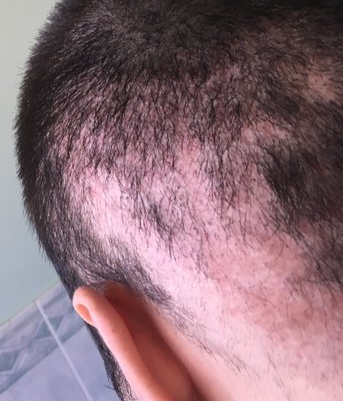
We continue to see over-harvested donor areas where those doing the hair transplants take out so much donor hair that they start making the donor area bald. In this man, clearly the hair transplants also failed as you can see from the top of his head. The donor hairs were also taken from his neck area which is not permanent hair.
Click to enlarge
2021-01-20 03:21:562021-01-20 22:06:46Over-Harvested Donor Area from Turkey (photo)
Both of these young men had too many FUE grafts taken from their donor area and now, even with long hair, have what appears to be balding in the back of the head. Longer hair will help, but Scalp Micropigmentation (https://scalpmicropigmentation.com/scar-covering/) usually solves the appearance but doesn’t replace the missing hair in the donor area.
2020-02-17 04:00:052019-07-17 15:22:56Over-Harvested donor area from FUE surgery shows even with long hair to cover it (photos)
2020-10-19 03:50:032020-09-15 12:44:49Over-harvested area shows up even in blonde (photo)
I suspect that you were over-harvested with grafts taken too low. There is some possible devascularization of the donor area. If the hair does not return by the 6th months, then I would recommend Scalp MicroPigmentation, See here: https://scalpmicropigmentation.com/scar-covering/
Hi Dr Rassman
I had a procedure done, it’s now day 8 post surgery, and I get my staples out in 2 days. The donor area is still a little sore but not to bad. It’s mainly when I put pressure or sleep on back of my head, and some of the scabs are coming off now. I would like to get some exercise and go surfing.Should I wait a little longer? Is it normal to feel a little sore in the donor area 8-10 days later? Is surfing 11 days post-op too strenuous, or could the ocean water cause infection? Of course I would take it easy and certainly wash my hair right after.
Thank you Dr. Rassman for your blog and reply
Since you have staples, I’ll make a wild assumption that you had the strip method surgery, in which case the wound should not be soaked for easily 3-4 weeks after a surgery. If you had a surgery using the follicular unit extraction (FUE) technique, then you could probably go surfing. The wounds are not strong at 10 days, but at about 3-4 weeks, around 70% of the final healing strength will be present. I’d keep waiting.
Hi there! I was wondering if there is a possibility for hair grafts to fall out a month and a half after the procedure. I was gently rubbing my head when I noticed one of the tiny hairs fall off. That tiny hair had a piece of the root that came off with it (not just the bulb but a piece of the root that has dried up and is normally seen with a harvested hair graft prior to the transplant). Any input would be greatly appreciated. Thank you!
I would hope you were given post-operative instructions, and that somebody at the surgical clinic explained to you what was involved and what to expect following a hair transplant.
About a month following the procedure most of the transplanted hairs fall out, at times appearing to be the full graft. This should not be the graft at 6 weeks though, as the “root” of the graft remains even if the hair and the surrounding tissue comes out with scabs. For more on this, see Graft Anchoring in Hair Transplantation (PDF file).
It takes anywhere from 3 to 8 months to start noticing significant growth, provided that your surgery was successful.
2010-08-04 13:02:182010-08-03 08:35:25Over a Month After My Transplant, Grafts Came Out!
Most posts I read on various hair loss forums like Reddit, seem to be from guys who’re in their late teens/early 20’s who were probably going to be able to grow beards anyway, but for whom the minox may have just accelerated the process. Any success stories from older guys? I’m nearing 40 myself and looking for some inspiration. Much appreciated.
Men react differently to hair loss at any age. The most common reactions involve opting for very short haircuts or even shaving their heads. This trend is noticeable in places like airports or shopping centers. Some men embrace this change and never look back.
Others take a different route, seeking ways to regain their hair. Many of them share their experiences and seek solutions on platforms like Reddit or various forums. Some younger men might become fixated on their hair loss due to familial experiences.
Then, there’s a group who prefer not to rely on medications and choose the hair transplant route. They seek an immediate solution, despite the significant cost involved. I’ve performed hair transplants on men as old as 92, driven by various reasons like wanting to appear younger for dating purposes. Typically, men between 35 to 55 years old make this decision. With today’s technology, unlike older methods, about half of men can restore their hair in a single transplant session.
The crucial question here is personal: Does hair loss bother someone enough to (1) commit to lifelong medication (assuming it works), or (2) opt for a hair transplant despite the cost?
There are numerous success stories addressing hair loss, many of which are shared on platforms like Reddit. Are you bothered enough to go through treatments such as daily medications or a hair transplant. Only you can answer this question.
I perform HAIRCHECK tests on most patients who want to start finasteride because I want to be able to follow their progress and if the drug is halting or reversing the hair loss., The HAIRCHECK test gives me a metric which allows me and the patient to know with reasonable certainty what is happening to them and with my experience I can often predict long-term hair loss patterns allowing my patients to build a Master Plan for future planning both for financial reasons and for hair growth reasons. If the HAIRCHECK shows no balding, I don’t prescribe finasteride. Also if a patient is depressed and I feel that there will be a link between finasteride and his depression, I might not prescribe it. My assessment of the patient is always one-on-one and then I have the priveledge to prescribe it or not.
In addition, I take a careful history, get to know the patient and try to understand their sexual history and if they may be good a candidate or not go good candidate for this drug. I have turned people down based upon these discussions.
2020-10-16 03:41:022020-09-26 06:53:14When not to prescribe finasteride