
How to quantify your donor area hair supply?
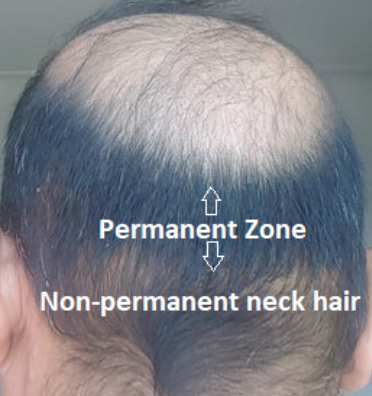
Here is a picture of the donor area of a man who asked me: How much donor hair do I have? He asks: You have talked about the Donor Bank in your writings, so I would like to know how many grafts are in my Donor Bank and what will be my lifetime supply of grafts for hair transplants in case I should become very bald?
First let’s see where the permanent zone of hair can be found. It is called the permanent zone because even the baldest of men, never lose hair in this zone (see photo below). The zone measured from 2.5-3 inches in height and extends around the entire head from temple prominence on the right side to temple prominence on the left side. We generally assume (safely so) that this hair will always remain (regardless of the balding pattern a man develops). Back in the late 1950, a doctor ‘Orentriech’ discovered that if this hair is moved anywhere on the body, even into a bald area of the scalp, it would grow as it would have grown in its home location in this permanent zone. That is why it is called the permanent zone of hair.
There are two important numbers to determine from the hair in this zone (1) the hair count per follicular unit (these are the groups of hairs that contain one or more hairs each in them) and the thickness of the hair shafts of this permanent hair (never look at the hair you are losing as normal hair as it often gets thinner and thinner). I quantify the thickness of each hair shaft in the permanent zone by feel (experience helps here) or with a micrometer as Fine (~40 microns or less in thickness), Average (~60 microns in thickness) or Coarse (70+ microns in thickness).
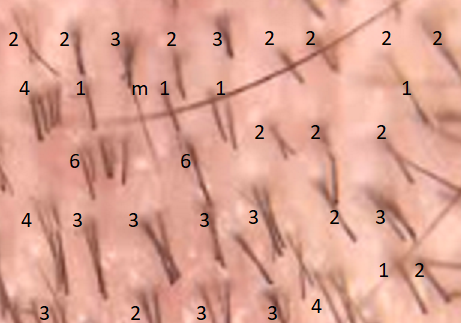
I generally take a picture of the donor area with the hairs cut short enough that I can count the number of follicular groups in the field of view and how many hairs are in each group (see below). This field of view of the donor area of one of my patients was taken with a purchased lens as an attachment for my cell phone (https://www.amazon.com/gp/product/B07S5YPPQX?pf_rd_p=ab873d20-a0ca-439b-ac45-cd78f07a84d8&pf_rd_r=CCSSMZGDS79G6AG31TT9) at a cost of $16, something you should consider purchasing.
First let’s do some simple math: There are 34 individual hair groups (in the area shown in the photo) which contain from one to 6 hairs each (each are counted and labeled for you). The total hair count in this field is 85 hairs. If we divide the number of hairs by the number of groups 85/34= 2.5 hairs per Follicular unit (a Follicular Unit is essentially what we call a Graft in a hair transplant surgery). The average Caucasian has 2.2 hairs per Follicular Group so the man shown here has a hair count that is 13% higher than average. I can tell from this number that this man has 125,000 birth hairs on his head regardless of how much hair he has already lost. I felt his hair for thickness and measured it. It measured 60 microns which is essentially an average weight hair.
Now let’s look at more detail at this picture. There is a single hair shown that I labeled ‘m’ for a miniaturized hair. So this man had approximately 1% miniaturized hairs. The number of miniaturized hairs can be as high as 20% and the donor area is still considered healthy. As we get older (into your 50-90s) these hair groups may drop hairs so that the count could be slightly lower and the hairs that we often drop will often be miniaturized before they fall out. Everyone experiences hair changes with age, as donor area hairs may get ‘finer’ so that they contain less hair bulk per hair shaft. If these hairs are used for a hair transplant, whatever happens in this permanent zone, will happen in the hair transplanted hairs as well.
The calculations of his total donor bank supply is a bit more complicated. Each person has a fixed number of Follicular units (about 50,000 for an average sized head). Generously assuming that the size of the donor area is between 20-25% of the total hair baring scalp (let’s use 25% as a number for calculations here), this patient has 31,250 hair in his permanent zone or 12,500 follicular units (grafts) of which he can transplant theoretically no more than 60% of these hairs (follicular units or grafts). The 60% number is based upon an average hair count, but because this man has 13% more hair, he can actually move 13% more grafts bringing his total available lifetime hair to 7,500 * 1.13 = 8,475 grafts available during his lifetime.
Experienced surgeons like me who have been measuring hair densities since I first entered the practice and defined it in the literature, have learned when they can increase even this number safely. This is where surgical judgment comes in. I would like you to try to make this important assessment of your Donor Bank so that you will be able to (1) test the doctor’s knowledge of what he says about your donor supply, (2) be confident that your donor quality and quantity is adequate to meet your short and long term hair transplant needs.
2019-12-17 11:20:442019-12-17 11:59:26How to quantify your donor area hair supply?
How to Measure a Mature Hairline?
this may be a strange question, but when one talks about measuring how much a hairline has receded, and says that a normal (“Mature”) hairline recedes a half inch in the front, and an inch and a half at the corners, how do you measure that? vertically, as if straight down the face to a point parallel to where the hairline initially was??
thanks!
The measurement of the mature hairline is essentially done with a drop string (gravity), from the leading edge of the hairline and to the highest wrinkle of the furrowed brow. Here’s a list of past posts that may help:
How to make your own topical finasteride, is it real?
Thanks Dr. Rassman. Any basis for why it will not absorb? Minoxidilmax.com one of the longest running topical finasteride sellers said this on DIY:
“If you want to make your own topical finasteride at 0.1 percent to save money, you should be able to do that with the right tools and material. No need to be a scientist to do so. The only tool you need is a scale that is accurate to 1mg level. All you need to do is to weigh 60 mg of pure finasteride power and pour it into a bottle of 60 ml minoxidil solution, close the bottle and shake it for 10 minutes.
The real challenge here is not how to make it but how to obtain good quality of finasteride material. Some people choose to use 5 mg finasteride pills (Proscar). In this case, you will need to pulverize 12 pills and then put the powder into a bottle of 60 ml minoxidil solution. Shake it very hard for 10 minutes. Let the bottle stand still for overnight and pour the clear solution to another bottle for use. The reason why it is recommended to dissolve the powder into a minoxidil solution is that it has right solvent that ensures the good absorption of the topical finasteride. You can’t just use pure alcohol as the solvent, because it evaporates too faster and you will end up with flakes of finasteride on your scalp that will never be absorbed.
With the 0.1% topical solution, you receive 1 mg finasteride if you use the solution once a day. If you use the homemade solution above twice daily, your finasteride dosage is actually 2 mg a day.”
This question is a moving target tied to instrumentation issues. Some doctors have done a) half FUE and b) half strip and measured growth differences and there were none. There are certain patients that FUE will cause damage, that group is a subset of those I called Fox negative patients in my original article. This group of Fox negative patients has contracted to a smaller number because of better and better instrumentation that has developed over the years. In that small sub-set of patients, there is no doubt that FUE is an inferior surgery and that sub-group, unfortunately, can’t be identified in advance, so each individual takes some risk that they may be in this sub-group when they elect to get FUE. Maybe this sub-group is 5% of all FUE patients, maybe less, but for them it is 100% less quality surgery because there is more damage to the grafts during harvesting. This presents the problem as if it is black and white, but there are gray areas in this sub-group that may make the sub-group larger than 5%. The strip doesn’t have that risk.
2020-04-07 02:39:532020-04-19 15:14:50How to make your own topical finasteride, is it real?
How to know the difference between baby hairs and miniaturized hairs on hairline.
Vellus hairs are the short hairs that are mixed in with each follicular group of normal hairs. Miniaturized hairs are hairs that have lost their thickness and are noticeably thinner than the hairs on the back of your head.
2020-05-15 04:00:222020-05-11 09:04:56How to know the difference between baby hairs and miniaturized hairs on hairline.
How to Know If Follicles Are Still Alive, but Dormant?
It may be tied to your age and how long you have been bald. The longer you are bald (10-40 years) the less likely anything will grow. Is there any hair present?
2020-01-01 04:00:422019-10-31 12:05:51How to Know If Follicles Are Still Alive, but Dormant?
How to keep my juvenile hairline?
It’s been reported that Dutasteride raises scalp Testosterone by nearly 100%. I don’t know if thats bro science or what. When I took fin for 10 years, my hair line didn’t move a cm. Since taking dut for 7 months, my hair line has went from a thick NW1 to an approaching NW2.5-NW3. I can see the pattern taking shape, although I’m about a NW1.5 now. Can Scalp Testosterone cause damage to hair follicles, particular the front where they may be more sensitive to T in general? Thinking of going back to fin and cutting my losses. Enough is enough
The model for hair loss is for DHT, which is a metabolite in the breakdown of testosterone by the body. Norwood Class 1 and 2 have juvenile hairlines and the leading edge of these hairlines do not respond to DHT blockers like finasteride, so using drugs to hold onto your juvenile hairline makes no sense and just will not work.
How to Get Propecia
Hi,
im 24 and ive been slightly receeding for several years now, however it has sped up in the last 6 months, ive also notice the front of my hair beginning to thin. I have read many things about propecia on your site but have no idea how to go about getting it or how much it costs. ive also read a bit about DHT, which sounds like the cause of my loss. Do you have any suggestions, and any suggestions on someone to see, obtain propecia from the vancouver area
thanks
You may obtain Propecia by asking your physician to write you a prescription and then purchasing it at a pharmacy. Prices in the United States run between $53-120/month for 30 pills, depending on where you buy it from. Being from Canada, you may be able to obtain Propecia at a better price than in the US. You may also obtain Propecia from my company if you become a patient. Our pricing is presently at $160 for a 3 month supply. If you are one of our patients we can ship it to you, but if you are not in California (Los Angeles or San Jose) to be evaluated, just see your family doctor and ask him/her.
Hair specialists who will often write Propecia prescriptions can be found at ISHRS.org.
2005-12-07 09:44:242005-12-07 10:55:17How to Get Propecia
How to Get Miniaturization Mapping Done When There is No Doctor Doing It
Dr. Rassman,
My main concern is being able to start using Propecia as soon as possible in order to slow down any further miniaturization and slow the progression of any further receding. The other concern I have is regarding the miniaturization study. I live in Minnesota and since your only offices are in California, the distance factor will create cost issues for me.
What options would I have with such a long distance and cost factors?
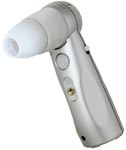 You can use a video microscope and look at your own hair. These run about $200-400 or so and are often sold online (price varies per vendor and tool used). I like the ProScope (the USB version for computers is more costly than the version that connects directly to the TV) and have them in my offices along with specialized software we developed for keeping records of the patient’s mapped scalp. You need to estimate the number of small hair shafts as compared with the larger, normal size hair shafts. It is often difficult to tell the difference between vellus hair and miniaturized hair, so I use an estimate of 20% as the normal level of miniaturized/vellus hairs. Any number in excess of this in different parts of the scalp is thinning/balding.
Alternatively, of course, try to find a doctor who will manage your entire hair loss process by developing a Master Plan, which should be the bible for your hair loss management.
How to Fix a Pluggy Hairline (with Photos)
From time to time, I get emails from men that are incredibly embarrassed about the results they got from an old, pluggy hair transplant. They’re so embarrassed that they request I don’t even publish their emails (even if there’s nothing identifiable in there)… and that’s fair enough. So I just wanted to write a post to quickly explain the best way to fix a pluggy hairline: you need to cut out the plugs and then put transplants in the place the plugs originally were. This is generally done in two sessions (8-10 weeks apart) and we have been doing this for years. It turned out that this man’s scar (from excising the grafts) healed very well, so well that it could not be detected. I put hair wide enough in front of where the scar was so that his hairline was lowered quite a bit. We built a wide transition zone in the leading frontal edge. Here is such a case on a man with black hair.
Before on the left, after on the right. Click the photos below to enlarge.
There’s another plug repair case at the NHI site — Dean’s Story. Be warned, some of the photos there contain surgical content, so if you have a weak stomach, you may want to avoid that link.