Good response to Miniaturized hairs from finasteride

I am on finasteride for 6 months and all of my miniaturized hairs turned in to thicker terminal hairs except temple hairs.,Why is that? Will topical finasteride or minoxidil helps in this situation?

Finasteride does not work on all miniaturized hairs. Sometimes the genes are too strong for the drug and the drug doesn’t impact it. Maybe, Topical Finasteride with minoxidil will help.


2020-09-08 09:46:18Good response to Miniaturized hairs from finasteride

Going to Bed with Wet Hair Causes Hair Loss?

Hello I’ve been told that going to bed with wet hair, after coming out of the shower without drying it first, can cause hair loss because of the humidity it builds up or something like that? Is this an old wives tale or is there some truth to it?

If you go to bed with wet hair, I do not believe that it will cause you to lose hair — but it will get your pillow all wet. Be sure that the wet hair does not get pulled when you move around. Generally, it’s probably best to dry it first.

Going on Holiday with No Finasteride

Im a 17y/o M and I’ve been taking fin and minoxidil from March with great results but I’m going on holiday with friends and my fin isn’t coming on time and all I have is minoxidil will it be enough to maintain my results for 2 weeks, also I expect my minoxidil usage to be inconsistent due to the nature of parties and hangovers do u guys think I’ll be ok.
Finasteride holds its value, even after you stop it for up to 10 days. Never a good idea to stop it. It is small enough to take it with you on vacation, don’t mess with it.


2020-05-04 12:44:30Going on Holiday with No Finasteride

I’ve Been Taking Half a Propecia Daily Because It Caused Shoulder and Chest Pain on My Left Side

I am 29 and I have been treating hair loss with minoxidil for approximately 6 years with an unfortunate gradual progression in thinning.

I started taking propecia in addition to the above about 2 months ago. When I first began treatment, after a few days on the recommended 1mg dosage, I developed a pain in my left shoulder/arm and also in my chest area (again mostly on my left hand side). I also suffered from less semen being produced. I stopped treatment for a few days and the pain subsided.

Determined to treat my hair loss I tried again with the propecia but taking just half (0.5mg) a tablet a day. After a day or two there were hints of this shoulder pain returning but it then subsided and I have been able to continue with treatment at 0.5mg a day with virtually no problems (I still have decreased semen production but not to the extent that it causes any problems).

My question is: having been taking a half dose for these 2 months would it be worthwhile trying to go up to the recommended 1mg again? Is there a chance that my body may have adapted to the use of finasteride and could cope with the increase or would it be wiser to remain on the 0.5mg dosage (given that i still have the side effect of reduced seminal fluid) and hope that it has some positive effects upon my hair loss situation?

A half a dose will work about 80% as well as a full dose. I would try one more time at the full dose but if the pain comes back, stick to the half dose. Have a doctor check out your chest and shoulder pain.

When Can I Scrub My Hair After A Hair Transplant?

When Can I Scrub My Hair After A Hair Transplant?

Scrubbing it tends to pull out hairs that are miniaturized or those near the end of their normal cycle. After a hair transplant, if there are no scabs present within a few days, the grafts are secure and will not come out with gentle washing. We wrote about this and published a hair pull study after hair transplants here:

My Wonderful Hair Has Become Thin With Age, What Do I Do?

When I was in my teens and twenties, my hair was long, lush, wavy and full bodied and made me look sexy. Now at 48, my hair is thin, the opposite of lush, limp and impossible to deal with. Is this a health problem that my doctor can help me with or is there someone else I can see to get my hair back to the way it was when I was younger.

I am going to use this question as a way of addressing a variety of subject reflecting hair questions that rise from our readership from time to time.

Hair changes with age and often becomes finer. The lushness and full bodied hair you are talking about is the result of the texture of your hair and its thickness. Over the years, our hair changes its character, not only turning gray, but also becoming finer. If you have long hair and you use a hair blower to dry your hair, curlers to add body to it, curling irons to add more body to it, you will damage the hair that you have more with each use. You may have gotten away with it when you were young and your hair was more coarse and your sebum glands were more active in producing the wax that protected your hair; however, at your present age your hair will tolerate less and less of these treatments. Curling iron and hot irons or all kinds, kill hair.

What you need to do is to lubricate your hair, restore hydrophobicity, neutrilize the charges on the negatively charged hair and add lipids (fats to your hair). Think about your fingernails. When the tip breaks, the break propagates further into the fingernail. Hair is like the fingernail and you can not prevent the propagation of the break in the fingernail by putting a gel on it to fix it. Good quality shampoos and rinses, possibly with silicone, will help maintain ‘hair health’. I put quotes around the term ‘hair health’ because you all should know that the hair in our head is keratin which is not alive to the concept of ‘health’ here reflects the preservation of hair qualities and our abilities to make the hair look and feel better to us.

Silicone will smooth the feel of your hair and reduce friction thereby making it easier to comb your hair. When you pull your comb through your hair with any resistance, you break the hair fibers. The silicone in many of the hair products help, but all silicone is not the same. Silicone in our hair products come in different size particles. If smaller particles of silicone are used, they coat the hair better but because they are small but they wash out more easily. Higher quality silicones can be very expensive products, so be careful when you buy them as many are over priced products. When buying a quality product, if you like it, stick with it.

Hair conditioners work to make the electrical charge on the hair more positive. The use of surfactants also has value. Hair is covered with a naturally produced hydrophobic oil (repels water) and the poils are easily damaged bu UV light. As the hydrophobic oils leave the hair, the hair develops a negative electrical charge. The use a surfactants reduces the electrical charge, but may not make the hair as hydrophobic as you may want (repelling water)

I know how important hair is for many people as the focus on your hair grooming takes a considerable amount of time daily. But you must recognize that your hair changes as you age (men and women) and many of the things we do to help our hair, actually damages it. Use a good commercial shampoo made by a reputable suppliers and a good conditioner to ‘top off’ your daily cleaning routine. Once you find the shampoo you like, stick with it. Sulfate free shampoos probably makes no difference in the products you buy. The use of spray-on solutions for UV protection may not work well (long hair as the overall length of the hair, end on end, can be many, many meters long). When you use good hair products, its is about deposition and evenness in its application and putting things on and into long hair is not easy.

Organic shampoos make no difference on your hair health. The use of hyaluronic acid can add moisture so it can be used for moisturization when found in products, but its use is still in a research mode. As hair is normally resistant to water, getting products into the hair can be very difficult but in the research mode, Hyaluronic acid seems to work well for moisturization.

Water conditions in the area you live in vary and may significantly impact the shampoos and conditioners you use. Check with the labels on the products you use and see if it discuss their use in hard water. Some companies put kelators into the products to normalize the water. Copper is the worst thing found in water and kelants can neutralize the impact of copper. Frequent washing of your hair with hard water is bad, so using a conditioner is important. Make sure that the water you use in washing and with conditioners is cooler water, as hot water can damage hair.

There are products that thicken the hair shafts by making it absorb water or by coating the hair shafts to make it look fuller. There are products that produce thicker and fuller hair but this is a difficult area to make recommendations for as many of the product offerings are not really effective. If one thickens the hair shaft by just a little, the overall effect on hair bulk can be very significant considering that the thickening impact reflects the length of the hair measured end-on-end from a bulk point of view. Such products can act as if you have added 5000+ hairs to your head. In some countries, oils are added (e.g. olive oil) which may thicken the hair as it coats each hair shaft.

For hair regrowth, minoxidil is the only game in town that has been proven to grow new hair follicles from balding areas. For frequency recommendations for washing: the less the better. skin has a microbial community and the sebum and flakes cause micro-organizes to eat that fat. These bacteria eat sebum and the unsaturated fatty acids these bugs produce are irritants. Wash 2-3 times a week may be ideal for addressing these ‘bugs’. People with lower hair density and lower hair bulk need less washing because less sebum is produced and the hair shafts have more air movement around them causing more drying. Asians, with their lower densities, might take note here.

Minoxidil is the only game in town for new hair growth. Propecia may work mostly on reversing the miniaturized hairs that are already beginning the genetic slide with androgenic alopecia.

Will Vitamin D Cure My Hair Loss

Includes snippets from Wall Street Journal Article: Crucial to the hair-growth and balding process, scientists have found, vitamin D and the microscopic receptors that bind to it in skin as essential to good hair growth. These elements have become the focus for several research teams. (Supplements might offer health benefits for people lacking enough vitamin D, but they won’t bring back lost hair, researchers say.)

Some researchers, including those from the San Francisco Veterans Affairs Medical Center and Harvard Medical School, have identified molecules besides vitamin D that appear to activate the receptor and hold potential for future hair loss treatments. Japanese researchers demonstrated in animals that adding vitamin D helped the process of using stem cells to generate new follicles. Found in the Wall Street Journal — The Search for a Baldness Cure

My friend Dr. Richard Shiell commented:

“Plenty of sunlight and Vit D here in Australia (world’s highest rate of skin cancer). From my observation, our baldness rate and pattern-type is pretty much the same as elsewhere.

We are seeing Vit D deficiency in some Muslim women and children who cover-op and do not take advantage of our sunlight. I have not heard of any increase in hair loss. Kids at the beach these days are covered from head to knee as in the Victorian era so, if the author is correct, we should see more baldness in the future. I don’t believe it.”

It’s important to highlight the sentence from the article that states: “Supplements might offer health benefits for people lacking enough vitamin D, but they won’t bring back lost hair“.

In response to this news, some hair restoration doctors stated that they often recommend vitamin D as part of the treatment for women with balding or thinning hair. There does not seem to be a downside to this use, but I wouldn’t get too excited just yet about calling this a “cure”.

Tags: vitamin d, hairloss, hair loss, wsj

Why do we need a Personalized Master Plan?

Young man started treating balding in the old days (15+ years ago) first with scalp reductions trying to cut out the bald spot, eventually getting transplants into the bald spot. He continued to bald and ended up with an oasis of hair surrounded by a bald scalp. This is the way it was, thankfully, not today. In those old days he rushed to get a hair transplant in the front, getting the old type of plugs transplanted into his head yet he continued to bald leaving him with terrible looking plugs, like a corn field on his head. The more transplants he did, the balder he got. His doctors made a lot of money out of him with multiple transplant sessions and three scalp reductions (where the bald spot was removed surgically for the thousands of dollars) never thinking of any Master Plan which would accommodate his balding progression. In the old days, Propecia/finasteride was not on the market so he could not slow the process down.

What can we learn from this and let’s compare the 1980’s to today.
1- The balding progression time-line has changed because of the use of finasteride today and this drug will absolutely slow hair loss down so that many people may not reach their final balding pattern in the youth. A balding man who might develop a Class 6 pattern without surgery in 1985, might develop that pattern before they are 30, but today on Propecia/finasteride, they might not develop that balding pattern for 10 or 20 years later, but it can happen sooner and it may be safe to assume that it will happen sometime in his older age.
2- If you have a 2 inch round balding spot in the back of the head and get it transplanted, you may lose hair around it to a 3 inch round bald spot in 5 years, it will look like you have an Island of Hair with surrounded by your bald scalp and your hair around that area. This is why I don’t like to transplant the crown, particularly if the drug finasteride can restore the hair. If the hair is not restored by the drug (with or without minoxidil) and the density of the hair in the donor area is average or better than average and if the frontal balding pattern has been addressed with transplants, then the crown can be transplanted provided there is enough hair to finish what was started (worst case planning is critical) and the patients final balding pattern can be defined by the surgeon. Only an experienced doctor who is not after your money but cares about your long term look, can make this judgment. Today, many doctors will transplant the crown without regard to this Master Plan I am talking about here.
3- The same rules apply to frontal balding. What is the worst case scenario? Finasteride does not usually work to reverse frontal hair loss but it will slow down the frontal balding process. So when you get your frontal area transplanted, ask your doctor what is his/her thinking about the progression of your frontal hair loss. If there the doctor has no good answer to this question, get the hell out of his/her office.

Why am I discussing this with you today. Because even today, we continue to bald no matter what we do. If we are lucky, we can slow the time line down enough never to face the end stage of balding that we are genetically programmed for, even with the use of finasteride. But to be safe, you must assume that you will not be the lucky one and figure out a worst case scenario with your doctor. You and a good doctor can build a Personalized Master Plan for your short and long term hair loss. Think about this and its meaning. Good planning is always the right way to go in managing your hair loss.

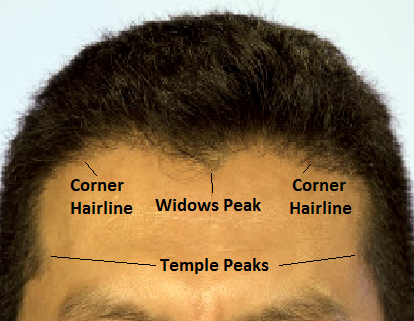
Where Are the Temples (with photos)?

Hello doctor, I have a 2 part question:

I am confused about the location of temples. I’ve been reading many of the previous posts here and I’ve heard you say a few times that people get the temples/corners mixed up and that the temples are above the ear. What I would like to know is: where exactly are the temples/temporal hair? I am having trouble understanding this. Also, I know what vellus hairs are but I see some hairs that are longer than 2 mm (what you said were the max length for vellus hairs) that are sort of whitish near the part of my head I assume to be the temples (right near the corners).

The leading edge of a hairline often has small vellus hairs that never grow very long. Behind this there are soft one hair follicular units and behind those are two and three hair groups. It is the two and three hair groups that make our hair look full. For purposes of definition, I have put a picture of a patient where we transplanted everything in the front of his head. Notice a soft hairline that is not a line but a zone that is irregular and reaches back to fuller, more dense hair. Many of our patients tell us in emails that they are losing their temples, but what they are saying without knowing, is that they are losing their hairline as this man did.

hairline labels