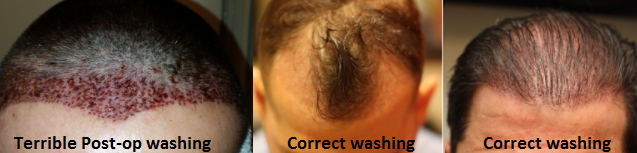
How does my FUE recipient area look? (photos)

You have excessive crusting as a result of poor post-operative washing techniques, or absence of them. An FUE is treated just like a regular hair transplant with regard to the recipient area, but the donor area has open wounds which require daily washing with soap and water. Within 3 days of surgery, you can resume full activities, heavy exercises if you wish. The recipient area requires daily washes as well to keep the recipient area free of crusts. I generally recommend the use of a sponge and supply my patient with a surgical sponge to fill with soapy water and press on the recipient area daily. By repeating this daily, all crusts can be washed off without any fear of losing grafts. IF any crust are present, use a Q tip and dip it into soapy water, and roll it on the crusts and that will lift them off without dislodging them, but never rub them, just roll the Q tip on the recipient crust. I like to see no evidence of any crusting in the recipient area and the crusts from the donor area gone in 7-10 days with daily washing much like the two patients on the right.

I don’t like the idea of anyone removing grafts that have scabs on them because we have published a paper in a formal medical journal, that when a person pulls off a scab (crust) from a recipient area in less than 12 days, the risk of losing the graft is very high. Put a shampoo on your head and let it sit for 10-15 minutes, then gently work the crusts with your fingers. This will take days to get the crust off so that you do not disturb the grafts. See the medical paper we wrote in a major journal below in the web reference that proves my point. Look at the two patients on the right, both one day after FUE sessions and both clean without crusts.

poor and good wash

FUE Questions

Hi,
I am seriously thinking of having a FUE procedure during the next 2-4 months. I’ll appreciate if you can please help me with the following info.
1. How do i know if i am a suitable candidate for FUE?
2. How long do i have to wait after the test to have the procedure?
3. how long do i have to wait after the surgery, before i can go about my business?
4. I see that you have a special offer going on now, what is the final per graft price after taking into account the travel reinbursement and your offfer?

There are many things to consider before deciding on any hair restoration procedure. I’ll answer your questions on FUE (Follicular Unit Extraction) first…

  1. At NHI we use the FOX™ test to determine if you are a candidate for FUE. The FOX test lets us know how easily viable grafts can be extracted. If there is a high percentage of viable grafts, you would be ‘FOX positive’.
  2. The FOX test can be performed any time before surgery. There is no waiting period once you have had the test.
  3. Patients have different tolerances for surgery. Many patients go back to work the next day, others wait a day or two. As long as you follow the post operative instructions, you can resume your daily routine as soon as you are ready.
  4. The 2005 summer special fee applies only to traditional strip surgery. Travel expense reimbursement is up to 5% of the cost of the surgery.

Some of the other considerations to keep in mind are FUE is a good choice for patients who:

  • Need a small amount of grafts
  • Do not have an advanced balding pattern
  • Those who want to wear their hair very short
  • Those who have a very low donor supply, a scarred donor area, or very tight scalps
  • Patients who tend to heal with wide scars
  • Athletes who must resume full activity soon after the procedure

BUT, most importantly, continue to research, make sure all of your questions get answered, insist on seeing patient results in person, and make sure that you choose a doctor who has your best interests in mind.

FUE question about framing my face

How far can I move my hairline down with FUE. I want to change the way I look and I was told that I need a lot of FUE grafts to get where I want to be.

There is no limit to how far you can bring your hairline down, the issue is to bring it down so that it improves your appearance and it is always normal. You need to work with an experienced hair transplant surgeon who can help you do this. FUE is now available in many surgeons hands, but make sure that they are experienced in it by asking to meet with some of their patients who had it done. We offer this every month at a monthly open house event were former patients can discuss the nuances of the hair transplant process as they experienced it. Here is an example of a perfect hairline that I created: https://baldingblog.com/norwood-class-7-pattern-patient-received-11000-grafts-plus-smp/


2019-02-01 15:26:47FUE question about framing my face

FUE over-harvested with scars and depleted donor area (photos)

More and more patients are experiencing over zealous surgeons who take out too many grafts from their donor area in doing FUE. I know that many patients want a lot a grafts so that they can get their hair back as quickly as possible, but pushing the envelope is a real problem as many men, who have donor densities that are not high, get this type of result and eventually may become bald in the back of their heads. If some of the hair does not recover (some of what we see is the result of shock loss), then the only option to treat this is scalp micropigmentation (https://scalpmicropigmentation.com/scar-covering/). I have discussed the limitations of FUE in previous posts here: https://baldingblog.com/2017/07/21/many-fue-grafts-many-fues-grafts-one-know-safe-limits/


2020-09-01 09:46:56FUE over-harvested with scars and depleted donor area (photos)

I Had an FUE and Now Have Scars in the Back of My Head (photo)

The FUE procedure depletes the donor area and can produce such scars as shown in your photo. If you let your hair grow out, the scars will be covered by the long hair. If you want to treat it, you can get Scalp Micropigmentation, which is very effective to mask these scars.


2018-04-18 08:09:12I Had an FUE and Now Have Scars in the Back of My Head (photo)

Why Is FUE Not a Popular Surgery? (from Reddit)

As the person who pioneered FUE, it is now the most popular hair transplant done worldwide. The doctors starting doing FUE when I published the first paper on the subject here: https://baldingblog.com/wp-content/uploads/pdf/mp-2002-fue.pdf. The public started to demand it, and within a year, doctors from all over the world were offering it but were doing it very poorly. Then, I licensed the hair transplant robot that we invented in 1998 to hopefully standardize the FUE. Over time, instruments got better and better and so did the doctors. Now, in every country in the world, FUE is a standard procedure for hair transplantation. Be careful as not all doctors perform FUE well.

Why aren’t FUE transplants a bigger deal? from tressless


2018-09-24 06:24:25Why Is FUE Not a Popular Surgery? (from Reddit)

FUE: More Automation and Physician Integrity (Part 4 of 4)

This is the last part in the series about follicular unit extraction (FUE). Here are the previous posts in this series — part 1, part 2, and part 3.

Neograft:

We have heard a great deal about the Neograft automated system. This system has two components to it:

  1. A sharp drill that provides controlled torque. It is a manual system requiring a very skilled operator.
  2. An implanter is part of the Neograft system and it uses an implanter invented by Rassman (patent #8062322) that works nicely.

The advantage of the Neograft system is that an implanter is offered, which is not present in the ARTAS system. Traditional implantation with forceps requires specialized skills and the greatest cause for failure or death of the grafts occurs during the implantation process. The neograft implanter, can be used effectively by an inexperienced person, therefore it is relatively easier to learn when compared against the use of forceps. The inexperienced surgeon or technician will probably get better graft survival with the implanter. When compared with a skilled experienced technician’s competence with forceps, I suspect that the two techniques will be comparable.

The manual drill requires expertise, and with the unit as designed the grafts have a tendency to dry out, possibly killing them before they get implanted as they are held in a chamber that has a high hair movement in it. As discussed before, air kills grafts as they dry and this killing process may take only seconds when there is substantial air flow in graft held in a chamber. Neograft associates with a private group of technicians that perform much of the procedure for the unskilled doctor, creating the illusion that the doctor is skilled in the process. If these technicians drill out the follicular unit, they will violate the laws in most states. Most doctors who use the Neograft system depend upon the technician teams to do the actual transplant procedure.

Other drills are supplied by a variety of device manufacturers. Dr. Harris employs a dull drill and his device is amongst the most popular of the devices that are manually driven with great success. He offers training for doctors who purchase his system. Drills with sharp edges are many and they differ only marginally from each other. Extraction speed varies with each surgeon and each instrument. There is no substitute for skill, and the skills for all instruments on the market (other than the ARTAS system) requires possibly years to perfect. Speed of extraction depends upon the surgeon’s skills and it varies between 200-1200/grafts per hour on average. The damage to the grafts varies with the surgeon, so speed tells you little about the skills of the doctor as some doctors kill more than 50% of the grafts in the extraction process.

Technology vs Skill:

The New Hair Institute uses a specially designed serrated system that is not connected to a drill. This instrument was designed by Dr. Pak and it is made by a machine shop that specializes in fine stainless steel instruments. We have gotten good value with this tool, pacing ourselves at over 1000 grafts per hour and producing little damage. Our speed of extraction in 80% of patients, exceeds the speed of almost all other such extraction tools in our hands.

All too often, patients focus on the technology, not the skill of the surgeon. Only the ARTAS system does not require surgeon skills as the robot cores out the hair grafts with minimal involvement by the surgeon as the robot does it all once it is set up. The ARTAS system does require manual graft removal and the difficult job of graft placement must be done by people with extensive experience in the field using forceps or possibly an automated commercial system called the Choi Implanter. Generally, it takes between 1-3 years to develop placing techniques that allow speed and minimize damage to the grafts.

I can not end this story without discussing the integrity of the doctor. Doctors tell you what they want you to hear — that they are the best at FUE, that they get less than 2% transection rates, that their vast experience makes them better than everyone else. Can you or should you believe what the doctor is telling you? I know for certain that many doctors claim expertise in FUE, promise minimal damage to the grafts, or even close to 100% growth rates, etc. The reality is that every patient getting FUE differs in their results and we published these differences in patient dynamics in a medical journal publication, which is the only such formal publication out there. I have seen some awful results with FUE and failures close to 90% in some patient. The proclamation of the doctor’s skills by the doctor is a reflection of their integrity. There is an old adage that if it sounds too good to be true, it is.

So in conclusion — be skeptical, use your skills in evaluating your doctor’s integrity as your guide as to what you can believe and what you can not believe. I look forward to comments from our readership.

FUE / FIT — Minimally Invasive Hair Transplants

Hello Dr Rassman,
Firstly I would like to congratulate you on this website. Its very helpful. I am due to have a FUE transplant (1000 follicles) next month at DHI in Athens. I have read your comments relating to DHI and the importance of a good surgeon.

I know that you normally refrain from doing this but I would really appreciate it if you could please recommend a paticular doctor (whose work you know of) at DHI. I am really freaking out now about getting an incompetent surgeon working on me. I realy dont want to make a wrong decision. I will not dislose your recommendation in any way at all to anybody. Thank you.

I do not know any of the doctors at DHI, so unfortunately I can not help you with that. I am told that they have switched completely to FUE and away from strip harvesting. Frankly, that makes me nervous, because of the complete absence of biopsies to qualify patients. DHI was taught by Dr. Cole, who calls his procedure Follicular Isolation Technique (FIT), which is a sub-set of what I call FUE. Dr. Cole, along with DHI, tell me that 100% of patients qualify. The FUE techniques are a series of processes that are fine tuned in each patient, as each process works uniquely in different patients. Dr. Robert Bernstein and I just wrote a chapter in a new text book on this very subject (due to be published shortly). FUE is an intricate process that requires a series of approaches, each matched to the patient’s tissue characteristics. Last week, for example, I performed an FUE procedure and prior to that procedure on an earlier visit, I used four different methods to optimize the process. One tool worked consistently at 100%, while others methods had failure rates in the same patient ranging from 90-20%. At the time of the surgery, the actual success rate was 88% based upon hair counts. For this very reason, I am absolutely convinced that biopsies are needed to qualify patients and match the techniques that work on that patient prior to the actual FUE surgery. On a few patients, FUE surgery is either not possible or so inefficient (taking a few hours per hundred grafts harvested) to make the process not a reasonable alternative to strip harvesting. Depending upon the technique used, patient eligibility ranges from as high as 95% of all patients in some doctor’s hands (very few doctors fit into this category and this group includes those patients who may not be efficiently harvested) to less than 30% in others.

What bothers me is that some doctors have a loose definition of FUE success. Some doctors may classify 100% success as his/her ability to extract at least one hair in an FUE graft. That does not cut it for me, because I classify success by hair count. That means that if a 3 hair graft was excised with FUE, some doctors would call a single hair extracted and two hairs killed off as 100% success while I would call it 33% success (actually this does not quantify the loss of hair, the negative value of hair that is lost forever). Probe the doctor’s definitions here and get an accurate count of what he did when he does the procedure, as you are entitled to that as part of your medical record. If the doctor does not give it to you or tells you that it does not matter, run for the hills. It may sound like technical talk, but the realities of what you get and what you pay for and what is destroyed by the process all come into the value equation. Again, as I always say, let the buyer beware!

FUE Information Request

Dr,
I recently saw you on channel 4 news describing a new procedure of hair transplantation where there is no incision done.I have had procedures done going back 15yrs.Approximately 5500 of the old grafting technique.my frontal hairline and down the middle needs to be enhanced.I still have gaps and have lost more hair since my last procedure 8 yrs ago.Could you please tell me a little bit about the new procedure or where I can read up about it. I should also set up a consultation appt.
Thanks

You are referring to the news item from April on the FOX Procedure, also known as Follicular Unit Extraction or FUE. This is a technique that I introduced in the medical literature in the summer of 2001, and published in 2002 in an article titled Follicular Unit Extraction: Minimally Invasive Surgery for Hair Transplantation. The procedure essentially removes the follicular unit one by one without a traditional incision. More information can be found on newhair.com: FOX Procedure, FOX Megasession, and Medical Publications. Newhair.com is probably the most comprehensive hair restoration-related site in the world, with the greatest amount of original content and patient photographs, so please poke around the site to see exactly what we offer.

The FOX Procedure is an exciting new technique for minimally invasive hair transplant surgery, but it is not for everyone because:

  1. the costs are higher
  2. it is better for less bald people
  3. it is very difficult to perform and very few doctors are willing to step up and build the expertise
  4. not all patients are good candidates for this procedure because of the type of collagen that they have in their connective tissue (10% of people are in the category).

The procedure has the advantage of having almost no post-operative pain, and very fast healing with full activities within days of the surgery.

As you are local, I would recommend that you visit me in my Los Angeles office, which is only about 8 miles away.