2018-02-15 06:06:352018-06-22 13:07:16My First Transplant Is Not Thick Enough (Photo)
Hi doctor, I have been recently been encountering certain problems with my hair over the past 5 months, I am 16 years old (male) and currently starting my first year of college. First signs of change were with the texture and build of the hair, as it started to become much drier and thinner. Then the amount of hair that started to fall out naturally started to drastically increase, although I have naturally thick hair the changes that I am experiencing seem too unnatural, one example is the fact that I never really used to be able to see my scalp, now I am really feeling concious about it. I have great foundations of friendship in the school that I go to and the worry of acceptance isn’t preying on my mind too much. I have asked my best friend about it and she seems to see no difference in the appearance of my hair, but I still believe there is something wrong.
My grandfather had troubles with baldness as a teenager and was completely bald on the top of his head at age 20. Confident self image is something that I always like to pursue, I style my hair using straightening irons and using gel based products, which I have been widely recognised at school for, for the past two years. A balding head it something that is not really seen around my social groups, and I’m not quite sure how my friends would react. I haven’t consulted my doctor about it and I would really like some impartial, friendly advice on what to do next, whether I should consult my family or keep it quiet and hope it will go away. I would really appreciate your help in this matter as I have only spoken to one person about this and I haven’t been able to research it myself much. Thank you
Go get your head mapped out for miniaturization, which will show if you are in the early phases of genetic balding. Especially at your age, it is too important to guess or work the answer blindly through the internet.
Dr. Robert Haber had a 67 y/o female patient for two years and she was taking 0.625mg minoxidil/day. She was in a minor fender bender accident with no evident physical damage or harm from the accident and no airbag deployment. She developed chest pain and in the Emergency Room after an extensive examination demonstrated that she has a pericardial effusion (‘water around the heart in the heart sac’). The doctors did not connect the accident and the cardiac problem identified, but knowing that oral minoxidil can produce this complication, her minoxidil was immediately stopped. Slowly the effusion subsided. This is a warning that a is known complication of minoxidil on higher doses. It was previously thought that doses 2.5 mg or less per day was safe from this complication. This may not be the case even at doses under 1mg/day. This is a risk everyone taking minoxidil should know about.
Now with that said, it is possible that this patient could have had Covid which is known to cause pericardial effusion. Even the vaccine has, in rare cases, caused pericardial effusion so maybe, just maybe the pericardial effusion was from another cause other than minoxidil. Here is an article that suggests a connection with Covid and pericardial effusion: https://www.statnews.com/2021/06/10/officials-higher-than-expected-heart-inflammation-cases-covid-19-vaccination/
2021-06-10 17:42:342021-06-16 12:33:09First patient identified taking 0.625mg oral minoxidil daily and developed Pericardial Effusion
http://www.koreabiomed.com/news/articleView.html?idxno=10914
The focus on the drug is to create or enhance collagen production. I was able to find some articles in support of hair growth claims, they are:
https://pubmed.ncbi.nlm.nih.gov/32255530/
https://onlinelibrary.wiley.com/doi/abs/10.1111/jocd.13729 (medication delivered by injection)
https://www.sciencedirect.com/topics/pharmacology-toxicology-and-pharmaceutical-science/dexpanthenol (a review of more articles)
https://www.webmd.com/vitamins/ai/ingredientmono-853/pantothenic-acid-vitamin-b5
2021-04-16 01:29:062021-04-16 06:31:56First new drug for hair loss released in South Korea
Guillermo started his FUE in 1998 and followed his hair loss with us since then. As he got older, he lost the central forelock which shows prominently in the before photos that he is holding. As you can see, his FUE is nothing short of normal looking. We published the first article in the world on FUE in 2002 based upon 6 years of clinical research and the rest is history. Every hair surgeon in the world, having read the article, started performing FUE. It took years for most hair surgeons to perfect the technology.
See original article here: https://newhair.com/wp-content/uploads/2018/11/mp-2002-fue.pdf
2019-02-11 11:08:532019-02-20 08:28:13This Is the First FUE Patient in North America
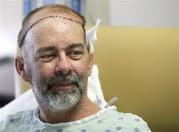
Opening a new frontier in transplant surgery, Texas doctors have done the world’s first partial skull and scalp transplant to help a man who suffered a large head wound from cancer treatment.
In this photo taken on Wednesday, June 3, 2015, James Boysen is interviewed in his hospital bed at Houston Methodist Hospital in Houston. Texas doctors say he received the world’s first skull and scalp transplant from a human donor to help heal a large head wound from cancer treatment. (AP Photo/Pat Sullivan)
I would guess that he received radiation for a brain cancer and that his scalp and skull had necrosis (death) that left him with no or a poor cover for the top of his head, leaving the skull and brain potentially exposed. This can be onerous. Assuming that I am correct, something like this would be lifesaving. This would not be a substitute for a hair transplant so for our readers, I wouldn’t rush to Texas to have this done. It is, nevertheless, interesting to read about.
I am 34 years old and I have a receding hairline. Now, I am getting a bald spot on the top of my head. What should be my first course of action to save my hair?
The first course of action should be to see a competent doctor who understands the male pattern balding (MPB) process. He will examine the hair on different parts of your scalp and look for the amount of miniaturization that you are showing in various locations. The things he will identify will not be the level that you can see with the naked eye as balding occurs slowly and insidiously and can not be picked up without high powered examination of the hair. Based upon a proper examination, he should develop a master plan for you that will cover your worst case scenario and probably include the use of medications for MPB if that is your diagnosis.
Hi Doctor,
At age 23, I started taking Propecia. I soon switched to Finpecia made by Cipla to save on costs. For three years things were great. I regrew hair on my crown, no more small baldspot and no noticable hair falling out whatsoever. It was everything I hoped for.
This January, after aproximately 3 years on Finpecia, I noticed my hair thinning out and everyday I see that I am losing hairs. I still have decent coverage on the crown but my hairline is receeding and it’s definitely thinner coverage all over.
I’ve been taking some supplements such as saw palmetto and been using 2% Nizoral. I’m wondering if adding Rogaine Foam may be to some benefit.
Also wondering, if in your experience, you think I should get back on the name brand propecia. I’ve been getting the Finpecia from a reliable online pharmacy that requires a prescription and is “certified”, but I wonder if the quality of drug is different.
Thanks for your help and I appreciate this blog.

For those readers not familiar, Finpecia is a generic Propecia (1mg finasteride) made in India by Cipla — the generic 1mg isn’t available legally in the US yet due to patent laws. And just like Propecia, it does not continuously work for everyone. Many men on finasteride will see results for 5-10 years (or beyond), but each case is different. You need to see your prescribing doctor about the reduced impact of this drug. I think you should still stay on the medication, because if you stop it you will likely lose a great deal of hair.
Cipla is a huge pharmaceutical company and I doubt there’s a difference between the generic and the name brand finasteride.
As for adding Rogaine Foam, I suppose it’s worth a shot. You might see some benefit, but I can’t say for sure.

Hello Dr.Rassman,
I am a 29yr old caucasian male who has over the last few years been dealing with questions of hairloss. Thus far there is nothing dramatic to speak of – no noticably thinning or balding areas. There is however one thing that has led to a good deal of concern – it can best be described as light or whispy hair around the frontal hairline (from temple to temple). My hair has always been quite fine in nature and until a few years ago a light brown color rather than the dark brown it has become. In recent years I have grown my hair out quite long – opting for the ‘rocker’ look as friends call it. If I pull my hair back I dont notice any loss at all – it looks like a regular hairline – but the hairs that make up the first cm (rough estimate) are lighter in pigment and fine in composition compared with hairs deeper in the scalp. Aside from the minor difficulties this phenomenon creates when attempting to style my hair I’ve been wondering if this is an example of the ‘miniaturization’ process that you have described. I have no signs anywhere else of this phenomenon – just the fringe of the frontal hairline. No crown thinning, no overall diffuse thinning, no temple thinning – and that is what is driving me crazy! If it were more extreme I would be prone to take some action be it drugs, topicals or other treatments. With this said however the lack of action kills me just as much because I wonder if I’m not acting when I should be – nipping my possible hairloss in the bud so to speak. Please let me know if you feel this is an example of ‘miniaturization’ or not and any course of action I should consider taking. Thank-you.
To really answer your question directly, you should be examined and have your scalp mapping of your hair for miniaturization, which is best done under magnification with a visualizing high power microscopic tool, like our densitometer. Fine hairs often exist in the very front of the hairline, but in regards to what you refer to, I am not sure if you mean the mature hairline that has probably evolved from your child hairline (age 10 or so), which is often lower and thicker. I would want to see pictures and possibly meet with you in person to make such assessments. If you’d like to send photos, you can email them to the address on the Contact page.
2005-12-07 15:01:072005-12-07 17:03:55Finer Hairs at Hairline
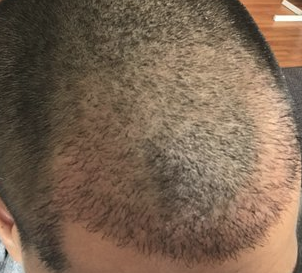
Yes, it is not unusual to thicken up the transplant with a second hair transplant, especially people with fine hair. Mechanically, there are limits to how close one can place grafts in a first surgery but on a second surgery, the surgeon goes between the previous grafts and this will double the density. After the next surgery, you should look good.