Does Estrogen Protect Women from Developing Male Pattern Hair Loss?

Doctor, I was thinking of something today. Females lose hair genetically too like female pattern baldness, but how come its not as common like men to lose hair? I mean there are females with bald fathers, grandfathers, uncles and brothers, but they never lose hair genetically?

If a man has so many bald relatives, there is a strong chance he will lose hair too, but the women tend to still keep their hair when the men in their family are all bald. Is it the estrogen that protects the hair?

There is no evidence that estrogen protects women from developing hair loss in the standard male patterns. The reason for female pattern baldness is not well understood.

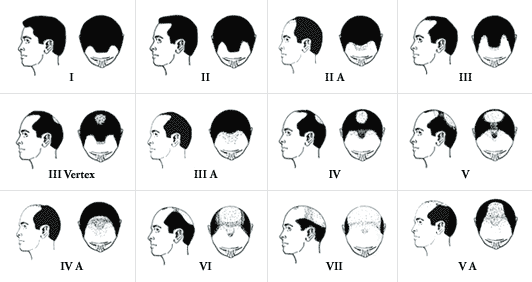
Male pattern baldness is just what it says — it is a male problem and it occurs in patterns that can be visually seen, as graded on the Norwood scale. Women with genetic hair loss do not generally develop patterned balding, or if they do, the patterns do not usually follow the Norwood scale for men. Genetic hair loss in women, also called female androgenic alopecia, can at times be seen in a pattern that is graded on the Ludwig scale. Other times, the hair loss is diffuse.

Fortunately for men, finasteride is a good medication… but for women, the only decent medication is topical minoxidil.


2013-07-02 17:30:58Does Estrogen Protect Women from Developing Male Pattern Hair Loss?

Does eating steak, reverse hair loss?

I stumbled upon a video a month ago with over a million views where a doctor talks about how to regrow hair, and the main conclusion seems to be that eating steak will fix your hair, delivered with just enough half-truths to seem convincing. I’m not even a vegetarian, but this carnivore cult stuff is getting on my nerves. Is there anything to this claim?

Steak doesn’t reverse the genetics and the chemistry of hair loss. The internet is full of misinformation, that is clear.

Does Early Norwood Class 6 Mean Class 7 is Inevitable?

Norwood 7A question about hairlines.

When i go bald is my hairline pre-determined or does it continually recede my whole life? for example I am 18 and thinning. If i am class 6 by age 25 will i stay that way the rest of my life because that is my determined hairline? or does it just keep receding my whole life until i die.

So if i’m 18 am I going to definatly be class 7? or do i stop where i’m supposed to?

In other words does having an early class 6 mean that 7 is inevitable?

Only about 7% of men develop Norwood Class 7 patterns and most of the Class 6 patterns that are developed will remain Class 6 patterns throughout life. To see all of the Norwood classes, click here.


2008-12-17 13:35:13Does Early Norwood Class 6 Mean Class 7 is Inevitable?

Does Dying Gray Hair Lead to Faster Graying?

How true is it that when you color your grey hair, you will grow more grey hair faster than not coloring. I have been getting different answers from the web. I need your opinion. Thank you.

It’s not true at all.

Hair color is the result of pigmentation due to naturally occurring chemicals (primarily melanin). These chemicals are present at different levels, thus giving hair its distinctive color. The more melanin present, the darker the hair; the less melanin, the lighter the hair. Hair color changes as we age, going from their natural color to gray and then white. The color change occurs when melanin is no longer produced in the hair root and new hair grows without pigment. Coloring the hair has no effect on the rate of graying and on the deposition of melanin in the hair shaft — it just affects the hair above the skin.


2008-02-20 09:22:23Does Dying Gray Hair Lead to Faster Graying?

Does Dutasteride Increase Hair Loss at the Hairline?

Hello

I’m fully aware of your position on Dutasteride as an unapproved hairloss treatment, however, I wanted to ask if you knew anything regarding Dutasteride increasing a recession of the hairline. I was prescribed Avodart off-label for a DHT-inhibitor for my hairloss (which is only at the hairline/temples) and have since seen no results other than a progression in my receding hairline.

I’ve read many hairloss forums/blogs where those taking Dutasteride have reported and increase in loss at the hairline. I’m aware that a 0.5 mg dose of Avodart decreses scalp DHT 16% more than a 1mg dose of Finasteride (54% versus 38%, respectively), yet increases scalp testosterone 104% while Finasteride only increases testosterone 24%.

Could Avodart’s dramatic increase in scalp testosterone be harming hairlines? Is there any reason why many people’s claims could hold true – that Dutasteride is bad for hairlines? Or, should one continue with Avodart for several months to hold out for the possibility of regrowing what is “shed” or lost from taking it?

Thank you for your food for thought. While it is interesting that you noted this, without data from the pending FDA study, there is no way to have real answers to your questions. You should take any claims made on the internet with a grain of salt, particularly when the information comes from various forums (where it unfortunately seems that many members like to play doctor).


2008-03-18 08:48:43Does Dutasteride Increase Hair Loss at the Hairline?

Does DUPA first appear on the back and sides of the head?

No, Diffuse Unpatterned Alopecia (DUPA) is a condition that covers the entire scalp including the donor area (back and sides of the head). Because it is diffuse, the use of donor hair that is impacted for hair transplants causes the surgery to be very disappointing, if not a relative failure. For this reason, it must be diagnosed PRIOR to having a hair transplant. I have seen too many DUPA patients that had hair transplants and they looked worse after the hair transplants because of the poor donor area recovery and often acceleration of the hair loss elsewhere on the scalp.


2019-03-09 10:38:54Does DUPA first appear on the back and sides of the head?

Does Drug-Induced Hair Loss Fall Out the Same Way as MPB?

Dear Doctors:

I am a 22 year old male with mildly active Crohn’s Disease and in the next few weeks I hope to be going on Humira. I know that both the disease and the Humira can cause hair loss.

My question is this: Does hair loss from drugs and disease miniaturize and fall out in the same fashion as MPB? I would like to know if there is a difference, because if it’s the disease/drugs, I can’t do anything about it and no need to waste money on it either. Thanks for reading.

The biggest difference is that in male pattern baldness, there is a pattern to the hair loss, as seen in the Norwood classification chart (see below). Drug induced hair loss is usually generalized loss all over the head without a pattern.

Norwood chart


Does Drinking Alcohol Contribute to Hair Loss?

Hi Dr. Rassman,

I am a 26 y/o male in the early stages of genetic hair loss. I have a quick question for you. Does the consumption of alcoholic beverages (whether it be beer or liquor)contribute to hair loss if you have genetic balding? Also does smoking cigarettes cause hair loss if you have genetic balding? Do they have a synergistic effect if used together? I notice that everytime after a night of drinking and smoking (I only smoke when I drink), more hair tends to fall out the next day. I looked through your past postings but did not see anything relative to this topic.

Also, are there any hair transplant doctors that you could recommend in the DC/MD area or the NY area?

I appreciate your help Dr. Rassman, I read your blog everyday!

With people who drink excessively, diet and vitamin deficiency commonly becomes a cause for hair loss. After heavy drinking, there are stress reactions that can precipitate hair loss. The more of these bouts of drinking, the greater the stress on your body. Drinking does impact the liver and the liver is a critical organ in managing hormones in your body’s metabolism. As for smoking, please see previous posts regarding that.

Dr. Robert Bernstein has offices in New York and New Jersey and is a great hair transplant doctor.


2006-10-18 13:53:41Does Drinking Alcohol Contribute to Hair Loss?

Does Dr Rassman Think He Is One of the Best Hair Transplant Surgeons in the World?

Dr.Rassman, this question may sound ridiculous and from looking at your replies to many questions on this blog it seems you are a very modest person. My question is, would you say you are the best hair transplant surgeon in the world. you have the most extensive collection of before and after photos which i must say have not failed to impress. also i have looked on hundreds of other sites and they dont have even half the amount of photos you have., or (evidence) as i say. John lennon once said ‘we are the greatest band in the world and the greatest songwriters, we have had more number ones than any other artist’, what i think he is saying isnt arrogant he is simply saying that they have more number ones than any other act. as you have the best results and more results than any one else would you say for arguments sake you are at least one of the best hair transplant surgeons.

I don’t mean to toot my own horn, but the International Society of Hair Restoration Surgery (ISHRS) awarded me with the 2004 Golden Follicle Award, which reflects what the doctors around the world may think about me. Only about 14 physicians have ever received this award in the history of the society. Our hair transplant organization has outpatient surgery facilities which are certified by the Accreditation Association for Ambulatory Health Care (AAAHC), which is a national accrediting agency for outpatient surgery facilities and holds these facilities accountable to a known standard of care. In the field of hair transplantation, there is no requirement to build a certified facility, but I have been adhering to this standard for the past 10 years and every three years or so, we get a physician reviewer who comes in to judge the standard of care, the outcome of our work, the infection incidence, the accident status, and the things that go wrong. If we have not met some minimum standard, we do not get the accreditation. Few hair transplant centers in the United States undergo this process, because it is a difficult standard to meet and the cost to adhere to their requirements on quality cost us well over $100,000/year. Even with this high cost, the comments of the reviewers guarantees that we are constantly observed and criticized to help us improve our quality of care. I generally tell those patients who are considering us to be their doctors, to check out any doctor that they are considering for such national certification. Our facility and our standards are the best and it is backed up by the accreditation of the AAAHC. What I’m getting at is that we strive for the best, and if people see us as the best, then we’re doing our jobs.

I thank you for your direct question, but although I like a pat on the back as much as the next guy, what I see, read, and hear from patients at our monthly Open House events (which we have been holding for over 15 years) says it all for me. I love the people side of this field… the doctor/patient interaction from the patients I meet. The diversity of my patients is what stimulates me to work, to listen, and to help them, and that is what makes me what I am, whatever it is.


Does Dr. Rassman Still Take Propecia?

Hi Doctor Rassman. Thanks for this very informative blog. My question is: Do you personally take propecia? and if so, for how long? Be honest about it lol

Although I’ve written in older blog entries that I took the medication, I actually do not take Propecia at this time. I used it for years starting when it first came out, but at my age I did not think I had progressing hair loss and eventually realized that the drug would not be too valuable to me. I know I’ve said that you run the risk of “catch-up” hair loss when stopping Propecia, but I did not believe that I benefited from the drug and the decision appeared to be correct when I did not lose hair after stopping it. I had no libido problems on the medication, though.

One of my sons takes Propecia daily and it clearly stopped his frontal hair loss, and in fact, he was the exception to the rule as it did regrow some frontal hair in the area that was heavily miniaturized. Frontal regrowth isn’t a common occurrence in most patients.


2010-03-23 10:11:39Does Dr. Rassman Still Take Propecia?