Does Dr Rassman Only Endorse Big Pharma?
Dr. Rassman,

Strictly for the sake of playing devil’s advocate with you here —

When you imply that products offered by non-“Big Pharma” companies are likely bogus or that you don’t buy into their efficacy because the only proof of their viability is based on their own self-promotion basically (i.e. your posts about Drs. Lee or Proctor or even laser product makers), isn’t that slightly hypocritical? I mean, your career and business is of course enhanced by people foregoing these alternate methods, so shouldn’t people just as much suspect an ulterior motive on your part?

I understand your usual answer that, without personally seeing the research, you cannot recommend one way or another on something. But frankly, were you physically present for the Big Pharma trials on minox or finasteride? I’m assuming not. Going a step further then, I assume you base your support for those “proven” products on the basis that you read their documentation — so how much documentation is necessary for you to believe a product is in fact what is says? Some of those non-Big Pharma products people have written in about have “some” documentation, though certainly not to the extent of the FDA mandated trials I’m sure. Where do you (or do you at all) draw the line?

Or is your ultimate argument that, “If [said product] were that good, a Big Pharma company would have picked it up?”

Thanks for your time, love your site (though I had to plead ignorance to my girlfriend when I recognized you on her favorite show “Jon and Kate Plus 8”, haha), your replies on these sort of issues just sometimes irk me — aspirin was discovered by a non-Big Pharma guy, after all.

Oh boy. I never said I needed to be there during the research study of a product to know it was true or not. No, I wasn’t physically present at the trials of the finasteride or minoxidil, but those medications are proven to work and FDA approved. The problem with many of the products I’m asked about is that they come out of nowhere — old wives’ tales, myths, etc. Most of them offer testimonials or mentions of a study, but offer zero evidence that the study was even conducted or if it was even valid. People write to me at this site every single day asking for solutions to their hair loss. Should I tell them to just go ahead and potentially waste their time and money on an unproven product while they lose more hair that they can’t get back… or should I let them know about medications that are proven to be effective?

I have no bias to solutions produced by the large pharmaceutical companies. I look at everything that is offered in this field by the evidence that is produced for me to review. I have, for example, evaluated the hair laser and found that the actual research was inadequate to recommend that patients use the laser for hair growth. I even took it one step further and acquired a large laser system and tried it for 12 months at my cost for as many patients as I could find willing to be studied (for free). The results were clear that the Low Laser Light Therapy (LLLT) had no value to those patients that were studied by me. If I would have found otherwise, I could recommend this treatment and charge for its use (making money), but I can not do that if I am not convinced that it will work. I learned from the days I was a boy scout that “honesty is the best policy”, and I guess I am an old-fashioned clinical scientist.


2009-12-08 10:02:56Does Dr Rassman Only Endorse Big Pharma?
Is it accurate to say that Donald Trump is significantly bald and relies on an expensive wig?

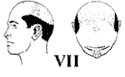
The evidence I’ve compiled indicates that Donald Trump exhibits a Norwood Class 5-7 balding pattern (the Class 7 pattern is depicted below). It appears that he underwent multiple surgeries, leading to the relocation of much of his remaining hair to conceal the frontal and top areas, albeit with limited success. Since Propecia was not available when he underwent scalp reduction surgery in the early 1990s, most men undergoing such procedures or hair transplants before 1997, when Propecia first came to the US market, experienced accelerated hair loss progression. Unfortunately for Mr. Trump, this would likely result in the development of an advanced pattern, such as the Class 7 pattern illustrated in the following graphic.
New York City-based cosmetic surgeon Gary Linkov believes that the politician may have undergone five separate hair-transplant surgeries (https://www.newsweek.com/donald-trump-five-hair-transplants-gary-linkov-1832991). I know that Donald Trump received Scalp Reduction Surgery sometime in the early 1990s when this barbaric surgery was a standard treatment for hair loss found in the top and crown of the head. I know its barbaric nature because I had three of these procedures over 90 days. By its very nature, Scalp Reduction Surgery attempts to surgically remove the bald area, stretching and thinning the donor area (the rim of hair around the head). Add to that the claim by Dr. Linkov that he believes that Trump had 5 hair transplant surgeries, likely in 1990 (before FUE was invented), suggests that most of his residual native hair (that should reflect a rim of thick hair going around the back and sides of the head) was moved into the balding area, thereby depleting his natural rim of hair from his balding pattern.

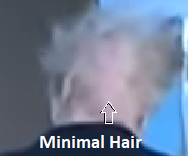
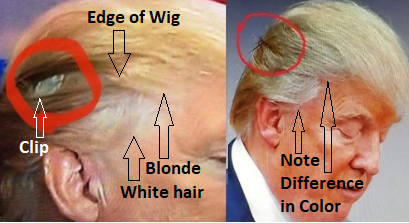
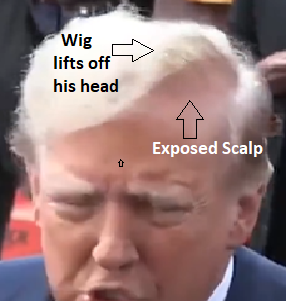
Photos of Trump boarding Air Force One reveal that the back of his head doesn’t seem to have much hair, suggesting minimal hair in that area where he should have had a strong rim of hair 3 inches high. Additionally, recent footage this week shows exposure of his frontal hairline, a characteristic often associated with wigs (hair systems). It’s common for such hair systems to be secured using glues, weaves, and hair clips. Considering the cumulative evidence of (1) the lack of hair at the back, (2) the exposed scalp in the front as what appears to be the lifting of his hair system from environmental factors like wind, and (3) the use of clips behind the ears used to secure a hair system in place, (4) the effect of multiple hair transplants on a Class 5-7 patterned balding man’s rim of hair, and the difference in color of the side hair (gray) from the top hair (blonde), it’s reasonable to conclude that Mr. Trump likely uses an expensive hair system. This system may involve gluing it to his scalp, weaving it with residual native hair, and using hair clips to secure it on the sides, where most of his remaining hair is likely located. Such hair systems often require regular adjustments every 2-3 weeks to accommodate the growth of native hair and then reattaching them. The hair is synthetic or human hair used to make hair systems and is often fixed on a lace platform, which is then glued to the scalp. The effects of these ‘lace’ systems are very effective if you maintain them properly. I have seen him pull back his hair in front of a camera on a late-night TV program that looked completely normal, consistent with a lace hair system.


The above photo reference showing his frontal scalp, see here: https://www.msn.com/en-ca/news/politics/concerns-raised-for-trump-s-hair-after-it-is-seen-flapping-in-the-wind/ar-AA1nHveb?ocid=mailsignout&pc=U591&cvid=2dc0422ef6d34569b9baf6f70de0fac9&ei=32


Below are some other interesting posts on this subject:


Does Diffuse Loss Eventually Stop?

Hi. I wonder if diffuse thinning stops or if you’re losing it diffusely, are you’re sure to end up a NW 5/6? I mean some people’s hair loss stabilize at one certain point like NW3 (like my dad who’s been a NW3 for about 20 years). But if you’re a diffuser, does the same thing happen?

Thanks.

You need to be examined by someone with competence in genetic hair loss and who can predict the hair loss based upon miniaturization and bulk analysis. Without an examination, I couldn’t say one way or the other if your diffuse loss would cause you to finalize to a Norwood 5 or 6 pattern.


2011-12-08 17:01:20Does Diffuse Loss Eventually Stop?

Does DHT Type I Cause Hair Loss?

Finasteride lowers type II DHT while Avodart lowers both type I and II. Does the amount of type I DHT have any effect on hair or it is only type II that may cause hair loss?

Thanks.

We answered this years back here. Short answer — it’s been proven that type II is linked to MPB, but type I hasn’t been linked.

Does Cutting a Month of Proscar Really Lose Effectiveness?

Does cutting Proscar a month’s in advance really reduce its effectiveness?

Cutting a month of Proscar pills (5mg finasteride) in advance could reduce the effectiveness like any pill would if exposed to air and humidity for a prolonged period of time. I don’t know what the exact point is that the medication starts to degrade, but that’s why I suggest splitting one pill at a time. The protective coating on the outside is what extends the life of the medication, and a cut pill obviously loses some of that.


2010-10-05 08:51:18Does Cutting a Month of Proscar Really Lose Effectiveness?

Does Couvre Cause Hair Loss?

Hi Dr. Rassman
Great site…thanks for helping out so many concerned men and women. I am a 42 year old male, with Norwood class III hair loss. I had 2 hair transplants about 10 years ago at the temples, and was happy with the results(they have taken me back to a norwood class I or II look). Now my hair is thinning more in the centre. I use a scalp covering paste (couvre) applied with a sponge, that does a great job of helping to cover the thinning area…but I am wondering if using this will cause my hair to fall out even more? Also, I read that most men slow down or stop their hair loss in their mid 40’s..my hair loss is starting to pick up again over the last year. Can I use products like minoxidil with products that colour the scalp?
Thanks for your help.

CouvreI highly doubt Couvre causes hair loss. You can use minoxidil with scalp coloring agents. For more on Couvre, see their site here.

I suspect you are losing hair due to general male pattern hair loss as it is a progressive process (something we do not like to admit). Hair loss should slow down as we age, but it still happens in men at all ages. There is no rule or exception if it is happening to you. You may consider seeing a doctor for a good diagnosis and you may be a good candidate for finasteride (Propecia/Proscar).


2007-08-31 13:33:50Does Couvre Cause Hair Loss?

Does Closing a Strip Scar Cause the Crown to Be More Visible?

Does the crown stretch when closing a FUT scar?

Hi there – First off I would just like to thank you for providing this excellent resource. I just have two short questions related to FUT scars:

1) Firstly, I know you have answered this in the past with hairlines, however since the crown is within inches of the incision site above the prominent bone, does it slightly move/stretch downwards towards the incision site once the scar is closed?. For example… I have some thinning in my crown but im lucky in the fact that it doesnt dip low at the back so its not very visible unless looking from above my head. If I had a strip procedure would this thinning crown be more visible from the back because the skin has been pulled down to close the strip wound?

2) Secondly, I believe avoiding strenuous exercise is recommended for about a month after the procedure to avoid scar widening, but is general head tilting and looking downwards in the weeks after surgery ok in terms of putting stress on the scar?

I would be most grateful for any response you have for the above questions. Kind regards.

Strip scars placed in the true donor area in the back of the head should not impact the location or the size of the crown area. Strip surgery takes up laxity that is there at the time of the surgery. Bending your head should also not impact the crown area.

I have never been sure why we tell the patients not to lift heavy weights. If there is a pull from the muscles, it comes from the trapezius muscle, which inserts below the scar at the base of the skull. I still tell the patients not to lift heavy objects, but I am not certain there is any value to the advice.

Does Bulk Measurement Depend on Hair Length?

A question about the hair bulk measurement tool – surely it’s dependent on the person measuring having exactly the same length hair every time a measurement is taken otherwise it’s going to produce inaccurate results?

I mean, great if you know your hairdresser can cut your hair the same length perfectly each time you want to do a measurement but realistically that’s not going to happen unless you use clippers which most of us don’t want to do.

Or does it not work this way? Am I missing something?

If not, then I’d think that a camera would be a better way of judging hair loss.

For the bulk analysis, you need to have an adequate length of hair (maybe 2 inches in length) so that the hairs can be bundled up and the bulk can be measured. Any adequate hair length will work the same, even if it is 3 feet long, because the measurement is made at about one to one and a half inches from the scalp. Think of a person bundling up a long pony tail. If you have more hair, the bulk of the pony tail will be much greater. As the measurement is limited to a point about one inch from the scalp, the longer hair will not impact the measurement.

We take a baseline measurement at the same coordinates of the scalp each and every time you return (12 months). If you cut your hair with clippers with a buzzcut style, you cannot do a bulk measurement. If you have gel or other products on your hair it will give a higher bulk reading, so we ask that there are no hair products on your hair when you come in for the analysis.

If your hair is very short, then we can always use a miniaturization study, looking at hair diameters at a microscopic level. Bulk measurement is doing it at a macroscopic level. These are all our attempts to measure an objective (not subjective) value of your hair status. The subjective measurement can be a simple before after picture of your head/face. The picture can be highly variable depending on lighting and angles. At NHI, we try to keep the angles and the lighting and the camera model, lenses, aperture, and external flash location as constant as possible.

Does Body Hair Relate to MPB?

Hi Doc!

Does male body hair, like chest hair and/or back hair, have anything in common with MPB? In other words, have you ever seen a bald/balding person without this kind of male body hair? (assuming he is not shaved)

I also wonder if a maturing hairline should be as thick as a juvenile hairline, or if it is common that it is a little bit thinner at the very front of the hairline.

I would really appreciate your expertise on these matters.

It seems at times that the bald men have bodies covered in hair, somewhat like a gorilla, but it is simply not the case. There is no connection between body hair and the loss of head hair, except to state that those with lots of body hair probably have good testosterone production.

The maturing hairline is as thick as the juvenile hairline, as long as there is no genetic hair loss in the actual hairline (no miniaturization). Sometimes, the mature hairline is thinner (at least it seems that way to me as I look at my mature hairline), but that is just a feeling. No facts on that subject to back up my ‘feelings’.


2007-01-29 13:49:41Does Body Hair Relate to MPB?