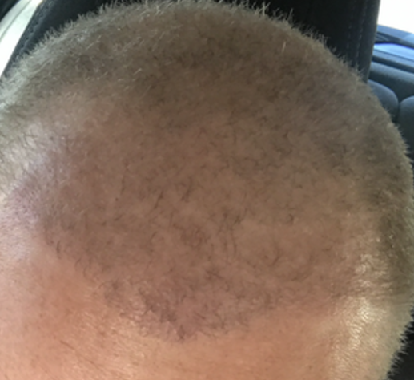
I am disappointed in the 5400 grafts I had 9 months ago, thoughts?

That is a lot of grafts for the balding area. At nine months, I would expect to see 90 percent of the growth already out. I doubt that many more grafts will come in but waiting a full year is a good idea. If you are still concerned at one year, go back and see your doctor and discuss your expectations and your doctor’s expectations for what was done. With 5,400 grafts, the team of technicians must be very efficient and fast, not leaving the grafts open to the hair for more than a few seconds in placing them or they will die and you will get dead grafts placed.

5500 grafts

Disappearing Neck Hair (photo)

Note that in this photo, the neck hair in this man has already started to disappear. This is a genetic trait that is different from general Male Patterned Genetic Balding. For this reason, I never transplant the neck hair into the recipient area because this hair, in some men, is not permanent hair. Note the transition between the neck hair and the scalp hair at are about the occipital notch (base of the skull).


2019-07-30 09:28:40Disappearing Neck Hair (photo)

Direction of Graft Growth

Hi Dr,

Can you explain how accurately a surgeon such as yourself can transplant grafts so that hairs grow in the same direction?

I have seen quite a few celebrity transplants where the hair still appears thin and the hair once grown out always looks messy because the direction of the grafts is not quite right.

How are you able to ensure that this doesn’t happen?

As someone with naturally fine and very straight hair then i imagine it would be essential that any transplant i had done should be performed by a top surgeon who is able to make sure that the angle of the transplanted graft is accurate. If i had thicker and naturally curly hair then i suppose this wouldn’t matter so much and is probably a part of the reason why those with curly make better candidates?

Thanks

Doctors have direct control of how the transplanted hair grows and how the transplanted hairs are distributed to give the most natural look. This is a very important point that most prospective patients do not take into account when searching for the right medical group for a hair transplant procedure.

You are correct in stating the fine straight hairs need careful attention to detail when undergoing a hair transplant procedure, but careful attention to detail is also a must for coarse hair, because each hair can have many times the bulk of a fine hair. A coarse hair put in the wrong direction will be more easily detected than a fine hair put in the wrong direction. Some surgeons, when placing the hairline, place the frontal hairs radially (like bicycle spokes). Is it possible that surgeons who do this do not understand the normal direction of the hair growth, just are ignorant of the facts? Sometimes I think so.

To be sure that these poor placement doesn’t happen to you, you have to do your own research and due diligence. There are many good doctors with great artistic skills. The best way to determine who these doctors are is to ask to meet some of their patients. My patients love showing off their results in the privacy of our office, so we set up circumstances once a month to allow this to happen. To me, this is just plain good medical education. This is why we have our monthly Open House events where anyone can come and see our former patients (up close) and speak with them face to face.

2012-09-05 10:30:14Direction of Graft Growth

Diffuse Unpatterned Alopecia-DUPA

I have a Class 3 balding pattern (just corner loss) and I went to a hair transplant doctor who offered to perform 2000 grafts in the front to address the balding area. It seemed to me that I was thinning outside of my frontal balding area. The doctor who offered me the surgery never looked at my hair under a microscope. I am a 24 year old male and I purchased a hand microscope as you suggested on Amazon. When I looked at my donor area, this is what I saw in different parts of the donor area. How would you interpret the hand microscope pictures I have attached here?

This is clearly Diffuse Unpatterned Alpopecia (DUPA) which I originally wrote about in 1997 (see here: https://baldingblog.com/wp-content/uploads/pdf/mp-1997-evaluation.pdf). The view of your donor area shows very significant miniaturization of the donor area which means you are not a candidate for a hair transplant because it will fail. The hairs that get transplanted will look like these hairs and not have much bulk to them. The doctor who recommended 2000 grafts just wanted your money and probably never read about DUPA. You seem too smart for that doctor. The drug finasteride sometimes helps.

This is what my donor area looks like

Diffuse Thinning

Does diffuse thinning only happen at the crown? Or can it happen all over the head (sides and back)? Also, if you are diffuse thinning or balding in general, can the sides and back become softer (individual hair becoming weaker and not as thick)? Or should the back and sides not be affected at all (at all as in should be as thick as when you were a kid/ teen)?

For men, thinning and balding occurs in patterns. For some men, crown thinning and balding is a pattern of hair loss, one that I personally had and transplanted it. If it is diffuse (all over the scalp) then there is a condition called Diffuse Unpatterned Alopecia (DUPA) something we originally defined in the medical literature in the 1990s which is a real problem for those who have it and these men are never candidates for hair transplantation. Diffuse hair thinning occurs in women but it does not occur in pattern and the causes for this are too many to list here.


2017-07-26 05:59:06Diffuse Thinning

Should Diffuse Thinning Be Treated with Hair Transplantation? (from Reddit)

Although some hair transplant doctors offer hair transplants for diffuse thinning, I consider this an issue of malpractice because, if it is really diffuse thinning, there is little value of a hair transplant to correct this. Sometimes, a hair transplant for thinning in the frontal area can work in women. For men, it takes a good honorable surgeon who is not in a rush to take your money. So, be careful about hair transplantation to solve this problem. Patterned thinning is often a precursor to balding. If you are a male, have a doctor evaluate you for this then build a Master Plan for your future balding which almost always happens.

Hair transplant for diffuse hair loss from tressless


2018-09-14 09:06:55Should Diffuse Thinning Be Treated with Hair Transplantation? (from Reddit)

Diffuse Thinning or Early Norwood 7?

In a recent question you write: “A 25 year old man already showing thinning in the Norwood Class 7 pattern will not benefit from Propecia unless it is caught early and still it may not do much more than stop the loss from occurring.”

Is there any difference between “thinning in the Norwood Class 7 pattern” and “diffuse pattern alopecia?”

And what’s a good way to determine if you are catching your thinning early? If you have hair all over your head, but your scalp is starting to be seen in the mirror, is that early? Or ?

Norwood class 7Let me clarify things a bit. If you are 25 years old and already a Norwood class 7 (it does happen), you will not benefit from Propecia because there is no hair left to save. If you still have some hair, and show signs of Norwood 7 with significant miniaturization present in that pattern, then Propecia would help hold on to the hair longer. Norwood 7 has a definite pattern to thinning of hair loss. A diffuse pattern is just as it states — you are thinning all over (even in the sides and back of the scalp).

A good way to determine if you are thinning early is to have your scalp hair examined for signs of miniaturization. Get the scalp mapped, then have it done again in 6 months to compare the results.


2010-01-15 09:12:10Diffuse Thinning or Early Norwood 7?

“Diffuse thinning as hair loss is the worst”

I feel as though I’d rather recede than diffuse all over top. Just so it’s easier to estimate a future transparent. My hair is long on top and when dry, it looks thick like Joe Jonas hair. When wet you can see the diffuse thing and patchy areas. I’m only thinning on top. I do have a recede hair line in the temples, but it’s not bad/I’ve had it since I was 18 – with actually fully thick hair. I’m 25 now. Been on fin and min for almost a year.

You should see a doctor. Diffuse thinning is a difficult problem and needs an assessment by an expert, like me. I would do a HAIRCHECK to see if I would find a pattern to your hair loss thinning (https://baldingblog.com/haircheck-test-how-it-is-done-and-what-its-value/). To find one in your area see ISHRS.org.


2019-12-10 10:59:15“Diffuse thinning as hair loss is the worst”

Diffuse thinning and not getting better

hi doctor, i’d like to apologize’ first because i dont have good progress pics to post but i’d still like to get some advice

i’m a diffuse thinner and i’ve been using minox for 9 months and finasteride for about 7 month. was losing 100+ strands of hair daily when i shower but since last month the hair loss has gone down to around 50+ strands, should be a good thing right? but the problem is that my hair density and volume are way below baseline and it worries me a lot

what should i do, are there any other options? keep it up and just wait and see how it goes? i’m worried that my hair loss didn’t actually “improve” and i’m losing fewer hairs simply because i dont have as much hair to lose now compared to before, if you get what i mean.

There are thickening agents you can buy which will make your hair look much better. These medications will hold the hair you have and not regrow new hair. You need to see a doctor and get a Personalized Master Plan for your hair both short term and long term, knowing where you are going will be helpful for your future planning.


2020-12-15 07:07:33Diffuse thinning and not getting better