Androgel and Hair Loss?

I am 52 and very athletic. I started taking Androgel about 3 or 4 years ago and usually stay on a low dose (2 to 3 pumps/day) except when training hard for a marathon or triathlon (a couple a year) and I go up to 8 pumps/day. I noticed I have lost a significant amount of hair around my crown so I’m now wanting to quit Androgel for good IF there is evidence that the hair will grow back over time. Is there any evidence that this happens or have I lost that hair for good. My hair is otherwise plentiful and my hereditary traits are for thinning hair but not baldness like I am getting so I feel sure the Androgel is causing it.

Usually, hormone induced hair loss in men is permanent. You might try minoxidil in the crown, which might grow back some of the hair. Finasteride (Propecia) may stop the progressive nature of the hair loss while you are on Androgel.

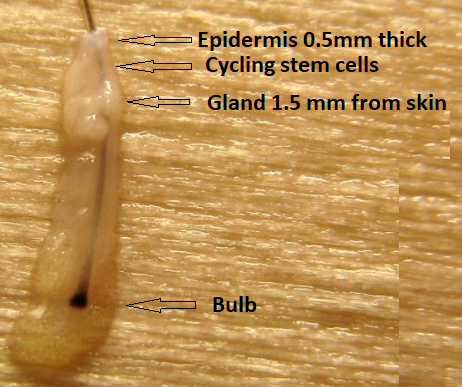
Anatomy of a hair

For those of you who perform microneedling, you want to reach the area between the gland and the skin which is between 1 – 1.5 mm from the skin edge

Analyzing the Results of the HairMax Laser Comb

I have added a link to some of the before and after pics of people who have apparently used the lasercomb.

What do you think?

https://www.lasercomb.net/beforeafter.htm

Thanks again Dr! I’m addicted to your site now!!!

Ah, the HairMax LaserComb by Lexington International. It’s worth noting that lasercomb.net and hairmax.com both go to the exact same site, so the link you sent is the official site of this product. The page you sent (linked above) has 2 groups of photographs, each with multiple before/after sets. The 1st group is apparently patient results, and the 2nd group is of clinical trial macro photos.

So let’s start with the first group of photos — the patient results. I looked carefully at these, and there is a real question in my mind as to what I am seeing. A few of these pictures have longer hair that is possibly responsible for the changes that I can see. I wanted to get an enlarged version of the photos to see the details that would tell me what I was looking at, but they are not available on the site. The first before/after set in the group are a good example to start with. There is a suggestion that the scalp has coloring to it (Dermatch or something similar), but as I can’t enlarge the photos, I can’t try to determine what it might be. Could the difference be lighting or combing style? I don’t know, honestly. Many of the photographs suggest styling differences. In no case was there any significant change in the hair coverage, though. Either the person had plenty of hair when they started or there was not enough hair when they finished treatment.

Moving on to the 2nd group of pictures, the clinical trial macro photos —

We analyzed two sets of the before/after high-powered magnification photos, which also includes the data that they based their research upon. The actual hair counts as they did them are well presented and can be seen by magnifying the circular areas of hair density assessments. Each hair grouping was identified, numbered, and the authors put the actual count on each follicular unit as they made the measurement. They did not separate or identify those hairs that were miniaturized. Because all of the information is present in the material presented on their website, it was easy for us to repeat their measurements and to ascertain if their numbers corresponded to an independent assessment.

Here’s a breakdown of what I found in the macro photos that Hairmax presents on their LaserComb site.

Macro Photo Set 1 – Before picture:

  • HairMax’s hair count: 107
  • My hair count: 115
  • Of these hairs, 12 were miniaturized

Macro Photo Set 1 – After picture:

  • HairMax’s hair count: 148
  • My hair count: 128
  • Of these hairs, 10 were miniaturized

See the image on the LaserComb site

Statistically, the percent difference between the before and after photos (according to my count) is insignificant. Therefore, in the first set of photos the LaserComb made no real difference.

In the second sequential set of photos, I discovered that the after photo actually had less hair than the before photo —

Macro Photo Set 2 – Before picture:

  • HairMax’s hair count: 147
  • My hair count: 161
  • Of these hairs, 12 were miniaturized

Macro Photo Set 2 – After picture:

  • HairMax’s hair count: 184
  • My hair count: 159
  • Of these hairs, 10 were miniaturized

See the image on the LaserComb site

Yes, I actually counted three fewer hairs after the LaserComb was used. My measurements of the data on their official site do not support the findings they offer.

I am comfortable saying that I am one of the world’s experts in hair densitometry. I can prove this as I am the inventor of this technology and hold the U.S. Patent on the instruments used by HairMax (or Lexington International) to demonstrate their findings (see: USPTO.gov). With that being said, I reviewed our findings and agree with our counts. I believe that HairMax’s photos do not show any objective evidence of hair growth on the first two sets of data and that the numbers that they derived do not correspond to the assessments made by us. Lots of good hype if you’re into it.

Analysis of My Donor Area

I have about 90 cm2 of baldness and about 200 cm2 of possible donor area. When I counted 1 cm2 of donor 3 times, I got 110,113 hairs and 123 follicular units per 1 cm2. I was wondering if the ones with red arrow are still the same follicular unit even though the hairs are spaced out compared to one with green arrow.

You are pointing out the follicular units that have more than one hair. Sometimes they exit the same pore and sometimes it appears to exit next to the main pore. The count of 110,113 hairs is about the average hair count in a Caucasian male and the number of follicular units are about 50,000 or 2.2 hairs per follicular unit on average. Clearly, some of the Follicular units have higher hair counts and others may just have a single hair. If you look at the leading edge of a normal hairline, you will see all single hair follicular units transitioning into more hairs per follicular unit as you move away from the leading edge. You were very astute in your analysis. The next step is to calculate the size of the balding area you are thinking about transplanting. That is just the beginning of the next analysis where multivariate analysis comes into play. The other variables that must be considered are (a) hair thickness, (b) character of your hair (wavy or straight), (c) the thickness of the hair shafts (fine, medium or coarse) and last and most important is where you are heading with your existing balding (based upon HAIRCHECK analysis, family history, your age, if you are going to treat the progressive nature of balding, and your long term medical plan with regard to going forward management).


2019-02-14 06:54:32Analysis of My Donor Area

Anagen Hairs Early in Growth

If you count the number of hairs in this follicular unit, you can see 4 hairs exiting at the skin edge, but the anagen hair just starting to grow has not reached the skin yet so there are at least 5 hairs in this follicular unit. This is why it is so important to use a high powered microscope to evaluate the ‘grafts’ when a hair transplant is done. We don’t want to waste any hairs, regardless of how small they appear because these tiny hairs will eventually grow up and be a full ‘terminal hairs’.


2020-12-14 16:34:31Anagen Hairs Early in Growth

An Island of Hair Around Transplant

Two things should be evident when you look at this photo. (1) the scar from the hair transplant (easily taken care of with scalp micropigmentation, see here: https://scalpmicropigmentation.com/gallery/scar-covering/#!https://scalpmicropigmentation.com/wp-content/uploads/2016/04/scalp_micropigmentation-new_hair_institute-146-scalp_scars.jpg and (2) the Island of Hair surrounded by the balding that occurred after he had his hair transplant (easily fixed with another hair transplant). The surgeon and the patient didn’t recognize that he was going to develop a Class 7 pattern at the time of his original hair transplant. I hope that the patient was aware that hair loss is progressive and that this progression is a real risk for this type of hair transplant in advanced pattern balding men. Fortunately, it looks like he has enough hair to fix this problem.


2020-12-18 06:52:04An Island of Hair Around Transplant

An alternative treatment for Erectile Dysfunction?

Minoxidil versus nitroglycerin: a prospective double-blind controlled trial in transcutaneous erection facilitation for organic impotence.

Randomized controlled trial

Cavallini G. J Urol. 1991.

Abstract

A new type of topically applied drug (minoxidil) to facilitate erection is presented. Minoxidil acts directly on arterial smooth muscles via relaxation. This drug (1 ml. of a 2% solution) was studied under strict laboratory conditions in a double-blind controlled trial on 33 patients (4 with neurogenic plus arterial, 10 with neurogenic and 19 with arterial impotence) and compared to placebo and nitroglycerin (2.5 gm. of a 10% ointment). The application sites were the penile shaft (nitroglycerin) or glans penis (minoxidil and placebo). Increases in diameter and rigidity were measured with the RigiScan device and arterial flow was evaluated by conventional Doppler sonography. Side effects were considered as well. This drug proved to be more active than nitroglycerin and placebo in increasing diameter, rigidity and arterial flow of the penis. The highest activity proved to occur in neurogenically impotent patients. Fewer side effects also were found with minoxidil than with nitroglycerin. For these reasons minoxidil is proposed as a long-term therapeutic agent for organic impotence.


2020-03-09 08:25:33An alternative treatment for Erectile Dysfunction?

Aminogen and Hair Loss?

Can the enzyme aminogen cause hair loss?

Thank you!!!!!!!!

There is no information on any connection. It appears that Aminogen is made from whey and it a nutritional supplement.


2009-04-16 16:07:03Aminogen and Hair Loss?