
Dr. Nghi, a surgeon in South Vietnam worked with me as I volunteered to assist South Vietnamese Civilians and wounded soldiers while I was in Vietnam. He was fortunate to be evacuated and ended up in Camp Pendelton when I was able to connect with him in 1975. I sponsored him and his family of 8 others including his wife and two children, plus other relatives including his wife’s father and mother. He joined me in my Surgical practice in Vermont, working as a physician assistant while studying for his examinations to get a license to practice medicine in the United States. After 9 months, he took the examination and passed it on the first round. With some help by me, he went onto to Dartmouth in Hanover New Hampshire and studied Anesthesiology for 3 years. When he left Dartmouth, a special award was created for him to recognize outstanding service while he was there and was offered a faculty appointment. He decided not to take the appointment and moved to Pittsburgh where he has been practicing anesthesiology every since. He has been active in helping Vietnamese refugees resettle and has been invited to the white house twice to be recognized as an outstanding community contributor. His family now extends to more than 40, all highly successful and integrated into American life. He has four children, an OBGYN doctor, a PhD researcher, a district attorney and a pharmaceutical Vice President. He told me that America gave him and his entire family the opportunity to succeed through hard work. He loves America. Below is this presentation posted by the History Museum in Pittsburgh just this week to honor Dr. Nghi and his family.
A Specialist Recommended Scalp Reduction Surgery For My Small Bald Spot
Hello,
After having a bald spot on the left side of my head for 28 years, I’d like to do something about it. The bald spot is circular in shape and 2cm in diameter, about 7cm directly above my left ear. The hair fell out when I was 2 and the bald spot has remained the same size for as long as I can remember. I am able to cover it with hair surrounding it, but it does take an emotional toll on me as I see it every day and I have to be very careful every month when having my haircut. I saw a dermatologist about a year ago who told me it’s triangular alopecia. He was not able to locate any hair follicles under the skin, and told me the chance of regrowth is slim to none, especially as there has been no hair there for 28 years. He suggested we first try cortisone injections which did not work, and then referred me to a specialist. I went to see a specialist and he recommended scalp reduction surgery given the small area and lack of hair follicles.
I’ve done some reading on scalp reduction surgery, on your blog and others. The risks seem to be significant (stretchback, slot scaring, hair angled incorrectly, etc.) and it’s clear you’re not a proponent. I’ve also been unable to find any success stories/testimonials online. I’m going to ask the specialist to share more information (# of surgeries he’s done, before/after photos, # of surgeries I’ll need, risks, type of incision, etc.), but before doing so I’m hoping to get your advice.
Given the small area (2cm in diameter) and being able to cover with existing hair, do you think this is a case for a successful scalp reduction surgery? If not, are there any alternatives you’d suggest (e.g., Rogaine, hair transplant)? Both my dad and grandpa have full heads of hair, so I’m not really worry about the hair on the left side of my head receding back to the site of the bald spot.
Thanks for your help!
You are correct in that I am not a proponent of scalp reduction surgery. This is because over the years I have never seen it work well. I’ve written about this type of procedure before here.
A scalp reduction could be very tempting to the surgeon and the patient, because it makes logical sense — just take out the bald spot — but the best you would get is maybe 50% improvement. Or you might get considerable scarring from this, depending on the location.
There are other options, such as a hair transplant using the follicular unit extraction (FUE) technique into the small area you described. This is a more predictable result, particularly for the small area.
A Special Letter from an NHI Patient
I just received this email from a patient of mine and thought I’d share it with you, as it brought a smile to my face. Periodically, I want to share the joys of this uniquely wonderful medical practice with my blog audience as I am getting terrific feedback for many of you.
Good afternoon, Dr. Rassman. I thought this might be of help to your new transplant patients and those considering a procedure. I have been a happy client of NHI since 1999. Your organization actually turned me away prior to that until you thought I would receive sufficient benefit.
In September of 2004 you yourself did a whopping 1400 or so in the crown area (your organization did 1200 grafts prior) . Now this is the reason I am writing to you (in addition to just finding this blog business on your website): your prospective patients, especially the younger guys, need to know that balding is a long process. Although they may awake to the process all at once with the “bell in the brain” event, it is likely that the process has been in place for sometime and will likely continue. In my case technology and my finances came together and I was able to get ahead so that I never had a bald spot period in my life and managed to keep the “shine through” months to a minimum. To this day it is a hoot to tell new friends or business aqaintances that I’ve had transplants and would have a spectacular bald spot had I not chosen NHI. None, and I repeat none, believe me. Even when I show them evidence of the donor scar most assume I am pulling their leg. Now, for the second reason for writing after reading a number of your blogs. Last week one and a half years after I started the process, I was lolling in the tub and discovered a veritable thicket of new stumps in the thinest area of my swirl. I made a mental genuflection to LA and hollered to the wife: blog the good doctor and tell him that, as in the previous two sessions, his theory of waves of hair growth continues to be proven.
Sorry about the length of email but continue to reassure your younger patients with confidence that it takes time to grow. My only regret continues to be that in never having gone bald I never got to qualify for your “before and after” photos. However, my dream may yet come true. At the advanced age of 57 my front hairline is going. You may see me back in LA or San Jose for splotch in the front. Please let me know if you are running any “forelock specials” and be prepared to guarantee me a minimum half-page pic in your next updated booklet and I’m there. Remember, there are many other hair docs who would benefit greatly from claiming your good work and artistry for their own were I to rent out to them my forehead and crown as an advert. Perhaps I should hold out for a 3/4 page or maybe an inside back cover. Thank you again for your time and attention to my skull. My wife sends her regards and hints that she needs another free shopping day so she’s hoping the front falls out. I’ll remind you that it was an inappropriate comment you made during my last session that all the other wives who drive their husbands get five free hours at the mall with the husband’s credit card. Through sessions one and two I had had her convinced her it was sufficient reward for her to share my salad at mid-surgery point.
2006-02-20 15:36:582006-02-20 17:48:21A Special Letter from an NHI Patient
A second hair transplant, when to do it?
If at the 8 month mark I desire more density, would another operation be appropriate or should I wait until 1 year?
Since 95% of the growth (possibly not length but growth) occurs within the first 8 months, a second surgery can then be done if the desired goals are not met. By the 8th month, you will have a good idea what the value of the first transplant is.
2020-08-25 02:48:512020-08-24 11:18:50A second hair transplant, when to do it?
A scalp biopsy with slightly surprising results…
I’m a 22 year old male with androgenic alopecia and diffuse thinning. I’ve been balding since I was 18 years old.
Recently, I’ve been experiencing very rapid shedding all over my scalp (top of the scalp, donor area, and both sides of the head). I went to my dermatologist and had a scalp biopsy (4mm, punch) done to make sure it wasn’t alopecia areata. Turns out, it’s telogen effluvium due to various stressors. 12 days later, I got the stitches removed from the area.
BUT
The hair that is currently growing out and closely around the biopsy site are probably the thickest that they have been in YEARS.
I currently use a topical minoxidil 7%, finasteride 0.1% compound solution ((been using for 1 month), stopped taking finasteride tablets due to sides (used for 2 months)) and I use a microneedling pen (1mm, once per month). Although I’ve had very subtle hair regrowth on my hairline and slight thickening on my temples, the hair from the biopsy site feels and looks thicker than most of the hair on my scalp at the moment.
I’m aware that it may seem like an “illusion” due to my current TE condition, but it honestly feels much more thicker than before the initial shedding started. It almost nearly resembles the texture that it was from when I was a teenager.
If anyone is familiar with the biological components of hair loss and hair regrowth, I would love to hear from you about this matter.
Wounds sometime stimulate hair growth much like microneedling does
2021-01-18 02:37:182021-01-17 07:29:21A scalp biopsy with slightly surprising results…
A review on the use of Minoxidil (oral and topical – scientific article)
https://www.ncbi.nlm.nih.gov/pmc/articles/PMC6691938/
Conclusions of article: Minoxidil is a common medication prescribed for treating hair loss-related problems. It provides remarkable benefits to patients with hair disorders. To date, the FDA has approved minoxidil only for AGA. However, minoxidil is used off-label for treating several hair disorders as well as increasing body hair growth. Although topical minoxidil is considered an effective and safe treatment option for various hair disorders, additional evidence-based data are needed for some applications.
Other mention: Salicylate and aspirin can inhibit sulfotransferase. A recent study showed that the follicular enzymatic activity decreased following 14 days of low-dose aspirin use. Thus, prior or concomitant use of aspirin decreases the clinical response to topical minoxidil.
A Remarkable Change Made from SMP on a Thinning Scalp (with Photos)
This patient came to see us after having a hair transplant (from another clinic) that still left him not a full as he would like. We offered Scalp MicroPigmentation (SMP) as an alternative option to having further transplant surgeries. He took this alternative option and the transformation was very exciting.
It would have taken between 3500-6000 grafts had he gone the hair transplant route and the results would have taken possibly 16 months for two procedures. The results you see here were instantaneous — no waiting period — although he had some touch-ups after the initial session.
Click the photos to enlarge:
After:
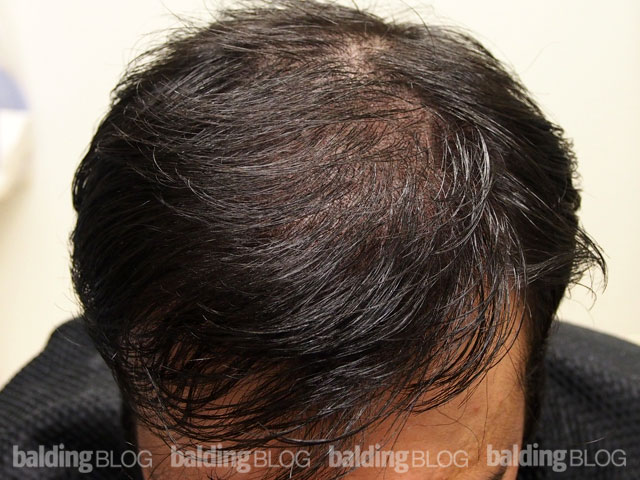
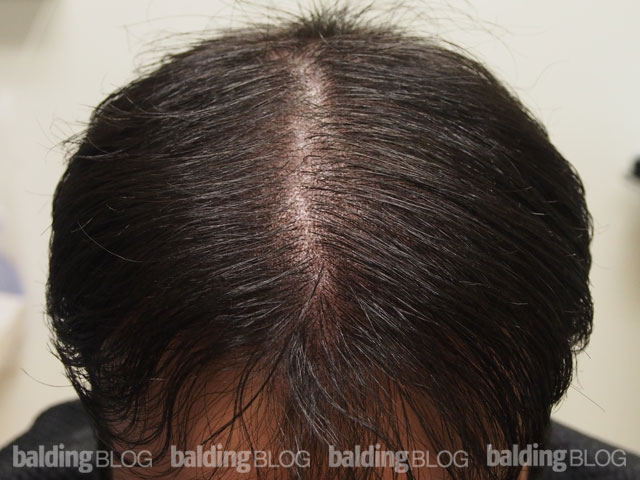
Before:
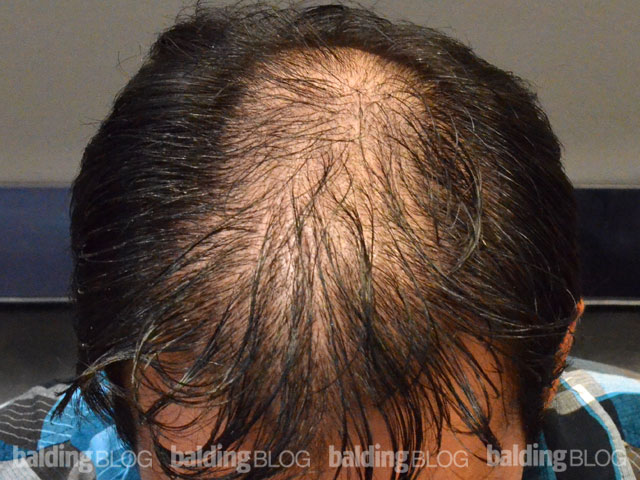
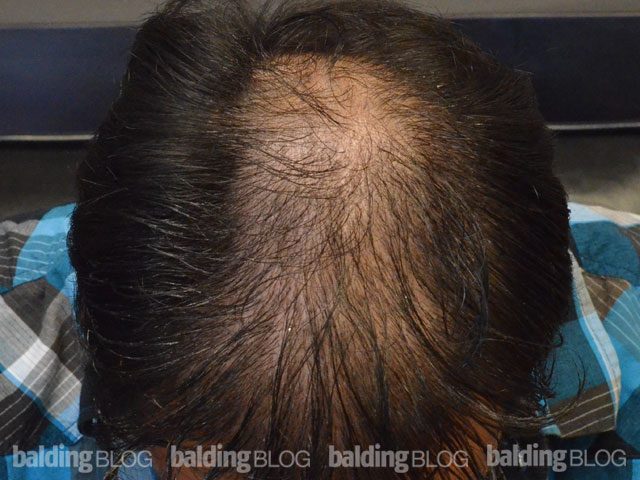
A Reader Gives Thanks to the Doctors of BaldingBlog
Dear Doctor,
I moved from Quebec to Vancouver (Canada) and I am waiting to get my health insurance here. In the mean time, no dermatologist accepted to see me.
Of all the Internet, which is a pretty big place, you have been the greatest thing. Not only for your knowledge, but also because of the way you speak, because it feels like you actually care. I’ve seen very few doctors like this in my life.
I don’t know if you are a real doctor or not, I don’t know what you have to gain from this, but thank you. The comfort I found in your blog combined with the quality of information was a great source of relief. I believe I am not the only one who feels this way.
Thank you
What a nice way to start the day!
Yes, BaldingBlog is written by real doctors. While we can’t give specific medical advice, I am glad you’ve found some useful information on the site. Your words are appreciated.
A personal rant on Hair Loss from Reddit (12/12/19)
Just want to preface this by saying that I’m all for fighting hair loss in any way you want if it’s what you wanna do. I’m genuinely not here trying to sway anyone one way or the other. That’s why I’m not even gonna mention what I’m doing/not doing for my hair loss. Just wanted to comment on how some people in the hair loss community might have a bit of an unhealthy relationship towards balding and I think we all torture ourselves more then we need to.
I had to say that I had a very enlightening talk with my therapist and also spoke with some of the good people on the r/bald sub and it was quite enlightening for me. I’d realized that it was super unhealthy to obsess about image and my hair to the extent that I was doing it (in the back of my head at all times, sucking all joy out of my life at the worst moments)
realized that a key for me was to not catastrophiez hair loss more then it needed to be and to realize that even the one thing I was fearing most in the whole world (being bald) is not something that’s that bad.
If we wake up bald tomorrow our family will still love us, our friends will still be there, we will still enjoy every hobby, tv show, movie, video game, book, interest that we had prior. It will be an adjustment period sure, it’ll be weird to look in the mirror and you’ll have to relearn to like how look the same as when you had hair and also for a little while after our loved ones will have to get used to the new look. But then after a few months at most, life will go on just how it was before. Having that mentality of ‘whatever happens it’ll be ok’ is so important in this situation.
I think most people who lose hair young torture themselves much more then they need to by making the stakes in their head so high. If you think being bald is a death sentence then of course you are going to stress over it 24/7 and drive yourself mad. If you think balding is just a natural part of life that happens to many people, just like wrinkles or skin sagging or any other changes our body goes through over the course of our entire life. If you convince yourself that if it happens to you it won’t be a huge deal, then you will have a much healthier perspective and be much more comfortable, whether you decide to fight your hair loss or accept it. Bring down the stakes a little, it’ll be a weight off your shoulders:).
So yah I think this sub is great and that if you want to fight your hair loss then by all means, more power to you. I just think that some people on here could tone down the animosity and negativity regarding certain topics and I know that if people had a healthier perspective and relationship with their hair loss and overall body changes then they might be a lot happier and more calm with whatever they decided to do. Even the worse case scenario for us would be ok so we don’t need to be as terrified as we think.
Wanted to get this off my chest because I recognize a lot of myself in the people on here with how I see them stressing so much with this all or nothing mentality and making the stakes so high in their heads that they spiral into bouts of depression.
Again nothing wrong with taking finasteride or whatever other method if that’s what you want and you’ve balanced the sacrifice/reward in your head. Just want people to know that they should do this because it’s something they want that would bring them pleasure, not because they should feel like they absolutely have to or else their life will be over because that can lead to being in a bit of an unhealthy place mentally.
This is all, thanks to anyone who read this far, wish you the best
What you said is important for Reddit readers to understand. There is a lot of information on this site and opinions like yours are an important contribution to the readers evolving opinions. Hope spring eternal for those with hair loss and there are many people working to reverse the hair loss with either a simple treatment or a cure. A simple treatment may be closer than you think. We are working on it right now as I write this post. Thanks for sharing your thoughts.
2019-12-13 02:25:522019-12-12 12:29:37A personal rant on Hair Loss from Reddit (12/12/19)
A Person with DUPA Should Never Have a Hair Transplant (Photo)
I wrote the original article on Diffuse Unpatterned Alopecia (DUPA) and yes, a hair transplant should never be done if you have this condition. However, too many young men assume that they have DUPA, and that is wrong. Get the diagnosis confirmed by an expert like me with microscopic examination of the donor area and a metric on the degree of miniaturization present in the donor area. The picture below cannot, without such a miniaturization analysis, arrive at a DUPA diagnosis.
2020-01-24 04:00:232019-11-22 15:42:05A Person with DUPA Should Never Have a Hair Transplant (Photo)