
5 Months After My Transplant, Nothing Has Grown In and Now I’m Losing Hair All Over!

Hi Dr. Rassman,

I find your blog to be incredibly informative and helpful to those with concerns after their hair transplants. I decided to undergo a transplant exactly 5 months ago as preventative maintenance. 1,700 grafts to fill-in the thinning top portion of my head. I still have hair on my head, but under direct light you could visibly see through to my scalp. I followed my doctor’s instructions and had no major issues after the surgery.

At 5 months, the incision scar is still pink and I have occasional pimples on the top of my head (with what seems to be a noticeable increase in grease on my head). Also, after the surgery I had shock fallout. But it seems that ever since my surgery for the last five months my shedding has been consistently increased. Not just from the top of my head, but all over (sides and back). I have yet to see any growth from the grafts. But I have noticed white streaks in my hair. I have pitch black hair, and there are now random strips of white developing throughout my hair (I had never had white hair before the surgery). Is it possible that the shock of surgery would cause some of my hairs to begin to turn white?

And I’m also concerned at this point that my grafts will not grow in and that I will continue to get thinner and thinner since my fallout has increased. Thank you for your input and advice.

In my practice, we never recommend a hair transplant surgery for “preventive maintenance”, mainly because most patients would not likely see much of a result as they continue to bald and run the risk of being worse off. There is also a good possibility that the surgically induced hair loss might make it look worse, something we call “shock loss”.

If you are really losing hair on the sides, maybe something else is going on like diffuse unpatterned alopecia (DUPA). Shock loss doesn’t usually cause hair to fall out from the back and sides of the head. White hair does appear with stress on some people, but I really do not understand the cause. It sounds like you need a good doctor to talk with and be examined by. Perhaps the surgeon that did your transplant would be a place to start.

In general it takes about 6 to 8 months before you can see results and I tell my patients that most people can see 80% of the impact from a hair transplant in 8 months. You should notice growth beginning about now and see improvement in the next 3 months. If you are young and had the transplant without taking the drug finasteride, and assuming that your preventive hair transplants were not really needed, then you will most likely not have as much hair as you did before the transplant (based upon what you are saying here). Hopefully though, over the next 3 months you’ll see some gains.
5 month finasteride then dutasteride (Photo)

This man started on finasteride for 2 months and then switched to dutasteride. The arrow shows early growth. I suspect that he would have had the same result had he stayed on finasteride. I suspect that the left side will eventually catch up to the growth we see on the right side.


2020-09-28 08:49:025 month finasteride then dutasteride (Photo)

Man comments on November 2nd post

Nice post on your blog. I’ve always wondered why some people’s HT don’t always take.
Questions this brings up:
– should one go to a dermatology clinic instead of a doc to get this done?
– perhaps in the same way one can take fin to mitigate shockloss, would it be wise to take corticosteroid pills say leading up to and after a HT?
Just trying to gauge how to put this information into practical use 😀
Thanks again! Love your work!
This patient is referring to the post: https://baldingblog.com/?s=ishrs+pearl. All good hair transplant surgeons should know how to do trichoscopy and perform it in their offices to analyze the hair and scalp. Such an examination will pick up diseases or suspicion of diseases like LPP or FFA. Steroids should not be taken blindly.

Minoxidil plus finasteride 18 months (photos)

June 2021 vs. today (11.2.2022), 1.5 years on 1mg fin every day, Niz 3x per week, and 1 month on 2.5mg oral min every day.

Nice improvement. Stay on your routine and it will only get better. It may take another full year to see more value of what you are doing and it is even more likely that it will get better if you add weekly microneedling to your routine. If this is not enough and you are over 25, then a hair transplant will give you a normal hairline, something to consider.

48 Years Old With Shock Loss After Transplant

Dr Rassman
I recently had transplant surgery at a reputable office to combat thinning hair on top and a receding hair line. I am 48 years old. I was suprised by what I believe was a fair amount of shock loss around the graft areas given my age. I was not on propecia pre-surgery but began taking it a few days following the procedure after reading your column. Now I believe propecia can also cause shedding in the early months. Could you explain the difference between shedding and shock loss and what you believe I am experiencing. Maybe a combination of both.

Thank you

It sounds like you experienced shock loss and if this is in the miniaturized hair, the hair may not come back. Treating thinning with transplants is not something I do often. In many people with miniaturized hair, transplanting into that ‘unhealthy’ hair does little to really increase the fullness. I believe that for most people like you, any benefit you will get in the long term may be lost in the short term, making transplants a poor decision. I would think that Propecia should have been used in advance of your hair transplant procedure just to minimize this risk. The transplants done may offset the hair loss and the Propecia may bring some of the hair back. Only time will tell. Once the glass of milk falls and the milk spills out, it may be impossible to bring it back.


2006-05-19 08:58:1948 Years Old With Shock Loss After Transplant

How a hair transplant changes a man’s life

Have your patients reported to you that their life improved was improved from getting a hair transplant (E.g. Confidence, more time etc)? I’m thinking about getting it done and I’m really worried about the first day travelling home.

Almost all of my hair transplant patient regret not doing it earlier. The average age for a hair transplant in my practice is mid-thirties. The older the man is, the more they regret not getting a hair transplant and living with balding. Almost 100% tell me hair transplants were a life changing process. I started doing large session transplants in 1991 with follicular units back then. I never did a ‘plug’ surgery

Is finasteride working?

I have been on finasteride but still encountering recession in my hairline in terms of miniaturization. But i noticed that my hair fall has actually decreased, so is the fin working or…? Was wondering am i really having Androgenetic alopecia

Yes, it is working but possibly not well on your hairline.

47 Year Old Female with Hairline Problem

I’m a 47 year old female. About 7 months ago, I noticed a thin spot on right side of my hairline, then a few months later, the left seemed thinner. It’s my underneath area, temple up to the sides of my widows peak. It seemed to be rapid because last summer I had full hair there. I’m so upset. I don’t know if it’s from my father or hormones. I have no prior hair loss. I don’t know when it will stop or if I need minoxidil. I’m taking stinging nettle and pumpkin seed oil. My thyroid seems ok but I have not checked my iron levels but because it resembles a bit of a male pattern. I wonder if it’s too much DHT. Please help.

Women are complex when it comes to hair loss as there are many causes that require an expert to evaluate. It takes many blood tests and a good examination by someone like me. As women get close to menopause, hair loss problems increase as estrogen levels in your body drop. Estrogen is the protector for good hair, so when menopause occurs, some women experience genetic hair loss. See an expert.


2018-10-10 12:18:4947 Year Old Female with Hairline Problem

4600 grafts for Frontal Triangle only (photo)

Wonderful results. You have possibly used up half of your donor supply or more depending upon your original donor density. From the photos, it looks like you have a Norwood Class 4A pattern and the A patterns are great because it is likely that even if you lost all of the hair in that pattern (a Norwood Class 5A pattern), you would still have enough hair to cover the new balding areas; however, for others who are not so lucky and don’t have a Norwood A pattern of balding, so many grafts placed in the frontal triangle would leave them devastated with not enough donor hair to fill up a Class 5, 6 or 7 pattern. Keep in mind that a Personalized Master Plan is needed to not only treat the present balding pattern with a hair transplant as you have done, but the worst pattern that you might develop so that you will always look normal and hairy.


2020-12-18 08:55:554600 grafts for Frontal Triangle only (photo)

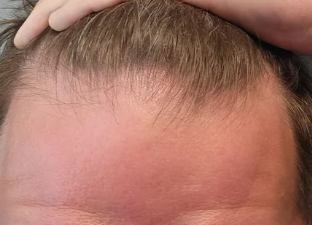
46 with frontal recession (photo)

I recently turned 46, and I’ve been damn lucky with my hair. Around 5 years ago, I wanted to change my hairstyle to go more forward, rather than back. I was 41. I noticed that when styled more toward my forehead, my hair looked a little stringy. I initially thought it was just a bad haircut. Upon closer inspection, the individual hairs/follicles appeared to have gotten thinner at the front of my hairline. Probably further back as well, but I have enough coverage that it’s harder to notice. There has also been some recession of my hairline (maybe a quarter of an inch), although not much, and happening extremely slowly. It’s difficult to tell a significant difference in photos from 5 years ago to today. The top of my head/crown is still full; no bald spot at all, just the cowlick I’ve had since I was a kid. At 46, does this just sound like normal aging, or is there something to be concerned about?

The things to try would include (1) oral minoxidil, (2) oral finasteride, and (3) microneedling. If these don’t work, then at 46, a hair transplant is the best option, and it will work, provided that you get a competent doctor. Your hair loss is likely to have been present for more than 5 years. The combination of all three drugs should be tried first unless you decide on a hair transplant, which is no fuss and with a good doctor, and best of all, there is no uncertainty.