
Settling In to a Hair Loss Pattern?

Hi, Dr. Rassman. Thanks for answering all of our questions.

My question is, How likely is it for someone to “settle in” to a level of hair loss (Norwood 3A, for example) and not see any more rapid loss for a period of time (years, for example)? Do some people get to a certain level of hair loss beyond a mature hairline and stay that way without medication? Or is your fate essentially sealed after you reach a certain level?

Let me clarify what I see as your misunderstanding. The Norwood chart is not to be seen as a progression of hair loss chart, but rather the final patterns seen in a large male population.

Some people do seem to go from a Norwood class 3 to a 4 and then to a 5 pattern, but you may just “settle in” to your Norwood 3A state, as an example. There is really no 100% certainty, but a good doctor with a good miniaturization study and examination can give you a better assessment of what hair may go with time. Here’s the Norwood chart so we’re all on the same page:
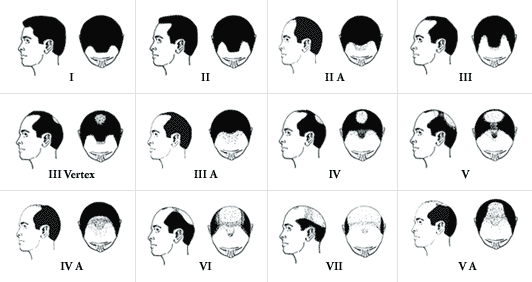
Norwood

Your “fate” was sealed in your genetic code when you were conceived many, many years ago. Very few patients become a Norwood class 7 pattern, and even the balding patients who start as a class 5 may not go much further, even at the age of 100 or so. So for example, there’s no “point of no return” that says if you reach class 4 by this certain age, you’re guaranteed to be a class 7 later in life.

Server Problems

Just getting over some server problems today — thanks for being patient. Things are looking stable now after the system upgrade.


2006-06-30 14:32:01Server Problems

Serum Testosterone and DHT Conversion

Hi Dr. Rassman,

Thank you for your willingness and dedication to share your expertise and insights around this very important field of medicine. My question pertains to the relationship b/w serum testosterone levels & DHT. I am 38 and have been on both Proscar 5mg & Avodart.5mg as well as a slew of natural antiandrogens (eg, saw palmetto, etc.). I recenty increased my dose of Avodart to 1mg but have met w/ marketly increased shedding 2-3 months following the dose increase.

My question is if I could have elevated my free testosterone to a level that is allowing for more conversion of DHT in the small amount, say 10%, of DHT receptors that are not blocked. Is there a balance or fine line between the level of serum testosterone and DHT conversion that takes place? I’ve noticed that my hair shafts have thinned in diameter and lost pigmentation at the bottom and it seems to correspond to about 3 months of growth (I.e., aboth the time I increased my dose of Avodart). Could I have raised DHT levels by raising free testosterone or could I have induced a form of telogen effluvium shocking all my hair into a resting state? If so, can I expect subsequent regrowth? Your professional opinon is greatly appreciated.

On a side note, although this is a progressive,unorthodox, and off-label treatment regime, I am tolerating the treatments very well-very little side effects. Just want to try to understand the science better. Thanks-a-million!

You can not match one piece of a science to another and then create new science. You are doing many things to your hair and your body, all at the same time. You have no measurements taken (mapping out the hair for miniaturization and followed over time area by area). You may be shedding and this may be temporary, but only time will tell you that. I can not heal you with any insight other than what I have written before on this site.

Sertraline and Hair Loss

I am a 19 year-old male living in Turkey. At age 13 I’ve been diagnosed with depersonalization / derealization disorder and was prescribed half a dose of a sertraline-based anti-anxiety drug (known as Lustral here) daily.

I used it for about two years and since then used it on and off for a few weekly periods, including for about two months when I was 17. I heard about antidepressants causing hair loss and in the periods that I used the drug, I noticed that my hair strands were generally thinner and weaker, but no balding visible. And when I ceased using it, my hair returned to its normal strength and thickness. So my question is that, do these antidepressants really cause irreversible harm to hair (thinning / balding) or is it always “back to normal” when medication ends?

Thanks Doc, I’m really curious about this.

The medication you know as Lustral (sertraline) is also commonly known as Zoloft. And as you may know, many antidepressants (including Zoloft) can cause temporary hair loss, possibly even permanent loss in those genetically inclined to lose hair. I can’t say for sure whether the stop/start method you’re using with the medication will always continue the same hair loss/regrowth you’re seeing.

The consumer drug information for sertraline mentions hair loss as a side effect when overdosing, but I suppose it is possible to see loss with normal dosing as well (possibly even half dosing like you were prescribed), depending on how sensitive your body is to it.


2008-12-11 08:38:59Sertraline and Hair Loss

Sensitive to other people’s hair loss

Was hooking up with a girl and realized she also had hairloss. I think once you become obsessed with hairloss you notice it so much. Noticed that her hair part was wider and thinner hairs around there. Can totally see more scalp than most women. She is still hot so idc. But my point is once you know about balding you easily notice it. So many people have hairloss.

Yes, that is very true. Ever since I entered this field of Hair Restoration Surgery 30 years ago, I look at other men and women to establish what is normal and what is not normal for hair loss. From all of these observations, I have learned (especially at airports when I see many people walk by and have little else to do) what normal hair loss patterns are found in the general population. From this, I drew interesting conclusions which I speak about at medical meetings as I have identified patterns of loss that are not the patterns confined to the Norwood Classification.


2021-09-03 10:56:22Sensitive to other people’s hair loss

Sensigraft and Folligraft

Hello Dr. Rassman. I wanted to thank you for having this blog and answering questions.

Sorry this is long, but…I’m a 27 year old guy who’s been receeding for 6-7 years, it quickly became a Norwood 5 and stayed there. What’s worse is I have a preppy, young looking face and overall appearance (which I enjoy and would like to keep), so the baldness clashes even more. I currently wear a fairly good hairpiece, but want to find a relatively permanent and hassle free solution, which brings me to my main question.

Have you heard anything about the non-surgical hair replacements like Folligraft and Sensigraft? I haven’t been able to find much information online either way (I always look for other places not on their website, so I know it’s not a marketing scam). My main concern is if it “breathes” to where you can sweat without being uncomfortable or itching (that’s a slight drawback of the hairpiece). The other would be the approximate cost, since I can’t afford a good HT. I obviously don’t want to blow a couple thousand dollars I barely have on something that may not even completely work, but I’d like to be able to have something more versatile (i.e. different hairstyles or able to be more comfortably active).

If I want to have the friendly youthful look, would you recommend staying with the ‘piece and save up for a good HT, or for hair cloning if it (hopefully) becomes available in the future? Or are the cosmetic treatments an idea worth looking into?

There is a fair amount of material on these websites — Folligraft.com and Sensigraft.com. Both appear to be like a membrane that is glued to the scalp. The scalp must be shaved to apply the Folligraft membrane and the manufacturer claims that it is porous so that the membrane may cut down on the sweating. As the hair grows, it almost certainly will impact the security of the membrane. It sounds like it requires a great deal of maintenance, probably driving up the costs, but clearly you can check them out at their websites and go from there.

If anyone uses either of these, I welcome your comments… but I don’t have any personal experience with them.

Senator John Ensign’s Hair

Does Senator John Ensign have a transplant? Sen. Ensign was in the news recently due to an affair with a former staffer.

Here’s a frontal pictureAnother view of the top of his head

I looked at the photos you sent along with some others I found on the web, and it appears that Nevada Senator John Ensign has a great natural head of hair. I really don’t know if he had a hair transplant, as the best hair transplants aren’t recognizable anyway. You only spot the bad ones and some people will notice when you’re visibly balding for years and then your hair regrows (this is particularly the case with those in the spotlight — celebrities, politicians, etc).

Also in my search, I found that many political gossip blogs are referring to Senator Ensign as “The Hair” or something similar, so his thick head of hair does not go unnoticed. There’s just something about politicians with great hair that seem to have the upper hand over the follicle-challenged politicians…

Does Semen Cause Vaginal Problems When a Man Is on Finasteride and Does a Man Have to Stop Taking It If He Wants to Get His Wife Pregnant?

Supposedly, very little (if any) Finasteride comes across with semen, so I doubt that this is causing her problem. She should see her gynecologist. The levels present in the ejaculate of patients taking 1 mg appear to be negligible. From the literature I have read, there does not appear to be any need to stop 1 mg of Finasteride in those patients trying to conceive or in those whose partners want to be or are pregnant.

Finestride and semen from tressless


2018-06-22 05:57:19Does Semen Cause Vaginal Problems When a Man Is on Finasteride and Does a Man Have to Stop Taking It If He Wants to Get His Wife Pregnant?

Self-Esteem and Its Relationship with Hair Loss (from Reddit)

There is little doubt that hair and self-esteem go together. Imagine how many celebrities and successful business people’s self-esteem increased after a hair transplant and their careers took off. Some of these people (men and some women who had their hairlines lowered by us), believed (wrongfully) that the hair made the difference, but, when a person feels good about themselves, they act more positively and confident. Positive attitudes make positive things happen. Hair may be an important contributor to this process.

Bullied my whole life for being too ugly, when things were getting slightly better, I start going bald.. from tressless


2018-09-13 13:39:13Self-Esteem and Its Relationship with Hair Loss (from Reddit)

Selegiline and Moclobemide and Hair Loss

Dear Doctor, I am a 41 y.o. male and suffer from androgenic alopecia, which I am currently treating (with poor results) with Finasteride 1.5 per day and minoxidil. Unfortunately, I also suffer from social anxiety and my doctor prescribed me selegiline 10 mg per day(Jumex). I have not taken this drug as I am afraid of the side effect on hair loss. Before I was on moclobemide 450mg, which I stopped due to mediocre results and concern of hair loss (which I thought got worse due to Moclobemide). I would kindly ask you:
1) Selegiline can worsen my hair loss? How likely is this to happen. Is it a rare occurrence or a common one?
2) How long after stop taking Moclobemide can I assume that that drug is not making my hair loss worse? Thank you for the great information you provide.

Selegiline and Moclobemide are medications to treat depression and anxiety. I do not have experience in the type of medications that you are using so I really cannot say much about its effect on hair.

You must understand the “big picture”. Male pattern hair loss (MPB) is genetic. Medications such as Propecia (finasteride) can help slow down the hair loss. It sometimes improves and regrows hair. But over the long term you will continue to lose hair. Genetics always win out. The side effects from medications is not really an issue as much as it is a genetic problem. Many people try to make sense of their hair loss issue by correlating it with their diet, drugs, or other non specific factors but they do not understand that the root cause of the hair loss is mainly the genetic fate that they were born with. At this point, there is no cure for hair loss.