Selective Removal of Cobblestoned Grafts via FUE

This is in response to My Hair Transplant Made My Skin Cobblestoned!

So, Selective removal of the grafts via FUE is not an option to reduce the cobble stoning? I too have this issue, and I only Have a few hundred grafts, not all of them are cobble stoning, maybe a total of 200 are cobblestone. I know FUE leaves a small scar, but would the removal of 2-300 grafts over my entire scalp really be that noticeable? Why do you say more hair transplantation is the only option?

Follicular unit extraction (FUE) is done with very small punches where a follicular unit is removed one at a time. Cobblestoning is a whitish scar with no hair in it. If you want these white scars punched out, then they will form new white scars, i.e. no gain. Removing the entire larger graft with the cobblestoned skin is the only real way to do this, and the scar that may be formed will probably be less detectable than the cobbled area. Depending upon the location of the cobblestoned area, camouflaging it with a hair transplant may be needed.

This is a very difficult question to answer without seeing just what you are concerned about. Please send me photos and I can be more pointed in my answer to you.

Selecting a Hair Transplant Doctor | WRassman,M.D. BaldingBlog

In This Section

  1. Selecting a Hair Transplant Doctor
  2. How to Avoid Dishonest Doctors
  3. Why Should You Visit Us?

Selecting a doctor for any medical need has many common rules. You should look for a doctor who:

  1. Is caring and compassionate.
  2. Takes an interest in you as an individual.
  3. Takes the time to learn about your problem, listens to you and does not lecture you by imposing his/her views upon you.
  4. Is willing to educate you and bridge the gap between his/her knowledge and yours.
  5. Has excellent credentials in the specialty field you need.
  6. Has built a reputation of excellence in the field based on their results, and are recommended by family, friends, patients, or a physician that you trust.


ChecklistWhen these attributes are applied to selecting a hair doctor, the same rules apply:

  1. Caring and compassionate– This starts when you first contact the office. How are you treated by the doctor’s staff on the phone? When you come to meet with the doctor, what is your first impression? Is the office clean and the staff friendly and organized? A caring doctor will meet with you and does not send a salesman in to gather information on your needs as his first bonding experience with you is in taking your history and learning about your concerns. The consultation agenda should be set by you with the purpose of establishing a basic patient/physician relationship. Good communication between both parties is key.
  2. Taking interest in you– Does your doctor care about you by showing real concern? Does he look into your eyes when speaking with you? Does he treat you with respect? Do you get the opportunity to share who you are and what you do with him? Does he want to learn about your lifestyle, your family, your culture?
  3. Time– The time the doctor schedules for you will tell you much about how he values you as a patient. For all new patients, I usually schedule a full hour for getting to know the patient, so I get enough time to examine the patient and listen to their concerns.
  4. Education– The doctor should educate, but not lecture, the patient during the consult once the issues have been presented. The first step in educating the patient is making sure that a detailed history of the patient is taken, understanding what has brought the patient to the office, followed by an examination of the affected areas. Just like a visit to your primary care physician, the examination is crucial. Your doctor should look closely at your hair, use a video magnifier to determine how far the thinning extends and this should lead him to an assessment of the point where the balding is advancing to.
  5. Credentials in the field – A heart surgeon should be well trained with years of experience before he works on your heart, just as a hair surgeon should be well trained and have substantial experience in the hair transplant field before they work on your head. What credentials should you look for? There is no Board Certification in hair restoration that is recognized by the American Board of Medical Specialties (ABMS). Only physicians who have met the standards of one of the 24 specialties recognized by the ABMS boards can call themselves “Board Certified”, and you can check on the ABMS website if they are indeed ‘Board Certified’ and in what specialty. You can also check with your state medical board to verify license status and education.
  6. Reputation based on results and personal recommendations– Talk to your friends and family to see if they have had any experience with physicians in the specialty that you need. Often there is an internet forum that discusses personal experiences with physicians, but you need to be careful that the site treats all posters the same (not just those that discuss advertisers or sponsors). Some forums may allow fake or misleading postings in order to promote particular physicians. Keep in mind that many people only post when they have something negative to say, but a physician that has many negative postings may in fact deserve their reputation. It is often said that a bad heart surgeon buries his bad results, but in the hair transplant field in particular, assessing the skills of a hair surgeon is easier since everything that is done by the surgeon sits on the head of the patient for the world to see. You can not hide a bad hair transplant. The best way to determine the quality of a surgeon’s work is to meet many of the surgeon’s patients, look carefully at the results from all angles, and ask yourself if those are the type of results you’d want on your head. By meeting patients directly, you can see not only what you are going to get from a hair transplant, but you can speak one–on-one and get the inside scoop on the doctor’s character, integrity, and skills.


Segals Solutions

Dr,

I am hearing lot of ads about ‘Segals Solutions’ in India nowadays and heard that this product is from Canada and claims to be working well for a long. Does this really help in growing new hair or reducing hair loss? Appreciate if you could pick up my question and give your valuable review/response,

Thanks in adv

SegalsThe Segals Solutions website says the product is “100% effective” and then just below it is says an independent study shows “67% noticed a reduction in hair loss”. So it works 67% of the time, every time? Uh huh. It then goes on to say that it is very convenient to use, in that you only need to rub their lotion on your scalp and leave it there for a minimum of 6-8 hours, then shampoo your hair with their product, and then take their pill in the morning. Where is the convenience?

I haven’t heard of this hair loss “treatment” before, even though they say it’s been made for 30 years. You’d think that with 30 years of success, there would be more than 2 before/after photos available on their site (and even those are smaller than my thumb, making it hard to see what’s going on). The lotion you leave on your scalp for 8 hours contains biotin, saw palmetto, B vitamins, and some other stuff, but the shampoo is just listed as containing “herbs”, and I have no idea what is in the pill. They say the entire treatment contains African “herbal technology” including rooibos, which is a tea common in South Africa. It goes on to discuss a French lab study showing hair benefits, but no further details are given, I can’t find the study, and I doubt it’s been peer reviewed.

I’ve gone over this before — there are two proven treatments that are FDA approved safe and effective, minoxidil (Rogaine) and finasteride (Propecia). If anyone wants to give Segals Solutions a try, by all means don’t let me stop you. Just keep in mind you’re probably wasting your time and money, as even their own marketing information sounds confused about what results you are “guaranteed” to see.

I have seen my scalp when I part my hair since I was as young as 8. My friends didn’t see their scalp.

If your hair is fine, the part looks more see-through than when your hair is coarse. It does not mean that something is wrong unless you believe you are losing hair. I always tell people that when I was young, the grown-ups would rub my short hair for luck when they saw me. They did this because my hair was coarse and there was no see-through to the scalp. If I asked you, I’l bet nobody ever did that for you and you agreed, that means that your hair is fine and fine hair never looks very full and the scalp is often seen through the hair.


2017-07-19 06:34:20I have seen my scalp when I part my hair since I was as young as 8. My friends didn’t see their scalp.

Seeing the Scalp Under Harsh Lighting

Dear Doctor Rassman,

In your juvenile hairline post I noticed something. In all pictures you used overhead harsh lighting. Therefore you see scalp in the juveile hairline of the woman and the man, and in the mature hairline of the handsome lad ;), with hair that is combed back.

Is it normal to be able to see some scalp at the juvenile frontal hairline under harsh lighting? Is this what we call a transition zone?

I must compliment you on the honest pictures used on your site and blog. Amazing results! Keep up the good work with your blog.

Yes, you are on target with your thinking. Everyone has a see-through transition zone… and under harsh lighting more scalp will be visible.

Seeing Results a Month After Using a DHT Blocking Shampoo

I wanted to ask you a question regarding the DHT component of male pattern baldness. Four weeks ago I began using a shampoo and conditioning system which blocks the production of DHT and 5AR in the scalp. I have noticed a significant amount of hair growth from a point in the rear portion of my head leading to a point just over one third of the way towards the front of the scalp. the rest of my scalp has little hairs similar to a man’s shaving stubble except at a point in the middle of my forehead which has a long patch of hair which I can comb or brush down as bangs. My question is this: It’s already been four weeks with these results and how soon should I expect to see the full results?

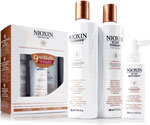
I am using Nioxin System 3 Scalp Cleansing Shampoo and Conditioner along with a daily multivitamin supplement designed for healthy hair, healthy skin, and healthy nails. As I said, I’ve had some definite results thus far, and am wondering at which point I should expect to see the full results?

NioxinI was not aware that Nioxin System 3 Scalp Cleansing Shampoo contained a DHT blocker, so I looked to their website. The company states that it is a “vitamin-enriched, daily leave-in scalp treatment – delivering essential botanicals, nutrients, antioxidants and vitamins onto the scalp skin and hair to help safeguard against environmental residue and DHT buildup on the scalp.

I don’t know how to prove that it does what it claims, and the FDA isn’t required to clear these types of products before they make it to market. It certainly is not approved by the FDA for claims of hair growth or as a DHT blocker, and as a physician I will not endorse it for that purpose.

The sebum containing DHT and requiring some blocker type of topical shampoo to manage it makes no sense. The sebum is not the problem. I would not expect to see any significant benefit in days or in a month, because the hair that grows out only grows at 1/2 inch per month and therefore there is no time for benefits to show. I am not sure what you are seeing, but it is not the result of blocking DHT.

I See Cyclic Changes in My Hair and Do Not Understand Them

Doctor can this happen on propecia. Ive been on it for 2 and half years with good results, maintained and thickened a bit, but my hair is weird. the first year on propecia it looked like it was getting worse, then into the second it started getting better over all. then again half way through the secong it looked bad again, and then a few months later it thickened again. I take pics, and that’s how I can tell. also there is a single hair that I excluded from the other hairs to follow and look at to see how it progresses, and to give me an overall picture on how the other hairs might be responding and growing. the last month or so that specific hair thinned and looked like it was gone, and then a few days a go I see It growing and thickening again. I know this is a weird email lol, but from you experiences does hair go through diff stages?

To be exact I started propecia in june 2013. from june 2013 to june 2014, it looked like I lost ground a bit, so I still stuck it with propecia. then around January 2013 my hair started looking good, and was thicker and the pics I took started to show a difference from the baseline. around april of 2013 my hair looked thin again and looked like I was reverting back to baseline. around august till about now my hair has looked its best. I started noticing new hairs sprout from the hairline that were not there before, and the looked so much thicker, and way different from baseline. its basically at its best. my question is why does it go through these stages? bad, good, bad, good, etc? is that normal?

Our hair will cycle and grow in different stages, so some hairs fall out while others grow from a stem cell that regenerates the hair follicle. You may be noticing some changes, but you cannot really say with scientific objective certainty what is really happening with just subjective observations or pictures. For example, dry frizzy hair in dry fall weather can make your hair seem voluminous, where oily damp hair in the humid summer days can make your hair seem flat and thin. Even different shampoos or hair products can affect how your hair may look and feel. For a more accurate analysis, we try to quantify it with measurements such as a miniaturization study and hair bulk measurements and compare the values on a yearly basis.

Finally, you need to understand that being on Propecia does not mean your hair loss will stop. Based on your genetic predisposition you will continue to lose your hair to the predestined hair loss pattern. Taking the medication (Propecia) means it will probably slow the process of hair loss down but each individual’s response to the drug is different. There may be some variations where you may notice less hair loss and more hair loss over the many months to years. We generally lose about 100 hairs a day (on the average), but this number is also highly variable with time for the individual. So I think what you are experiencing is likely normal.

Simply put, what you see may not reflect what is really happening. That is why we measure hair bulk with the HAIRCHECK instrument and also a microscope for a Miniaturization Study. The metric (numbers) what they instrument tells us, will allow us to compare a year ago to today and determine if you are really losing hair or not.

See a chronology of a balding man evolving into a hairy man with hair transplants (many photos)

This is a terrific story shown in photos in multiple surgeries. Congrats to the patient and the surgical team. It is important to note that the change was gradual, evidenced by the photos and I am sure that nobody saw the daily changes (like watching grass growing that you never see). People have always told me how surprised they were that nobody noticed, however, if anyone ever looked at an old photos, then they would know for sure.


2017-09-14 10:53:36See a chronology of a balding man evolving into a hairy man with hair transplants (many photos)