
2019-10-09 10:31:452019-11-06 16:36:26NHI patient tells his story from before his hair transplant to growth at 4 months (Video)
2019-10-09 10:31:452019-11-06 16:36:26NHI patient tells his story from before his hair transplant to growth at 4 months (Video)
Video: NHI on California Adventure TV
When we did this interview and video shoot for California Adventure TV, the host was very excited and she showed it in this piece. Can you imagine why we got excited?
And in case seeing a beautiful woman talk about hair loss treatments isn’t enough to get you to watch it, the video also gives a brief look at the Scalp MicroPigmentation (SMP) process.
This is a review of a mid 70’s retired healthy active man who wanted to look like the way he felt.
He had 1657 grafts to the front areas to give him a younger non-balding frame to his face.
The results were better than the patient and his wife anticipated. Actually his wife complained that when they went on vacation people came up and asked if they were mother and son!

New Hair Institute Review of 1657 graft Hair Transplant

New Hair Institute Review of 1657 graft Hair Transplant

New Hair Institute Review of 1657 graft Hair Transplant

New Hair Institute Review of 1657 graft Hair Transplant
2014-09-19 04:30:222014-09-17 12:48:26NHI Hair Transplant Review of Mid 70 Year Old (Before & After Photos)
Hi Dr. Rassman,
Thanks for this site. It has helped me with several of my questions on multiple occasions. My question is this: I followed one of the links on your site to Bernstein Medical and noticed that you have some pictures in your before and after sections that are of exactly the same people. The caption on his site reads: “view results of patients treated at our New York and New Jersey facilities using Dr. Bernstein’s pioneering hair restoration techniques.” Your website says that the pictures are all of NHI patients. Why do you have pictures of many of the same exact patients, and how does a customer know which patient was treated by which company?
These pictures are a big part of helping me decide where to get a transplant, and it is confusing seeing the same pictures on both sites so I really appreciate your answer.
Thanks.
Dr. Robert Bernstein was part of the New Hair Institute from January 1995 – December 2004. These patients were treated by Dr. Bernstein and the NHI staff during these years. When Dr. Bernstein and I divided up the practice, the NHI staff in the east coast offices (that he and I trained) stayed with him. I had no interest in opening up another office at this time and have been trying to simplify my life with less offices. The split between Dr. Bernstein was only a business separation, as we continue to work together, sharing everything we do in this field. Any breakthroughs that either of us make are shared or jointly developed. We have continued to write scientific and clinical papers together for publication. I believe that Dr. Bernstein and I are doing almost identical work and that is because we developed almost everything together and published what we did so that the world knew it was a joint development. The patients that are shown on both sites were done by Dr. Bernstein, but they were actually patients of the New Hair Institute when Dr. Bernstein was working exclusively with us. Therefore, the photos should be on his site as well as NHI’s site.
Dr. Rassman,
Thank you so much for your answer concerning the two shoulder injections of cortisone!
I also have acid reflux,& had taken nexium, but stopped it after noticing hair loss more accelerated than usual. Are you aware of any hair loss associated with Nexium, as this drug seems to work best with GERD, & will regrowth occur after suspension? Also does regrowth generally occur with hair lost to seborrheic dermatitis, if treated? Thank you again for your prolific insight!
Nexium can cause hair loss, though it is a rare side effect. Seborrheic dermatitis rarely produces hair loss unless you scratch it and produce traction alopecia by continuously pulling at your hair.
2006-05-25 12:34:372006-05-25 08:52:26Nexium and Hair Loss?
I smiled when I saw these illustrations. Men often grow hair on the face and sideburns in many different iterations when they don’t have head hair. These photos are a look back in history over the past 150 years.
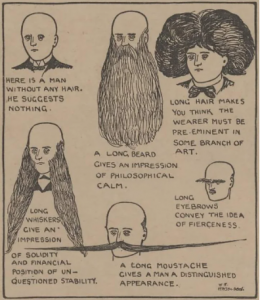
In my daily research, I came across 2 articles worth mentioning…
When I read the stories in these links, it was clear that I, the reader, was being hyped. But when you are desperate for hair — losing more and more of it each and every day, depressed when you run your fingers through it and notice that there is less today than yesterday, see the hair go down the shower drain or come off on your fingers when you shampoo, and when you see the person in the mirror you immediately wonder, “Could that be me? NO WAY!” — you take notice of each and every story out there that could possibly lead to the solution. Are you getting the picture here? Put these thoughts in your head and then read those above ads posed as actual news and all of a sudden, there it is, the cure you have been looking for. Yeah, right. The hope offered by this Arizona-based hair center is about as refreshing as a glass full of air. At least it says they offer a money-back guarantee. I have reviewed the limited published results of these hand held lasers and there is no evidence I could find that indicates that they actually work. Hey, maybe I am wrong — I’ll continue to hold onto hope but I am not going to get into a fight to get my few hundred dollars back when the reality of this hand held laser hits me and I find out that the business entity that made the guarantee is in bankruptcy. That would just make me lose more hair thinking less of the guy in the mirror and more foolish.
2006-05-18 10:33:572006-05-18 12:27:10News Articles – Laser Hair Growth
Newb here. Thinking of getting a hair transplant and needed advice from tressless
By observing mouse hair follicles, scientists discovered an unexpected mechanism of aging. “If I didn’t see it with my own eyes I wouldn’t believe it,” one said.
Every person, every mouse, every dog, has one unmistakable sign of aging: hair loss. But why does that happen?
Rui Yi, a professor of pathology at Northwestern University, set out to answer the question.
A generally accepted hypothesis about stem cells says they replenish tissues and organs, including hair, but they will eventually be exhausted and then die in place. This process is seen as an integral part of aging.
Instead Dr. Yi and his colleagues made a surprising discovery that, at least in the hair of aging animals, stem cells escape from the structures that house them.
“It’s a new way of thinking about aging,” said Dr. Cheng-Ming Chuong, a skin cell researcher and professor of pathology at the University of Southern California, who was not involved in Dr. Yi’s study, which was published on Monday in the journal Nature Aging.
The study also identifies two genes involved in the aging of hair, opening up new possibilities for stopping the process by preventing stem cells from escaping.
Charles K.F. Chan, a stem cell researcher at Stanford University, called the paper “very important,” noting that “in science, everything about aging seems so complicated we don’t know where to start.” By showing a pathway and a mechanism for explaining aging hair, Dr. Yi and colleagues may have provided a toehold.
Stem cells play a crucial role in the growth of hair in mice and in humans. Hair follicles, the tunnel-shaped miniature organs from which hairs grow, go through cyclical periods of growth in which a population of stem cells living in a specialized region called the bulge divide and become rapidly growing hair cells.
Sarah Millar, director of the Black Family Stem Cell Institute at the Icahn School of Medicine at Mount Sinai, who was not involved in Dr. Yi’s paper, explained that those cells give rise to the hair shaft and its sheath. Then, after a period of time, which is short for human body hair and much longer for hair on a person’s head, the follicle becomes inactive and its lower part degenerates. The hair shaft stops growing and is shed, only to be replaced by a new strand of hair as the cycle repeats.
But while the rest of the follicle dies, a collection of stem cells remains in the bulge, ready to start turning into hair cells to grow a new strand of hair.\
Together with a graduate student, Chi Zhang, Dr. Yi decided that to understand the aging process in hair, he needed to watch individual strands of hair as they grew and aged.
Ordinarily, researchers who study aging take chunks of tissue from animals of different ages and examine the changes. There are two drawbacks to this approach, Dr. Yi said. First, the tissue is already dead. And it is not clear what led to the changes that are observed or what will come after them.
He decided his team would use a different method. They watched the growth of individual hair follicles in the ears of mice using a long wavelength laser that can penetrate deep into tissue. They labeled hair follicles with a green fluorescent protein, anesthetized the animals so they did not move, put their ear under the microscope and went back again and again to watch what was happening to the same hair follicle.
Video

What they saw was a surprise: When the animals started to grow old and gray and lose their hair, their stem cells started to escape their little homes in the bulge. The cells changed their shapes from round to amoeba-like and squeezed out of tiny holes in the follicle. Then they recovered their normal shapes and darted away.
Sometimes, the escaping stem cells leapt long distances, in cellular terms, from the niche where they lived.
“If I did not see it for myself I would not have believed it,” Dr. Yi said. “It’s almost crazy in my mind.”
The stem cells then vanished, perhaps consumed by the immune system.
Dr. Chan compared an animal’s body to a car. “If you run it long enough and don’t replace parts, things wear out,” he said. In the body, stem cells are like a mechanic, providing replacement parts, and in some organs like hair, blood and bone, the replacement is continual.
But with hair, it now looks as if the mechanic — the stem cells — simply walks off the job one day.

Image
But why? Dr. Yi and his colleagues’ next step was to ask if genes are controlling the process. They discovered two — FOXC1 and NFATC1 — that were less active in older hair follicle cells. Their role was to imprison stem cells in the bulge. So the researchers bred mice that lacked those genes to see if they were the master controllers.
By the time the mice were 4 to 5 months old, they started losing hair. By age 16 months, when the animals were middle-aged, they looked ancient: They had lost a lot of hair and the sparse strands remaining were gray.
Now the researchers want to save the hair stem cells in aging mice.
This story of the discovery of a completely unexpected natural process makes Dr. Chuong wonder what remains to be learned about living creatures.
“Nature has endless surprises waiting for us,” he said. “You can see fantastic things.”
2021-10-10 10:23:492021-10-10 10:25:12New Your Times Article Giving Insight into Hair Stem Cells
