What Class Is My Boyfriend’s Hair Loss? (with Photos) – Hair Loss Information – Balding Blog

Hello Doctor,

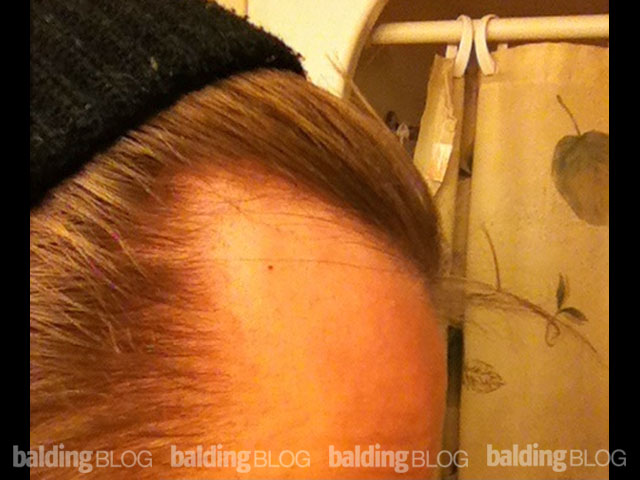
My boyfriend is rather paranoid about his hairloss, personally, I don’t see a problem… but I pointed him out to your website as I feel it’s a great source of information! My boyfriend has agreed to post some pictures so you can help determine his Norwood class, and he would also like to know if propecia and/or rogaine would be suitable to help him with his receding hairline! Thanks for your help! We look forward to hearing from you!

Block Quote

This is a Norwood class 3 pattern. I can not recommend how to treat him without seeing him. Generally neither Rogaine nor Propecia will reverse this pattern, but Propecia may prevent its progression to another more advanced pattern. Your boyfriend needs a good doctor.

I’ve posted the photos below. Click to enlarge.


Does the Age You Start Balding Affect the Final Pattern? – Hair Loss Information – Balding Blog

Hi Doc,

Two-part question for you: Does genetics determine what age we get MPB (for example, was I destined to start losing my hair at 21), and also, how does a mans’ age at which he begins balding affect his final pattern, if at all?

Block Quote

Norwood 4AThe start of hair loss is mainly genetic (according to our general understanding), but recent studies suggest that diet, lifestyle and other factors such as stress, will also impact the start and rate of balding. It is believed that our final pattern is predetermined. That means if it is meant to be a Class 4A (see image at right), then the variable will be the rate of achieving that final pattern. A Class 7 will not evolve out of a Class 4A genetic pattern if the genes are not lined up that way.

I Want to Use Cream to Remove My Scalp Hair, But Not Permanently – Hair Loss Information – Balding Blog

Hello Dr. Rassman,

I’m a young man experiencing MPB, and I’ve decided I want to embrace it. I’d rather not shave my head since I find razors irritate my skin. My question is this: Do you know of any hair removal creams that are safe for use on the scalp? I’ve read varying reports that indicate Nair can damage the scalp. Furthermore, if I later choose to have a transplant or other hair restoration procedure done, would the earlier use of hair removal cream alter my hair’s regrowth in any way once I cease using the product?

Thanks for your informative site and the time you devote to answering all our questions!

Block Quote

There seems to be many warnings on using depilatories such as Nair. The warnings suggest chemical burns and damage may result from their use on the scalp. It appears that your options are limited to shaving. Try different razors or shaving creams to see if that helps reduce irritation.

Hair Loss InformationRepliCel Results to Be Released in Q1 2012 – Hair Loss Information – Balding Blog

Hi Dr. Rassman,

I was wondering if you had read the recent posting concerning Replicel’s technology and initial results that will be released Q12012.

Link: RepliCel’s cell-based solution to hair loss

The reason that I ask this question is to see if you had any ideas or guesses as to who (of the companies performing research in this area) might have the best odds of delivering a viable solution? I had heard that a few of the companies presented at ISHRS-Alaska and it appears they realized the initial approach (followed during the past 5-10 years) was the wrong route. Aderans is using the dermal papilla cells while RepliCel is employing the dermal sheath cup to produce the replicated cells for later injection into the patient’s scalp. Guess that we will have to wait until Feb. 2012 for the clinical trial results. One good sign is that they filed their protocols on the FDA website which allows their approach/results to be a bit more “transparent”.

Block Quote

Thanks for bringing this to our attention! This is a good read for our audience.

I really have no best guess as to which path will be the most successful, but like everyone else, I’m hoping at least one of the paths turns out to be successful. The more proven treatments available for those with hair loss, the better. I guess we’ll know more early next year when the early results are released, though the article says the study won’t conclude until August 2013.

Hair Loss InformationIn the News – Insomnia Raises Heart Attack Risk? – Hair Loss Information – Balding Blog

Snippet from the non-hair loss article:

People who struggle with insomnia appear to be more prone to heart attacks than those who typically get a good night’s sleep, a large Norwegian study has found.

In the study, published Monday in the American Heart Association journal Circulation, researchers conducted a comprehensive health survey of more than 52,000 adults, which included questions about sleep quality. Over the next 11 years, roughly 5% of the participants had a heart attack for the first time.

Compared to solid sleepers, those who had trouble falling or staying asleep nearly every night were 45% and 30% more likely to have a heart attack, respectively, even after the researchers took into account age, blood pressure, cholesterol levels, and other factors that can contribute to heart disease. People who reported feeling tired or unrefreshed after waking up at least two mornings per week were also at greater risk.

Block Quote

Read the rest — Insomnia May Boost Heart Attack Risk

You can find the abstract of the study here. While the study concludes that the risk is moderate, it this is an important health issue that many of us just do not take into account.

Hair Loss InformationPropecia Sufferers Are Misdirected and Belittled – Hair Loss Information – Balding Blog

In a recent blog post you wrote about sexual side effects associated with propecia use, “These side effects are reversible withing one to two weeks after you stop the medication.” You then went on to say that Dr. Irwig’s study in Journal of Sexual Medicine was not a scientific study.

When you read through the FDA hearing on Propecia (FDA link) Keith Kaufman of Merck talks about the 3.8 percent of finasteride users experiencing side effects versus 2.1 percent of the placebo. He then goes onto say that these patients then completed a validated sexual function questionare. I am not a doctor but Merck basically based these figures on self reporting, should those numbers not be considered scientific?

In July the Dr. Irwin Goldstein the Editor-in-Chief of the Journal of Sexual Medicine wrote “I think of the frequent phone calls I receive from distressed men with varying degrees of hair loss who have used 5 alpha reductase inhibitors and now have newly manifested sexual and cognitive complaints that often persist despite discontinuation of the 5 alpha reductase inhibitor. Often such 5 alpha reductase inhibitor users have sought help only to be belittled, betrayed, misdirected, and sometimes misinformed. In general, these patients feel deceived becuase of the lack of information warning them of the potential side effects.”

I am one of the individuals suffering from persistent sexual dysfunction after stopping propecia and it appears pretty certain to me that in a small subset of men the persistent sexual dysfunction is due to the medication.

Block Quote

I am not going to get roped into an anti-Propecia agenda. I will leave that up to those who regularly comment on almost every post where the word “Propecia” appears.

My heart goes out to you if you actually have long-lasting sexual side effects, but the questions of validity ring true to your cause of sexual dysfunction. I am not in a position to judge your problem or to put the pieces together for you. That must be between you and your doctors. I am a doctor, but the posts here are just my opinions on my blog. Some may not agree with me, but that is OK! As the disclaimer on every page says, BaldingBlog is not a place for treatment advice or diagnosis. If the readers want to discuss their issues on a professional basis, they can always make an appointment and see me.

I will post an interesting excerpt from the 1997 FDA Drug Evaluation Hearing that you quote (the last sentence particularly worth noting):

We attempted to obtain followup on all patients reporting sexually-related adverse experiences. Of the 36 patients on finasteride reporting these adverse experiences, 21 reported resolution of the adverse event while continuing finasteride therapy. Seven reported resolution following discontinuation from the study, and seven had persistence of the adverse event while continuing in the study on finasteride therapy. The pattern for patients on placebo was essentially similar, with most patients resolving either on or off drug, four patients reported persistence of the adverse event while remaining on placebo therapy.”

Hair Loss InformationI’m 23 Years Old and Want a Hair Transplant – Will I Regret It in 10 Years? – Hair Loss Information – Balding Blog

Hi,
I am a 23 year old male seriously considering a hair transplant. I am a norwood class 2 w/a naturally high hair line and diffuse thinning in the temples about an inch back and slight thinning in the front (minor). I have been on finasteride for 2 years and rogaine foam (on the hairline) for 2 years. I have a few uncles on my mom’s side who are norwood 5’s and some uncles on my dad’s side who are norwood 2’s and 3’s. My dad is a norwood 2a.

I have been to two hair transplant surgeons who both said I was a good canidiate because I have good donor hair and I’ve halted/slowed my hair loss with finasteride. The surgery would be a conservative approach to establish a mature hairline. I’m not trying to get my adolescent hairline back. They each recommended btw 800 and 1000 grafts via the strip technique.

I know I am young but what do you think? Will I regret this in 10-20 years? Is shock loss a major concern in my case?

Thanks.

Block Quote

You need to find a great doctor that is known to be honest — not one that wants your money instead of giving you what you need. A good relationship with a doctor you trust will be critical to the decision making process. I cannot say the recommendation you got was good or bad, as I haven’t seen you. Some 23 year olds are excellent candidates, some are not. If you do go through the surgery, hopefully the Propecia will limit or prevent shock loss, but there’s no guarantee.

It seems you are having doubts and that raises a red flag for me. Unfortunately I cannot give you a diagnosis, recommendation, or prognosis here.

Hair Loss InformationI’m 21 Years Old with NW6 Pattern and I Want SMP – Hair Loss Information – Balding Blog

I am a 21 yr old male diffuse thinning in the NW6 pattern. I am currently on finasteride but I know it will not last forever.

Is this look possible with SMP? It is pretty much the only hope I have left.

Block Quote

Yes, this is a good option… but you must get educated on the facts that go along with it. Remember, this is a permanent decision so it needs to be thought through carefully.

Here is a 22 year old in your similar situation — Client 17. He started losing his hair when he was 16 years old and had worn a hat everywhere he went. After the SMP procedure he told us he went out for the first time without a hat on! SMP is not for everyone, but it does have its use in certain segments of the balding men.

Hair Loss InformationScalp DHT vs Serum DHT – Hair Loss Information – Balding Blog

Dear Drs,

I was wondering which is the difference between “scalp DHT” and “serum DHT”. I guess “scalp DHT” needs “serum DHT” concentration to reach the scalp; am I right? Then, what means in the dutasteride/finasteride studies the differentiation of “scalp DHT” and “serum DHT”?

I know Avidart inhibits, 90% of serum DHT and 55% of scalp DHT, what it mean? The 55% is inhibited from the total DHT or from the 10% (respect the 90% serum inhibit)?

Thank you.

Block Quote

When a drug like finasteride is introduced into the body, it works its way through all of the fluid systems of your body. In theory, almost every cell in your body gets exposed to the drug and some of the cells will do something to the drug. So when you take this finasteride pill, 50% of it will remain in your blood stream after 4-6 hours, and every 4-6 hours the concentration halves.

The drug then works its way into the body fluids around the cells, and it may (finasteride does) attach to the hair follicles and the skin of the scalp. Slowly this process reverses (probably about a week), as the drug does its job on the individual hair follicles, minimizing the DHT. This DHT working, becomes less effective because of the competition for the sites in the cell. That is a very simplified way to explain how it works.

As I’ve said before, I am not a biochemist. I really do not know how scalp DHT or serum DHT are measured.