FUE vs Strip — A Technical Analysis

This comes from prominent New York hair transplant surgeon, Dr. Michael Beehner:

With FUE, it is easy to fracture the neck of the base of the follicle when the bulb is “naked” and then grasped for placement, while in microscopic dissection with a strip harvest, there is good fat around the base of the follicle and fracture of the hair follicle almost never occurs during placement. When all of the people placing the grafts have to grasp the naked follicle, I think this causes a kink on the end of the exposed follicle and may be accompanied by poor growth.

Quite frankly, I wish that, instead of our always talking to the patient about the choice between FUE and “strip” harvesting, I would rather talk about FUE vs. “microscopic dissection of grafts”, because this is where the biggest difference is between the two procedures. Also, the FUE often strips the end of the graft as it is being pulled out, leaving less tissue and fat on the end. With strip harvest and microscopic dissection, the doctor’s staff have total control on how that graft will be produced and we never see stripped grafts. Also, the fact that in a strip surgery, we are always taking the strip from the absolute richest center of the scalp where the best hairs are, this makes the choice difference for me a “no-brainer”.

I have no trouble convincing 95% of my patients who walk in seeking FUE to go with strip when I present the FUE problems to them this way. I explain all of these things and reassure them that many patients have almost undetectable strip scars.

We wrote about Follicular Unit Extraction (FUE) vs Strip (FUT) nearly two years ago: FUE vs FUT — Which is Better?

When you look at a follicular unit, you will see all of the anatomical parts that are traditionally created from a strip harvesting technique. All of the critical anatomy is preserved as the grafts are dissected under a microscope from the strip harvest. Damage, providing that the grafts remain hydrated, is rare and growth is excellent.

When FUE’s are done, the follicular units are not-infrequently disrupted in some manner, and these grafts may not grow as well as a result of the disruption. This is shown in some grafts that we put aside for trimming when a patient had the type of collagen that resisted the extraction in the FUE process. This is viewed here. Once these second class grafts are trimmed, they must be grasped with a forceps at the bulb or just above the bulb, which can fracture the hair shaft (this is what Dr. Beehner was talking about above).

With good instrumentation and considerable experience, FUE can be done as successful as with a strip; however 100% of patients do not have a tissue anatomy that allows such a clean FUE. This was discussed in our pioneering article that introduced FUE to the medical profession.
Full Contact Sports After a Hair Transplant

I train regulary in full contact fighting sports. How long would I be out from training after a hair transplant???

If your surgery was done using the FUE technique, 7-10 days should be adequate (or until the scabs have gone away) before resuming your training. For a surgery done using the strip technique, I would wait 4-6 weeks.


2009-08-11 08:36:52Full Contact Sports After a Hair Transplant

Fungal Infection In Recipient Area a Month After My Transplant

Hi, I received a hair transplant FUE type, nearly two months ago. I am a male and aged 46 years. After the first month i developed bumps of dry scalp on the transplanted area only. The Doctor stated that this was a fungal infection, so i started using Nizoral shampoo after using this shampoo for 15 day’s the condition has cleared. My question is, will this effect the hair transplant and the growth of the graphs, to become a successful hair transplant.

Thanking you for you professional advice.

I’ve never seen a fungal infection following a hair transplant, so I have no experience with this type of situation as a point of reference. I would think that if the infection is gone it should not impact your hair growth, particularly since the infection occurred a month after the transplant. That being said, I would ask these questions to your surgeon and hope for the best!

If one of my patients had a fungal infection, I would get the opinion of an expert who works with fungal infections (perhaps a dermatologist). Good luck.

FUE without taking finasteride

I did research and saw it’s important to take fin for a year prior to FUE, but did my research a little too late, and discovered this sub after I had my FUE a week ago…. It’s too late to turn back time, and I started taking fin now post-op, but I have anxiety that my FUE will be a waste and unsuccessful. Will my transplanted hairs survive if I never took any fin/min prior to FUE, but will continue to do treatment after my FUE?

FUE harvests the hair from the back and sides of the head which are never DHT sensitive, so finasteride has no impact on these hairs. If the FUE was done by a good surgeon with a good team, they will grow and last your lifetime; however, your native hair around the hair transplant may still be impacted by your balding process made worse by the FUE surgery. This is particularly relevant if you are in your early 20s, so I don’t do surgery on men under 26. The older you get, the more secure your native hair will be. Finasteride started prior to your FUE will protect the native hair in most men.

FUE Without Shaving the Donor Area?

Dr. Rassman,

Thanks for the good work of educating us on hairloss on this website. You may not recall but I came to your clinic in December last year. One of the main questions I asked was whether it was possible to do FUE without shaving the donor area. You showed me a picture of a patient with “stripped shaves” as a way of hiding the surgery.

Recently, I came across Dr.Cole’s website. The website talks of a technique in which FUEs can be harvested without shaving your hair. I find this an interesting prospect as I would not want to have evidence of my transplant when I go to work.

Is this something that you may consider doing at NHI?

Here is the link: Forhair.com

I must be missing something. I read the link you suggested, but it sounds like what we’ve been doing for years… which is to clip a small area of the donor to extract the grafts. It allows those having FUE to maintain their same hair style, as the hair just above the donor area will cover the clipped part. The link you sent seems to just talk about how Dr. Cole’s patients now don’t have to shave their entire head.

At NHI, we do not completely shave the head to do FUE, as shown in the photos here.

Full Head of Hair with Shedding

My hair right now is very thick, and my hairline is a Norwood 0-1.5 depending on who looks at it. But sometimes when I’m showering and also when I put gel in my hair, I notice that some of the hairs that shed are very thin. They are so thin that they are hard to see unless you are looking for them. Other hairs that shed are very thick and can be felt on my hands, while the thin ones can’t. Is this a bad sign?

You may be seeing miniaturized hairs that are falling out. Miniaturization is part of the early balding process. A good video microscope purchased from Amazon for under $20 can tell you if you are miniaturizing. You can read my many posts on miniaturization on BaldingBlog.com (https://baldingblog.com/?s=miniaturization+hand+microscope&x=0&y=0).


2018-06-22 13:00:06Full Head of Hair with Shedding

Fungus on Scalp

i had to move out of my home due to fungi spores outside home was over 5000 and was consuming the inside of new home also. i am very allergic and had to be put in hospital, i have been on flagyl for 3 wks now and i still have bacteria,and fungi internally and on scalp. is it normal to constantly pass black and red dots from scalp and is this scalp fungus? going bald,and intense itching for 6 months now. please give any suggestion. thank you so much

It sounds like you have some serious issues. I would follow the recommendations from the doctor who is treating you. It is impossible for me to give you any medical advice over the Internet, as I am not your doctor. I can only give general opinions as a doctor. I do not know what “black and red dots” you are passing on your scalp, and I would have to see them to get an idea of what you’re talking about. It certainly does not sound normal.

Again, you need to ask these questions to your doctor who can actually examine and see what those “black and red” dots are. Sorry.

Funny Patient (with Photos)

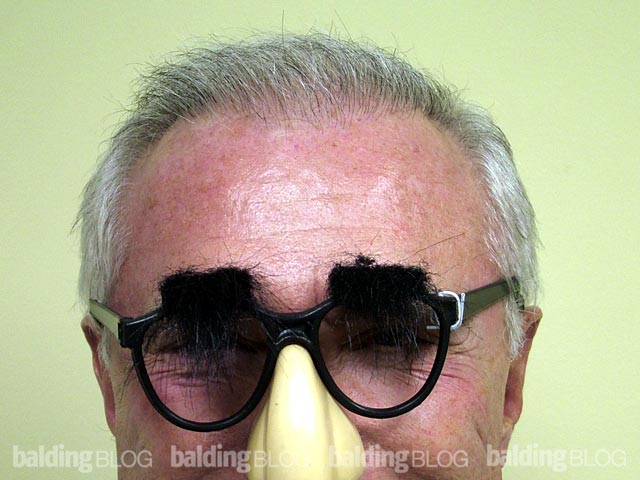
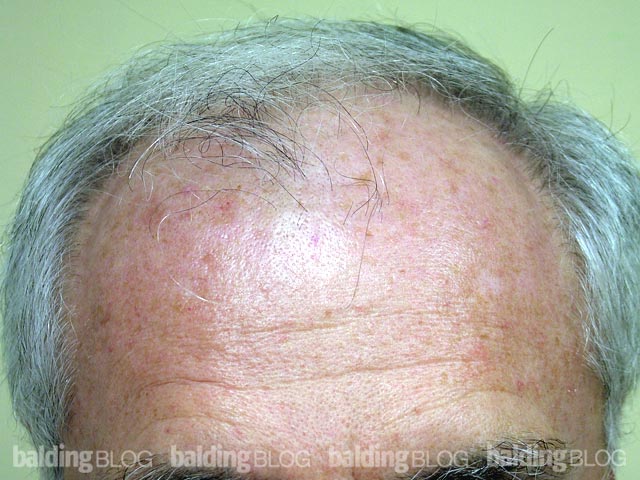
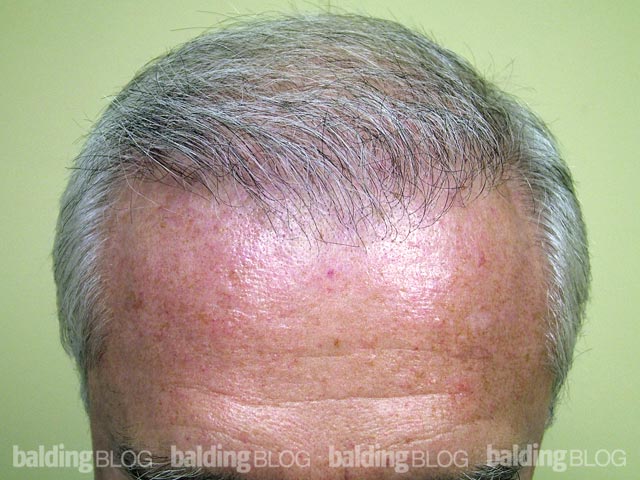
The photos below are of a patient who came to my office yesterday, now 11 months after his transplant of 2403 grafts. When he saw his before pictures, he asked me to cremate them because that man no longer existed. We had a great laugh together as he shared his own amazement of the transformation which he had not fully appreciated until he viewed those old photographs. The humor took another step as he put on the Groucho Marx mask that we bought to give to his grandson. It was one of those joyous experiences that I see day after day. For me, it’s the impact on peoples’ lives that really makes my day.


This patient is a Norwood Class 6 with salt & pepper, medium fine hair. “Before” on the left; “After” in the middle and on the right.