Not Hair Loss News – Dementia Risk 122% Higher With Low Levels of Vitamin D – Hair Loss Information – Balding Blog

Older patients with very low levels of vitamin D have about a 122% increased risk for dementia compared with those with higher levels, according to a large, prospective, population-based study.
Pauline Anderson
August 06, 2014

The study provides “robust evidence” of the link between vitamin D and cognition and adds important new information to the association, said study author David J. Llewellyn, PhD, senior research fellow in clinical epidemiology, University of Exeter, United Kingdom. “

Block Quote

For those of you who have elderly parents, this is an important piece of information for you. Testing for Vitamin D levels in your blood is easily done in most doctor’s office and taking vitamin D is even easier.

Minoxidil and Caffeine 2.5% May Be Better Than Caffeine Alone – Hair Loss Information – Balding Blog

Golpour, M. Rabbani. Comparing the effectiveness of local solution of minoxidil and caffeine 2.5% with local solution of minoxidil 2.5% in treatment of androgenetic alopecia. Journal of Mazandaran University of Medical Sciences. 2013;23:29-36.
Abstract: Background and purpose: Androgentic alopecia (AGA) is physiological hair loss induced by androgens in genetically predisposed persons. Different medications have been suggested to treat AGA until now but there is no certain treatment. This study aimed to compare the effect of caffeine + minoxidil topical solution 2.5% and minoxidil topical solution 2.5% in AGA treatment. Materials and methods: In this double-blind randomized clinical trial study 60 patients were enrolled. The sampling method was simple classification and patients were divided to 2 equal groups. The first group received minoxidil topical solution 2.5% and the second group received caffeine + minoxidil topical solution 2.5%. Method of treatment was the same in both groups (one milliliter of solution was applied twice a day) and follow-up was by computation of hair numbers on alopecia area in scalp. Both groups were followed in 7 stages: at the beginning of study and the days 7, 30, 60, 90, 120, and 150. Results: Caffeine + minoxidil topical solution 2.5% was more effective than minoxidil topical solution 2.5%. There was a significant statistical difference between the groups. Conclusion: This study overtly showed that the effect of caffeine + minoxidil topical solution 2.5% to treat AGA was better than minoxidil topical solution 2.5%. We suggest more studies with greater sample size and longer period of follow-up

Block Quote

This study, as stated in the abstract, uses only a small population. Also, it is not clear that the increase in the number of hairs with Minoxidil and Caffeine 2.5%, produces enough hair to be visibly improved. We have seen benefits of Minoxidil, but only 15% of subjects have significant visible benefits. Clearly, more investigation is needed before the FDA will allow such a treatment on the market.

Can I Die From a Surgical Procedure Such As Hair Transplant Surgery? – Hair Loss Information – Balding Blog

The risks of having a complication or dying from a surgical procedure is small in some cases but clearly not insignificant. I found the following article which not only outlines the problems concerning the long-term risks of any major surgery, but also the article had some suggestions for doctors on how to go about assessing the risks. There is no easy solution.

Introduction of article: “Owing to increases in life expectancy, the patients presenting for surgery are older, and have more co-morbidities. Worldwide, 3–4% of patients die within 2 months of major surgery, with increased mortality and morbidity in high-risk surgical candidates, including the elderly and medically unwell.[1,2] In Australia and New Zealand, older patients having non-cardiac surgery have a 20% risk of serious complication and a 5% risk of dying within 30 days of surgery.[3] The cost to patients and the community is enormous. In a cohort of 806 534 Medicare beneficiaries having surgery in America, 51.5% of patients discharged after a surgical procedure had either died or been readmitted to hospital within a year, and 70.5% of re-admissions were for a medical problem.”
(*) Above quote was taken from the British Journal of Anaesthesia, 2014;112(6):955-957., “Not Fit for a Haircut … How Should We Assess Fitness and Stratify Risk for Surgery?” by M. A. Shulman, B. R. Thompson

Block Quote

As part of the informed consent for any surgical procedure, even a hair transplant, patients must fully understand the risks to life that confront them. I am aware of two deaths from hair transplant surgery, probably the result of doctors inexperienced with the use of medications such a Xylocaine (Lidocaine). One of those cases involved a non physician involved with surgery. That person is still out there offering discount hair transplants last time I checked. How he is still allowed to conduct business is beyond my understanding.

Many years ago, I was the guest speaker at a major medical meeting where the audience numbered about 300. At the end of my speech, a doctor came to the microphone from the audience and ask the following question (from the best of my memory) “I am seeing some of my patients complaining of numbness of their fingers and lips. Have you seen that complaint?” I asked him to see me after the meeting and found out that as his number of grafts were increasing with each surgery, he was increasing his dose of Xylocaine. Numbness of the lips is a sign of Xylocaine overdose and it may be followed by seizures and/or a drop in blood pressure. When I told him, he was shocked and relieved. He asked me why I did not get that side effect. I told him that more anesthesia was unnecessary with large hair transplant sessions. He thanked me.

Doctors must command every medication they use and the complications of that medication. Even hair transplant surgery has its risks. People have hair transplants even with known heart disease, kidney disease or liver disease. These diseases could impact the results of a hair transplant surgery and I am sure you would want to know that you doctor is prepared for all such eventualities. Both Dr. Pak and I are routinely certified for Advanced Cardiac Life Support every two years as part of our preparedness. Fortunately, in the 24 years of performing hair transplant surgery at NHI, even thought we have done hair transplants on many men over 80, some with known cardiac disease we have never had a complications from a hair transplant procedure that required our advanced (non hair transplant related) training.

Hair Loss InformationCan Scalp Micropigment SMP Cause Skin Reaction or Infection and Who Enforces This Process? – Hair Loss Information – Balding Blog

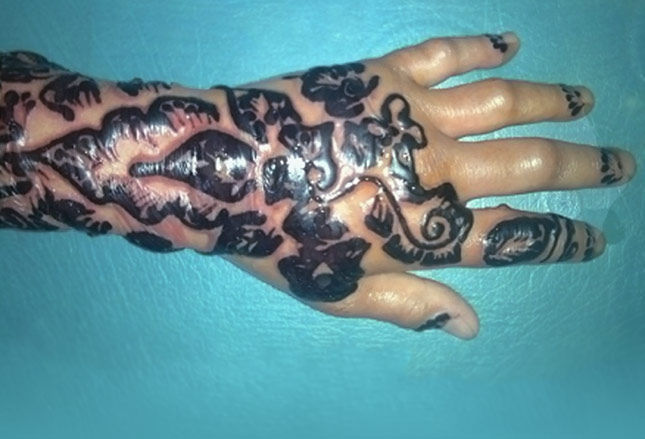
From Medscape by Terrence Keaney, MD, FAAD: “An allergic sensitivity to tattoo pigments is a common adverse reaction. Individuals may manifest sensitivity to a particular pigment in several ways, including contact dermatitis or photoallergic dermatitis. This image shows a bullous (or blistering) eczema allergic reaction to a henna tattoo.
tattoo infection
Image courtesy of the NIH.”

Block Quote

Tattoo and pigments under the skin can cause infection and reactions. We have not seen issues with infection associated with SMP at New Hair Institute. It probably helps that we are a medical facility and our physicians oversee and perform SMP. We are careful not to go overboard and are generally conservative in our decision making process. We give patients the option for a steroid injection to minimize any reaction. We perform a patch test before the SMP procedure to determine allergies to metals and any topical allergies to the tattoo pigments we use.

The regulations for business offering tattoo or permanent pigment (such as SMP) varies by state and city. It does require a license and registration with local authorities if you are not a licensed medical doctor.

Here is a link for Los Angeles Public Health

Can I Measure Miniaturization Of Hair With a iPhone And What Percentage of Bulk Measurement Is Normal? – Hair Loss Information – Balding Blog

For the Haircheck device what is considered a normal percentage for non-balding male 5-8% or more? what percentage would normal for a non balding male from the donor hair to
the hair on front,top and the crown?if some of hairs diameters look different when I take a picture up close with my iPhone is that normal for a non balding male my dermatologist said you really can’t do that unless you have digital handheld microscope.Can you tell miniaturization by just taking a picture of your hair? My dermatologist said I had no thinning or signs of male pattern baldness and I have thick hair. Thank you again and look forward to hearing back from you! Have a great day!

Block Quote

ruler
Bulk measurements measures an area of hair that is gathered in a particular area of the scalp. We take several measurement on different areas of the scalp. We compare the bulk measurement from area to area. The back of the head is our baseline as this area always shows what a normal bulk will be for each person. When we compare area to area, we can tell if the bulk in one area is less than the bulk measurement from the back of the head and by how much. For example, the top of the head may have a bulk measurement equal to 50% of the back of the head and this would indicate that the person lost half of his hair volume on the top of the head. We also look at the measurements taken over a period of time (about one year) to see if there have been changes. For example, maybe last year the top of the head showed a bulk measurement of 50% of the back of the head, but today it might show a bulk measurement of 25% of the bulk measurement from the back of the head (such a finding would show progression of hair loss over the past year). This way we can put a number or a metric to the hair loss or gain. This will help the patient in developing a long term plan. It’s better than a photo.

There is a margin of error of up to 10%. You can probably measure the same location at the same location within a minute and get a small variation in the measurement. Every doctor may be different in how they go about using the bulk measurements. The number values are not important if there is no one to give you the analysis or a meaning to the numbers so that you understand the big picture.

Finally, you can’t look at miniaturization with an iPhone or a photo. We look at miniaturization with a microscope that has a 50x zoom lens. Miniaturization is also looking at comparisons between one location of the scalp to another location and seeing if there is a pattern of very thin hairs to normal thickness hairs. This suggests some early balding if the number of fine hairs is significantly larger than the number of normal hairs; however, this is hard to replicate and as it measurement only an area the size of a pea, it is far less accurate than the bulk measurement made with the Hair Check instrument.

Hair Loss InformationSMP Scalp Micropigment to A Bald Patch On Temple Peaks (Triangle Alopecia) – Hair Loss Information – Balding Blog

Can you have SMP to patchy areas on your face?

Block Quote

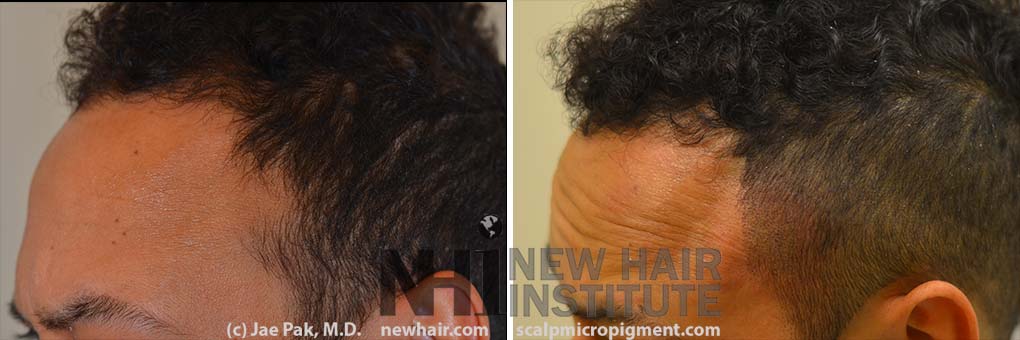
Here is an example of what we did for someone who was missing a patch of hair on the temple. It is known as triangle alopecia. While we generally can treat this with hair transplant surgery, this patient wanted a non-surgical approach using the SMP Scalp MicroPigment technique. He knows that he will need to keep his hair short on the temples to make it look natural (since SMP is not real hair).

Click on the photo for a larger image.

smp_134
NOTE: This photo was taken immediately after the SMP session so you can see the redness on the scalp. The redness usually subsides in 1 to 2 days. He realized he needs to keep his hair shorter to achieve a blended look.

Hair Loss InformationI Have A Wide Scar On The Back Of My Head, Is There Anything I Can Do? – Hair Loss Information – Balding Blog

Hi there I have scar in the back of my head very wide and I like to know if theres anything to make invisible when I shave bold I can see the big strip there, please let me know thanks!

Block Quote

Yes. The scar in the after picture here is still there. Can you see it? This is a typical result of our work with Scalp Micropigmentation?

SMP – Scalp MicroPigment to hair transplant scar

In addition you can check out this POST

Hair Loss InformationOne Session of 2678 Graft Hair Transplant With Photos – Hair Loss Information – Balding Blog

Very happy camper with terrific results after one hair transplant session. He was more than willing to allow me to show the dramatic changes. The before picture showed the distribution of the 2678 grafts on the day of surgery

For some of you that may think the results are still thin, the difference is that he now has a hair line. The density can be achieved with a future SMP Scalp Micropigmentation to the entire scalp.

IMG_3927BEFORE

resized_IMG_7342AFTER

Does Weight Lifting and Working Out Cause Hair Loss or High Testosterone and DHT? – Hair Loss Information – Balding Blog

I always find the online posts about the relationship between hair loss and weight training, most of the posts stated that weight lifting could increase the testosterone level, it will be bad for the hair follicles since more testosterone will transfer to DHT so that the follicles will be attacked more often by that. I know wight training can increase the male hormone level to build up more muscle, but I suspect that it will cause hair loss at meanwhile, do you think the statement making sense? Thank you.

Block Quote

popeye

Online Internet is as full of misinformation as it is with good information. Weight lifting does not cause hair loss in men (or women). The most common cause of hair loss in men is Genetic (called male patterned balding – MPB) or androgenic alopecia (AGA). It is not the testosterone (or even DHT). It is the genes that you inherited from your mother or father. If you have the genes for hair loss, then DHT (dihydrotestosterone) is one of the key hormones that seem to precipitate the male pattern balding. Propecia is a drug that impacts the way DHT works by competitively blocking the enzyme that converts testosterone to DHT at the target organ (in this case the target organ is the hair follicle). Many online and Internet sites take this information and infer that since DHT is derived from testosterone that an increase in testosterone will cause more hair loss. This logic is flawed and human biology does not work this way. You have to look at the main underlying reason for hair loss (which is genetic). If you are not confused about this thus far, you may find it interesting that testosterone is made from cholesterol (as is many other hormones). The online (bad) logic will dictate that high cholesterol will now cause hair loss but this is not the case either if you extend the logic saying that cholesterol is used to make testosterone which is needed to get DHT.

Hair Loss InformationI Want An FUE and SMP But I Have A Strip Scar And Don’t Want to Shave – Hair Loss Information – Balding Blog

I am considering a FUE op . I already have a strip from an older op. I will have to shave my scalp for the FUE . I was thinking i might have a SMP on the scar prior to the fue . The question is , can SMP on the scar be done without saving ? (please notice that after the FUE i do not intend to shave ever again ) . If so , how much time do i have to wait between the SMP and the FUE ?

Block Quote

You can have Scalp MicroPigment (SMP) to the linear strip scar first if you are thinking of shaving. Then the scar will not be as noticeable with the hair shaved and FUE can be performed. The time between SMP and FUE can be about one week (after your last SMP session). Keep in mind FUE will also cause scars (hundreds of tiny 1mm white dots). If you ever what to address the FUE scar with SMP you would need to wait about 3 to 6 months.

FUE after SMP = wait 1 week
SMP after FUE = wait 3 to 6 months

Finally you must ask yourself as well as your doctor the main reason why you are planning a FUE if you already have a strip scar. You can easily have another strip surgery without your hair shaved and all of this may not be an issue. Every patient and their reasons for doing such procedures are different so that is where the individual one on one patient to doctor relationship is important.

IMG_0999 FUE scar (before SMP)

IMG_1029 FUE scar (after SMP)