My Donor Area is More Coarse and Curly Than the Rest of My Scalp – Hair Loss Information – Balding Blog

Doctor,

The hair in the back of my head is more coarse and curly than the front. How does that work with a frontal hairline transplant?

The hair on the sides is the same as the front.

Thanks

Block Quote

In most cases, if the donor hair is curly then the transplanted hair will be curly. Wherever the hair is harvested from should remain the character of the hair when it is transplanted to a new site.

Many men with large differences in the character of their hair in front when compared to the donor area have early cases of thinning. A good examination of your hair bulk will establish this one way or the other.

Hair Loss InformationWhere Does the Hairline Belong? – Hair Loss Information – Balding Blog

There is an art and a science for placing hairlines. The normal midpoint of a mature male hairline lies 1.5-2cm above the highest crease of the furrowed brow. If you go to a mirror and lift your brow, you will see two things:

  1. Where the hairline was when you were 8 years old (it hugs the crease)
  2. By moving up 1.5-2cm above the crease, you will see where the central point of your hairline belongs

Some people do not raise their hairline to the 2cm point with a transplant, as they may go upward only 1cm as their hairline matures. But placing the hairline in the proper position is critical when the transplant is done and it is critical in your understanding of what constitutes balding versus the changes associated with a maturing hairline (which is not balding).

Here’s a patient’s hairline at 17 years old (left), and the same man at age 30 (right). Click the photos to enlarge:


My challenge was to help him select the proper location for his new hairline. I used the 1.5-2cm rule, and he was happy with what we drew. The photo here is just used to point out the change in his hairline over 13 years (an almost juvenile hairline to a balding Norwood Class 3 pattern). The actual hairline he chose was between the two lines (juvenile hairline and the highest receding point of his leading frontal edge). I could not help but wonder if he had taken Propecia when his hair loss began, would he have lost this much hair?
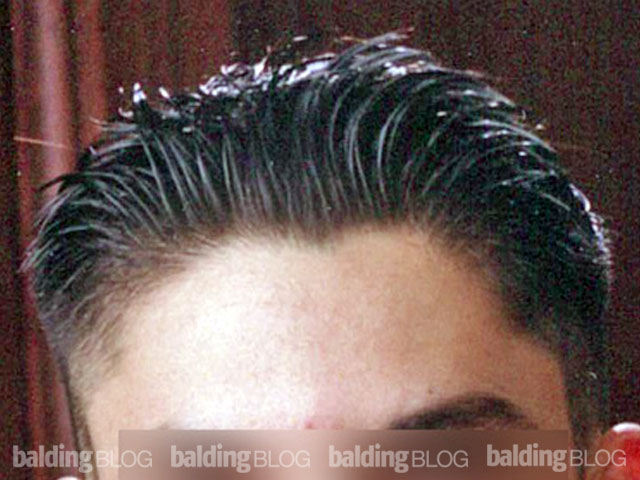
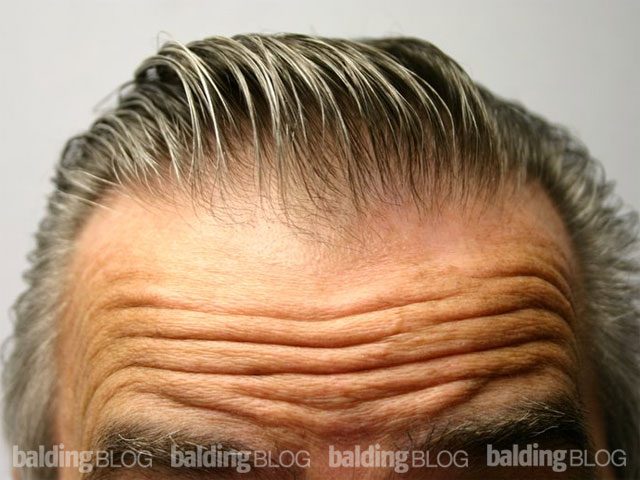
Oliver StoneEarlier this week I saw director Oliver Stone interviewed on CNN. As you can see from the photo at right, his hairline is significantly higher than 2cm from the highest wrinkle. There’s a larger version here. The hairline is strong, and the combination of a strong hairline and a high location suggests that this is transplanted. Even when the hairline looks OK, placing it in the wrong position (too high) can make some one look just “not right”. When a normal hairline moves up as high as Mr. Stone’s, there is usually some erosion of the hairs at the leading edge… but Mr. Stone has no such erosion. I have seen this pattern appear on the heads of hair transplant patients who had surgeons that just did not understand what constitutes a normal hairline location.

Sometimes people ask to have their hairline located higher than the 2cm point (above the wrinkled brow) to save hair for an expanding or expanded hairline for future hair transplantation, however, that dooms the patient to detectability of the transplant no matter how good the procedure was. So placing a hairline requires the 1.5-2cm rule for most people. The new hairline can be placed lower than 1.5cm, even as low as the crease of the furrowed brow, and that may look normal for that particular patient, but I generally do not recommend that a person brings his hairline to his 8 year old location.

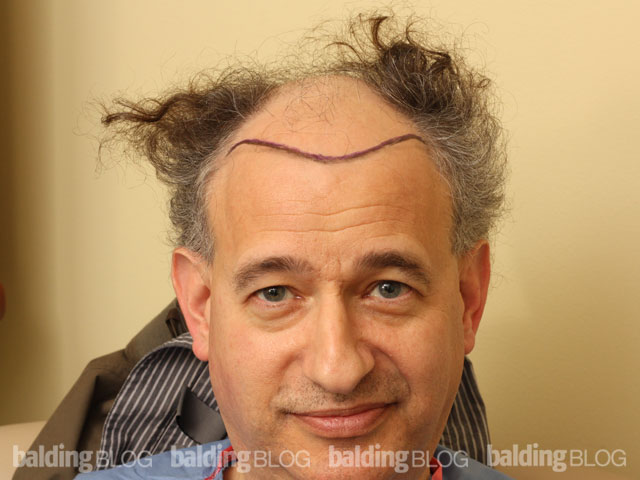
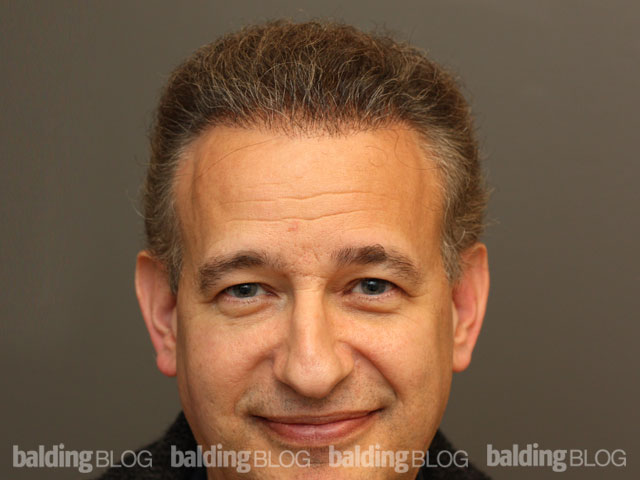
In the rare instance that I do agree to place the hairline at the highest crease (I have done this for a few actors), I always have this discussion with them. My hairline is 1.5cm above the highest crease and the hairline has never been transplanted, so I show our patients my hairline (see below) and ask them if they would like it for themselves. Nearly all patients given that challenge have agreed that they would take my hairline location. Click the photo of my hairline to enlarge.

 

Hair Loss InformationEyebrow Transplant of 189 Grafts (with Photos) – Hair Loss Information – Balding Blog

Hi doctors,
Are eyebrow transplants something that men have done? My eyebrows are not that thin but I am very particular about them, border line obsessive. Can I have maybe a couple hundred grafts done just to fill them in around the edges? Is this something that looks good when all is said and done?

Block Quote

Yes, we’ve transplanted the eyebrows of many men. I have a patient that sounds like what you’re describing, with great looking results that strengthened the overall brow by filling in the edges (and thankfully he’s given me permission to share his photos below).

This man had a eyebrow transplant procedure of 189 grafts about two years ago.

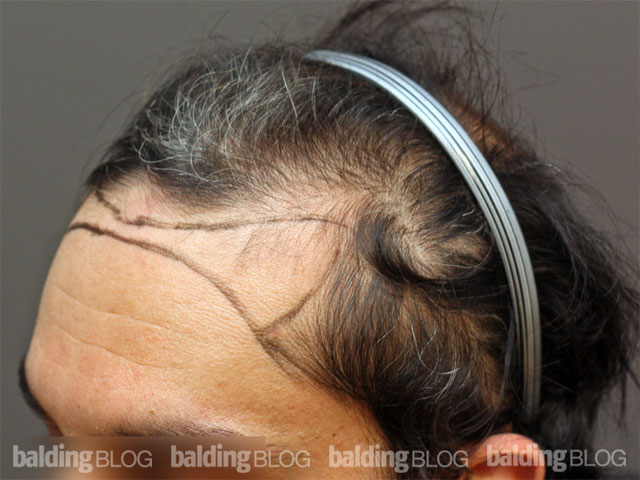
Before (with lines drawn in):


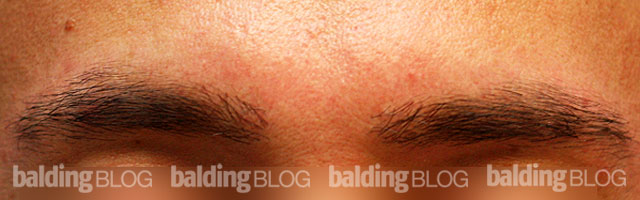
After (189 grafts in 1 procedure):


Hair Loss InformationHow Can I Help My Strip Scar Turn White Faster? – Hair Loss Information – Balding Blog

Hi,
Are there any ways to speed up the process of the strip scar turning white? I have had mine for just over 2 years and although it is slowly fading it is still a light pink colour. Does vitamin E or steroid cream help as I have heard people mention these.

Thanks!

Block Quote

I would ask your doctor first for an examination and a diagnosis for the correct treatment plan. Sometimes, just giving it time may be the best treatment. It generally takes over a year for a scar to settle, but if it has been over 2 years, I would consult with a doctor. Most of the time the redness is very difficult to treat.

Some doctors may recommend over-the-counter steroid creams, but the redness is sometimes due to superficial blood vessels, in which case a cream would likely not be effective. Be careful, as this type of medication can be absorbed by the body with prolonged use.

Hair Loss InformationDot Scarring from a Large FUE Procedure (with Photo) – Hair Loss Information – Balding Blog

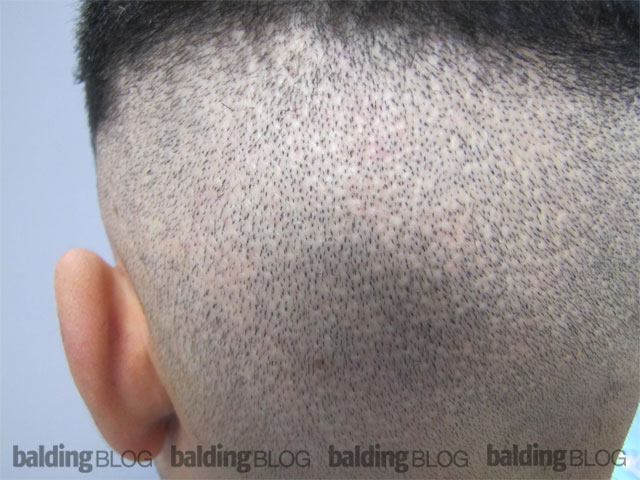
I (Dr. Rassman) have had a total of 2200 grafts in three strip surgeries over the past 20 years, the last one being 6 months ago. If you were to look at my single linear scar, most people (even with a comb in their hand looking for it) can’t locate it. My strip scar is certainly far less significant than the mottled scars from follicular unit extraction (FUE) in this patient below. To be fair, if the patient had let his hair grow slightly longer, the scars would be less visible.

This is not my FUE patient, but I was told that he had 2500 grafts extracted in one session four years ago (and saw extremely poor growth). FUE scars like these are very common, and as most people get FUE procedures because they want the option of cutting their hair very short without a linear scar, many of them can’t do so when these dot scars are so detectable. Click the photo to enlarge:


I grant that some patients will have visible scarring from a traditional strip procedure, but now with Scalp Micropigmentation (SMP) the linear scars can be made undetectable. The same treatment can make these ugly FUE scars undetectable.

My point for this post is that scarring occurs with all types of surgery. Scarring should not be the motivator for the choice of FUE over strip surgery. Considering the cost differential between strip and FUE surgery, this is just part of the calculation each person must do in making the decision between strip and FUE surgeries.

Does Transplanted Hair Have a Slower Growth Rate? – Hair Loss Information – Balding Blog

I had a hair transplant of about 1600 grafts almost a decade ago that gave me a great hairline that had been missing for years. I’ve always noticed that when I get a haircut every month or so, the barber will point out that my hair length is uneven in the front. The hair in the transplanted area is shorter than the natural hair in my crown and even at the back of my head. Then I get the hair cut even all the way around and a month later, the barber notices the same length issue.

Does transplanted hair just grow slower or could there have been some sort of damage done to the grafts at the time of the surgery to cause this? The results are amazing and its really not that big of a deal, but I’m just curious if you’ve had any other patients mention slower growth from transplanted hair. Thanks. Love the site!!

Block Quote

Transplanted hair should grow the same rate as the hair on the back of your scalp (where it was taken). However, I do not know of any scientific study that proves/disproves this assumption. Your barber may have made an astute observation, particularly if he sees this with all of his transplanted clients.

Can Propecia Possibly Thicken Hair or Is a Transplant Necessary? – Balding Blog

HI Doc,

I am a 30 year old Hispanic male who is currently experiencing significant hair loss. I’ve always had thin hair, but recently it’s very noticeable. I also have scalp psoriasis and sometimes use shampoo that contains salicylic acid, which I know weakens hair shafts. My question to you is: Can I use something like Propecia to thicken my hair or do I need a hair transplant to regain thickness (fullness)? Also, If hair transplant is needed, how many grafts does it look like I need. Please help, I’m willing to do anything to get my hair somewhat back to normal.

I have attached a picture of my hair/scalp. I give you permission to post my pic if you’d like.

Thanks

Click the photo to enlarge:


Propecia (finasteride) does not “thicken” hair that is thinning due to medication, but works for those who have thinning due to genetic male pattern baldness (androgenic alopecia). The medication does not work to thicken transplanted hair but will often slow down or stop further hair loss. If you have early hair loss, it’s possible that Propecia could be helpful to even regrow some of the top and crown, but I wouldn’t expect too much regrowth in the hairline. You should really talk to a doctor about your options after an in-person examination.

If you want a telephone consultation, send good pictures with your hair pulled back and your frontal forehead wrinkled upward. That will show me where the hairline belongs. Just based on a single photo, I can’t tell you if a transplant is in your future or how many grafts you’d need.


Related Posts Plugin for WordPress, Blogger...

Balding Forum - Hair Loss Discussion

Hair Loss InformationDo I Have Cobblestoning In the Recipient Area 10 Weeks After FUE Surgery? (with Photos) – Hair Loss Information – Balding Blog

Hi Dr,

I had an FUE surgery performed around 10 weeks ago in Europe. However, my hair transplant Dr has not been very helpful in post-patient care. Because of my concerns, I have since become quite depressed and worried about the future success of the transplant.

So I now I hope you can assist me, being on the other side of the world, there are few people here available that could help (I am from Australia). Specifically, do you think I have cobblestoning in my recipient area? Or a nasty case of follicultis? I have sensitive skin and it has stayed pink since surgery, so I was hoping you could address some of my concerns through the attached images.

If so, what recommendations could you make to removing the redness and/or follicultus/red dots?

Also, are the little pits around the hairs normal that are trying to break out? Do these go away with time? There are some dark hairs breaking through and lots of light blonde ones too.

Thank you very much for your help. Feel free to use my pictures.

Thanks

Block Quote


If you have issues after a hair transplant surgery (or any surgery) you need to follow up with your doctor/surgeon. In your case, you traveled to another continent for your surgery, but you should be able to email some photos to your doctor and speak with him/her over the phone. It’s unfortunate that your doctor hasn’t been helpful to you after your procedure.

In general, redness and folliculitis can develop with any hair transplant surgery and sometimes it just needs a good physician follow-up. This may involve something as simple as warm compresses, to something like a course of antibiotics. The reddened areas can persist for a few months on rare occasions.

I suspect you may be overreacting, but to find out exactly what is going on, an examination by a doctor is your best bet. You can always get a second opinion (visit the physician search at ISHRS.org for other doctors in Australia).

Hair Loss InformationIs It Common for People to Run Out of Donor Hair? – Hair Loss Information – Balding Blog

How often do people run out of donor hair? I have low density, straight Asian hair. I am already thinning, and my dad has a diffuse NW6 pattern. I am afraid that if I go for a hair transplant I will not have enough donor hair to cover my entire head. Is this a common thing?

Block Quote

This is a very significant question. An Asian has an average of 80,000 hairs on their head. A Caucasian has an average of 100,000 hairs on their head. The donor area can be exploited so much that you can see through it. That is a particular problem for Norwood class 5, 6, or 7 Asian patients who will not have enough hair to cover the entire balding pattern (on average), so I would expect that many of these patients with the higher degree of balding need to have a Master Plan created by the doctor to account for this problem. If I met with a typical Asian with a class 6 pattern, I would tell him (up front) that he will not have enough hair to cover his entire head. This is particularly important in Asians who have finer hair, as they will run out of donor hair earlier in the process. There are some solutions to this problem, but every Asian patient who has these advanced patterns of balding must be aware of the finite amount of donor hair that they have.

I see some Asians and many Caucasians who have run out of donor hair and are perplexed that their doctors never told them this truth. In many of these patients, the donor area is see-through and has become more of a problem then the balding area. Scars in the donor area compound this problem significantly.

I can write a book on this particular subject, so I hope that readers realize that I am just answering the fundamental question posed in this post.

Hair Loss InformationFollow-Up: Patient Results – Amazing Change in 9 Months – Hair Loss Information – Balding Blog

We received a few comments and a bunch of emails from people with questions about the patient results we posted late last week, so I wanted to provide some follow-up info. Here’s a before/after (2781 grafts):


The hairlines are always chosen by the patient in conjunction with the doctor performing the surgery. In this particular patient, I was the surgeon and we bonded well. His hairline was chosen to reflect my own individual hairline, a mature hairline in the truest sense of the meaning. I would put the hairline anywhere he chose, provided that it was a reasonable placement. In this case, the hairline was placed one fingerbreadth above the highest wrinkle of his furrowed brow. This man is in his 50s, but even if he was 25 years old this would not be an unreasonable hairline location. Hairlines should always stand the test of time.

Also, the fact that no one noticed the hair grow out is important. It is like watching grass grow — you never see it grow, but you see the change when you look back on the brown dirt where you placed the grass seeds. Hair is no different.

His results are typical for individuals with hair that is medium coarse character. He had no problem showing off his results, because he knew that he would be a good educational example for us. When he came to one of our Open House events prior to his surgery, he met with many patients who had results like he had, so a result like this was his expectation. Those expectations were clearly met.