
Could Restrictive Diet Have Caused Rapid Hair Loss?

I am a 19 year old male and since August of 06 I have lost a significant amount of hair due to shedding and maybe miniaturization (some hairs that fall out look much thinner than others). From about february 06 till august 06 i was on a very reduced calorie diet and lost about 80 pounds. I can’t help but think there is some connection between the weight loss and hair loss.

My first question is: could that restrictive diet have caused my early and rapid onset of hairloss? Also, I have currently been taking propecia for the last 2 months.

My second question is: will taking vitamins (which ever ones they say promote hair growth. ex.Vitamins B6 and biotin) along with propecia help promote new growth? or are vitamins ultimately uneffective against hairloss (assuming its MPB)?

Thanks for your time, and your site is by far the most informative i’ve found so far.

Nutritional deficiencies (or as you put it, restrictive diet) can cause hair loss. In addition, this may trigger a stress response and turn on a gene that may kick start your male pattern hair loss. Unfortunately, after the process has started it is difficult to stop the progression of hair loss.

In either case, you should have a balanced healthy diet. And if you are concerned about male pattern (genetic) hair loss, you should see a doctor to get the correct diagnosis. Propecia can only be prescribed by a doctor and even if it is readily available over the internet you should see a doctor for a correct diagnosis and appropriate follow up.
People that had FUT

What does your scar look like and what length can you hide it under? Like I usually get cut 3 on the sides and back, I have dark hair.

I had three hair transplants with strip surgeries. I can cut my hair to a one cut, and have no visible scar. Most people get just a line scar but 5% do get wider scars easily treated with Scalp Micropigmentation or wearing your hair slightly longer. Half of the hair transplants we do are with strip and the other half is with FUE and few patients complain of the scar as we are now using staples for the closures and they remain in for 3 weeks until the wound is healed. A minor inconvenience, I am told.


2020-09-15 12:15:44People that had FUT

Could You Stop Taking Finasteride If You Plan to Become Pregnant?

This is the directions I have been giving patients up to now: “You can stop the drug one week after your wife starts her period for a period of 2 weeks. If your wife has a normal 28-30 day cycle, then she will ovulate when you have a zero finasteride blood level, yet maintain enough finasteride in your hair to prevent withdrawal hair loss.”

UPDATE: Now there is some evidence that finasteride does cross into the uterus so the drug may not be safe, see here: https://baldingblog.com/more-on-finasteride-risks-in-pregnancy-from-reddit/ and here: https://baldingblog.com/responses-from-finasteride-can-cause-birth-defects-post/


2020-04-05 09:41:21Could You Stop Taking Finasteride If You Plan to Become Pregnant?

Peyronie’s Disease, a Deformity of the Penis

I found out that I have Peyronie’s disease and have been taking Propecia for some time. Is there any connection (cause and effect)?

I looked it up. One site said that Peyronie’s was reported in 6 of 4,700 patients on finasteride, which would be an incidence of 0.13% of this population. In the general population (even in those that do not take Propecia), the incidence is between 0.5 – 13%, and varies with age. That would suggest that Propecia is not a cause of this disease and perhaps (long shot) with its lower incidence with people on finasteride it even has some protective properties.

We’ve written about this before, but the connection is still unknown.

Creatine Supplements May Increase DHT Levels And Possibly Hair Loss

College-aged rugby players taking creatine monohydrate supplementation for three weeks had their Testosterone and DHT measured. The results of these tests indicated a rise in DHT levels when using this supplement in their diet. A rise in DHT levels can accelerate, at least in theory, the hair loss seen in genetically balding patients.

https://www.ncbi.nlm.nih.gov/m/pubmed/19741313/

Physicians Less Likely to Order Cancer Screening Late in Day or Late in the Week

This is a very distressing article. It suggests that you are getting better medical care in the morning and towards the beginning of the week. It seems that when you get your examination at the end of the day or the end of the week, many things just don’t get done and maybe get skipped.

https://www.medscape.com/viewarticle/913468?src=WNL_recnl_190527_MSCPEDIT_surgery&uac=128368AK&impID=1975986&faf=1


2020-01-31 15:20:28Physicians Less Likely to Order Cancer Screening Late in Day or Late in the Week

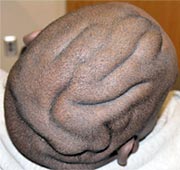
Cutis Verticis Gyrata and Hair Loss

I have a condition that is called ‘cutis verticis gyrata’ where the scalp grows ridges or abnormal lines on the surface. I have had this condition for some time, but have never been concerned before because I have hair that covers the ridges in my head. I’m in the beginning stages of MPB, and have been taking propecia for about a month. I don’t know if my hair loss will ever be extensive enough to show the condition of my scalp, but it causes great concern because I do not want this to happen. I am 32 years old. Have you ever dealt with this issue before? I have read a little on the internet to try to see what people have done with this, but there is not much out there about it. I have read that it has been treated with scalp reduction, which sounds reasonable, but then what? Any ideas?

Cutis Verticis GyrataAfter receiving your email, I wrote to a group of well-respected doctors to inquire about experience in this area, and the general consensus was that this should not be treated surgically. Most of the doctors I wrote to were dermatologists who may have an aversion to scalp reductions in this situation. You need to be evaluated by a surgeon, perhaps a very specialized plastic surgeon who has experience doing this surgery in a patient with your diagnosis. Logically, scalp reductions should work, but I wouldn’t recommend that you be the first patient to attempt surgery to correct this condition.

If you are concerned about balding (which might make the appearance more detectable) then I strongly suggest a miniaturization study to see what degree of hair is at risk of falling out, followed up by a Master Plan. If I was your doctor, I would explore your options after you became my patient, but I simply cannot give you an in-depth answer as I have not examined your scalp or your hair.

Image from DermAtlas

Plagiarism Seems To Be Common Among Doctors for Scalp Micropigmentation (SMP) And Hair Transplantation

We were explaining our hair transplant and Scalp Micropigmentation procedures to a group of patients today and we were shocked to find our pictures lifted off of our various websites and now appearing on the web sites of other doctors. This, of course, is a copyright infringement so letters are now being sent out by our lawyer informing these doctors that if they do not remove these photographs, then we will take legal action against them. They appeared on doctors websites and various other clinics from all over the world, not just the United States.
fraud
There was a case many years ago when I brought one of my patient to an international ISHRS medical meeting. This patient who was completely bald (Norwood 7) had phenomenal results in one session due to his unusual high donor hair density. Doctors were photographing him at the meeting. Later I found these photos on the doctor’s websites claiming that he was their patient! I guess that being a thief is really a matter of what is best for your pocketbook when it comes to unethical practices.

There seems to be a problem for many doctors wanting to get into Scalp MicroPigmentation but they do not have good before and after photos or reviews to show prospective patients. They take a short cut and plagiarize pictures they need off of the Internet. There seems to be no moral scruples among these thieves. Even a doctor can be a thief. We even found some of our photos with our own NHI WATERMARKS on them, telling those who see them that these photos originate from the New Hair Institute. We even found one of our celebrity patients on the site of another doctor.

What does this mean? It means that as a buyer, you must be careful for what the doctors are showing you, as what you are seeing may not be what you are getting.

Daily Hair Loss

Hi Doctor Rassman, how much daily hair loss is normal? some say 50-100, others say 100-150-200 is normal. From your expertise what is normal for an average male with no hairloss.

I believe we wrote about this subject many times over. The average person can loses 0.1% of their total hair count per day as these hairs go into telogen. You must also remember that the person is growing back about the same number of hairs each day. Assuming that the average telogen cycle recurs every 3 years and you have 100,000 total hair count, that calculates to about 100 hairs/day. The numbers are clearly not fixed by nature, so it may vary based upon individual circumstances, genetic patterns, your age and sex.

What Is The Point of Taking Propecia If You’re Going to Bald Eventually Anyways?

I really enjoy visiting the website and reading the wealth of information that is posted on here.

I know dr.rassman has mentioned a few times that if a person is genetically balding their hair has a certain lifetime (example 5 or 10 years) , with or without the use of finasteride, before it completely dies. If that is the case, what is the point of taking finasteride if the hair is going die anyways within 5 or 10 years? Could finasteride prolong the hair from falling out early?

Male pattern balding (MPB) also known as androgenic alopecia (AGA) is genetic. There is no cure. But there are two drugs: Propecia (finasteride) and Rogaine (topical minoxidil) that can SLOW the process down. In some men it can sometimes REVERSE and grow NEW HAIR! But eventually over time, you will continue to lose hair in the genetic pattern.

If you are rapidly losing hair in your 20’s and 30’s and you can take a medication to slow or sometimes reverse the balding process down for about 10 years, that may be worth it to some people. It is an optional medication with a low side effect profile. The most significant side effect for finasteride (Propecia) is sexually related (erection issues) or reduced sexual drive and it occurs in 1 to 2% of men who take the medication. The side effects are reversible once you stop taking the medication. But there are a subset of men out there who claim that the side effects are permanent. It is very difficult to prove or disprove the permanence of the validity of long term sexual dysfunction, but this is a consideration you must weigh if you take this drug. The risks and benefits should be individually discussed with your doctor.

The following is a LINK of before and after photos of men who took Propecia with great results.