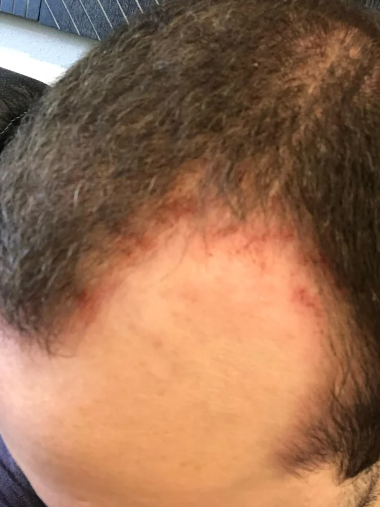
I am among the many young victims of breast cancer (37 y.o. with estrogen+ progesterone+ Stage III breast cancer) who has undergone 16 rounds of chemo, 6 surgeries (including oophorectomy), and 35+ radiation tx, plus am currently on aromatase inhibitors. I am treated at one of the top 10 facilities for cancer in the US, yet trying to get help for my slow growing Ludwig Type II hair while on aromatase inhibitors, esp. 2 years after chemo is proving more daunting. First, my oncologist revers me to dermatology, then dermatology refers me to endrocrinology, then endocrinology suggests I see a hair specialist doctor….but now I read in your archives to defer to the oncologist. It frustrates me that I am being punted around between medical specialties who don’t want to have any liability or necessarily want to work together to come up with a treatment plan for this pervasive side effect which many women in my position are experiencing. No one wants to touch this hair loss issue with breast cancer survivors.
I researched all the medical literature, and although there is plenty of information on observations of hair loss, there is nothing about the treatment of hair loss for those of us who are on either tamoxifen or aromatase inhibitors after breast cancer. I already started 12.5% Rogaine with Retin-A along with 5% minoxidil foam, Aminexil with Madecassoside, and washing with alternating 1-2% Nizoral. Propecia isn’t even an option. Also, I feel I’m relegated to wigs which you deem may accelerate hair loss (although if it not bonded or clipped to hair, I don’t know how that would be the case). Is there anyone in the San Francisco Bay Area that even has the breadth to tackle this problem?
Please tell me there at least some proprietary research out there that is addressing this issue on the horizon, because then I won’t be such a cynic about medicine. Clearly quality of life after cancer involves helping to alleviate hair loss as a result of aromatase inhibitors.
I am truly sorry to learn of your frustration (we’ve all been in situations where we’re referred back and forth and feel like we’re getting nowhere), but the hair loss issue really isn’t specific to breast cancer survivors. Hair loss in all women is a very difficult issue to treat. There are many potential causes, and especially with your medical history, it can be hard to pinpoint the cause. The only FDA-approved medication available to women to treat hair loss is minoxidil (Rogaine), but you should be careful with taking 12.5% and 5% minoxidil foam at the same time so that you do not overdose yourself. Some women have had minor success with Propecia, but that would be taking the medication off-label and there are potential serious risks for women that use this medication (so just to be clear, I do not recommend that approach).
Unfortunately, there are very few options available to women that are losing their hair. For men, Propecia slows the process down, could reverse it, or even completely stabilizes it for years; hair transplantation just rearranges permanent hair from the back to the front. For women, the hair loss may be so diffuse that there is not much to rearrange and there is no specific area of permanent hair like is the case with men. Approximately 20% of women may be helped with hair transplantation, so each patient must be individually evaluated. With regard to your specific situation, I would be willing to see you since you are somewhat local (I do have an office in San Jose) and maybe I can add something to help you, such as the possible use of concealers like DermMatch or Toppik. Wigs might work in your case, but one must be careful that there isn’t traction on the existing weak hair or that’s when you might run into problems with further loss.
I don’t know of any proprietary research, and I wish I had a specialist in mind that I could point you to… but I’m posting your message in hopes that it reaches a wider audience that might be able to provide more insight or assistance. As much as I might want to have all the answers, I fully admit that’s not the case.