How I treated my Gynecomastia

Background: I took fin for a month starting in March 2019. During this time, among many other sides, I felt pain in my breasts, but I didn’t stop as I thought it would go away on its own. A month later, I had large, permanent gyno. Even after that first month, it took a few weeks for the “hard lumps” under the nipples to form which made me think it would reverse itself with discontinued use of fin, but it did not, and I developed unmistakable pointy nipples with hard gyno lumps under them.

I’ve now been taking zinc supplements for 2 weeks, and my gyno is getting a lot better. The size is still larger, and the breast matter is still under the nipples, but the shape is starting to go down and they’re less puffy/pointy or feminine. I’m wondering if this is permanent or if this will go away once I stop taking zinc. The brand I got is the regular amazon essentials brand.

Not good to continue with finasteride if you have gynecomastia as it only gets worse. You might consider switching to oral minoxidil


2020-10-09 14:34:37How I treated my Gynecomastia

How Long Does It Take Before a Surgeon Is Competent at FUE?

Hi,
This is a great blog. Very insightful and well written.

My question is how many years/ no. of surgeries or grafts would it take for surgeons to be competent at FUE?

If someone has only been providing the FUE service for a year or so (even though he has been tinkering for a few years previous to this with smaller sessions ie less than 600 grafts), should I feel comfortable enough to go ahead with a 2000 graft FUE offered by him for my frontal hairline?

Thank you very much for your help.

It isn’t just about how competent a surgeon is at extracting grafts with a punch or a follicular unit extraction (FUE) tool, it is about a combination of factors, of which extraction may be the most difficult for the beginner. Most surgeons take a few years to learn the extraction process and once they got it, it is relatively easy. The next skill is placing the grafts into the scalp without drying them or damaging them. When the grafts come out in the extraction process, the surgical team must trim the excess tissue from the FUE graft (which some doctors do not do), make sure the direction of transplanted hair is correct (which some doctors never get), make sure the medical staff are handling the grafts properly (quality control issue), and commanding the artistic process for each particular patient by controlling the distribution and direction of the grafts so that the fullest look will be obtained.

Hair transplantation is an art and technical skill that takes years to master for the doctor and the staff. Some people don’t realize that the doctor is not the one who inserts the grafts into the scalp (placing), but the doctor is the one that determines the direction and distribution of the grafts, and trains the staff to do it correctly. These are the most critical aspect in how well a hair transplant surgery turns out. With respect to inserting the grafts, it usually takes over a year for the medical staff to learn to insert the grafts efficiently. Some doctors will hire per-diem workers to do this work, so the quality will vary day by day, worker by worker.

I have said this before: cosmetic surgery is not like buying a car. It is not a commodity. No matter what the technique is advertised, each and every surgeon and their work is different. This is where due diligence comes into play. Before you put your head in the hands of any surgeon you should be well informed. There is no reason not to ask the surgeon if you can see his/her previous FUE patients and to speak with them about their experience. Find out if they were happy with the results and if their expectations were met. You should always voice any concerns you have so that any and all issues are addressed to your satisfaction prior to giving your consent to surgery.

Bottom line — some surgeons are more talented than others and there are a variety of factors that influence the outcome of any given procedure, therefore it is difficult to judge a surgeon based solely on the length of time they have been doing a particular procedure.

Where did I get my hair loss problem from (with photos)?

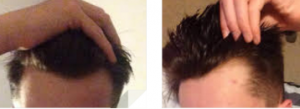
I’m 19 and stared at what seems to be a solid Norwood 2 with thick, dense hair. My maternal grandfather is currently a Norwood 3/3.5, thick hair nonetheless so considered very good for his age(66). I hope to be taking after him however, my grandma’s brother (great uncle) suffered from hair loss at around 40-50. What I’m wondering is whether my grandma could’ve inherited the gene through her family, passed it onto my mother of whom passed it to me. Would this be possible? My mum doesn’t have any brothers either, only sisters so there’s no way of identifying if the gene is present in my family.

Sometimes it is difficult to genetically trace where you are getting your hairline recession from. A receding hairline can lead to future balding. The balding genes can skip multiple generations, therefore you may not be able to tell where you got it from. If this continues to be a problem, see a doctor for the drug Finasteride. It could reverse your receding hairline, something that has a good possibility in someone your age. Since your great uncle suffered from hair loss, then you have proof that the gene does exist in the family line.

10 with early balding

How Long Should I Wait Before Considering Filling In My Strip Scar with FUE Grafts?

Thanks very much for the informative blog.

Say a strip patient is about 6 months out from FUT surgery and now has buyers regret (please, no reminder about thinking things through first!), and wants to fill in the scar with FUE/beard hair/etc. Is there any advantage to do it at this time or does one need to wait one year. I wonder if scar is more or less vascular when healing. Thanks.

If the donor scar has healed, you don’t need more surgery, and the scar is narrow, then follicular unit extraction (FUE) to the linear scar is possible. FUE does not fill in wide scars well, though. Scalp MicroPigmentation (SMP), on the other hand, may be a better approach. Explore it all.

I have white bumps surrounding each FUE graft that was transplanted. Why is that? (photo)

I fished up a photo from the internet of a patient that had FUE grafts in the frontal recipient area. Two things worth noticing: (1) the grafts are elevated and (2) there is skin in the graft that is as wide as the graft itself.

The skin will survive the transplant and the elevation will produce small, subtle white elevated bump surrounding each group of hair from the recipient area (called cobblestonning) and I believe that is what you may be seeing.

I do this differently than the doctor who did the patient in the photo, as I trim off the skin of the grafts before placing them and then place the grafts flush with the surrounding skin so that these white area are not present in our grafts. Click on the photo to enlarge it.

Screen Shot 2018-12-12 at 8.52.52 AM

How many grafts do I need? I’m 23 years old (photo)

I think that 23 years of age is too early because your final balding pattern doesn’t usually show up until you are 25-26 years of age, and even at 26, it may not show up. When I do a hair transplant, I prefer men over 25. The number of grafts depends on four factors: (1) the size of the area being transplanted, (2) the location of the transplant (frontal hairline or not?), (3) your donor density, and (4) your hair mass per unit hair. With that, I can build a personalized Master Plan for any patient, which will consider what might happen to them as they continue to bald (as every man who is balding does).

How many grafts do I need? (Video from Reddit)

Before you go for a hair transplant, I would be sure that you maintain minoxidil and finasteride for at least a year as it may be reversed on this combination of medications in a year or so. How old are you?

https://www.reddit.com/r/tressless/comments/b513fq/how_many_grafts_do_you_think_ill_need_for_thinned/

Why Did I Start Balding at Age 15?

Dear Dr. Rassman,
I am a twenty-seven year old man, and I began to lose my hair at age 15. I went to several doctors when I was younger but they all told me the hair loss was male pattern baldness and not the result of any health problem. I am already as bald as my father, who is thirty years older than me.
When someone begins to lose hair at the age I began to lose mine, will the baldness progress until all of my hair is gone? Will I ever be able to use a hair transplant system? And what the heck would cause my male pattern baldnes to start so early anyway?
Thanks.

Androgenic hair loss or male pattern hair loss starts as males enter puberty, as their testosterone levels increase, bringing on voice changes and pubic hair and other male sex characteristics. Although it is usuual to start the genetic process at 15, the DHT is clearly working on young men of that age. There is an issue of ‘gene expression’, which means that the trigger for the gene may have started early on you. Unfortunately, some men have the gene that causes male pattern hair loss to trigger earlier, while others do not see this until later in life. For example, Don Ameche, a popular old-time movie star in the 1930s and 40s known for his perfect hairline and good looks, started to bald after the age of 50 (late onset trigger for gene expression) and was almost completely bald when he was in his mid 70s (and starred in the movie Cocoon in 1985).


2006-04-12 08:56:24Why Did I Start Balding at Age 15?