Used Estradiol patch, minoxidil & Bicalutamide in 4 months
2021-06-04 01:34:132021-01-01 09:47:29Used Estradiol patch, minoxidil & Bicalutamide in 4 months
A Hair Transplant Patient Ponders the Connection Between Finasteride and Post Finasteride Syndrome
2019-02-14 04:58:462019-02-20 08:40:12A Hair Transplant Patient Ponders the Connection Between Finasteride and Post Finasteride Syndrome
Using finasteride while only having one testicle.
One testicle is as good as two. The one will make up the difference in your needs. If you use finasteride, think of yourself as a two testicle man and what would he do.
Using finasteride while only having one testicle. from tressless
2019-04-03 04:37:152019-04-01 12:38:38Using finasteride while only having one testicle.
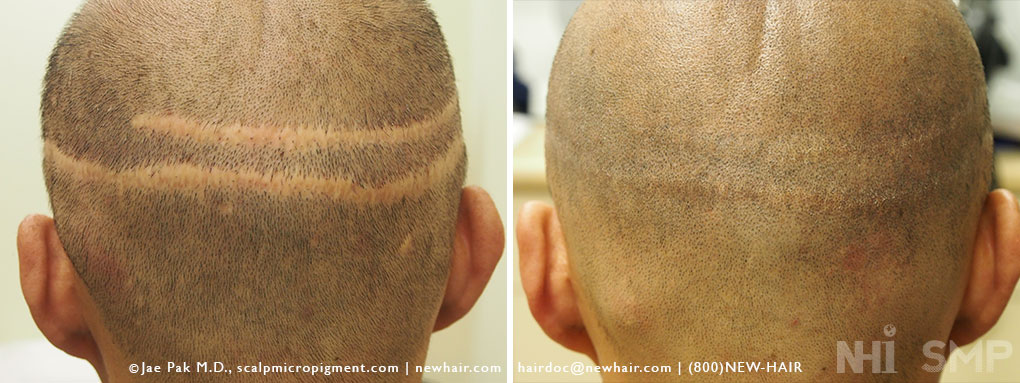
Hair Transplant Scars and Scalp Micropigmentation (SMP) (with photos)
I have had several transplants over the years and have lost about 30-40% of them due to thyroid related conditions. My main concern is if this continues will the transplant scars at the back of my head become visible. Some of the pictures posted on your blog shows promising ways of disguising these scars using SMP. Is this a one-time procedure or something that has to regularly undertaken?
The photo here is an example of what is possible with SMP on hair transplant scars.
SMP is generally a one time procedure and the longevity is similar to any tattoo. As with any tattoo you may want to have it touched up after several years.
If you would like more information, you can always give us a call to speak to our surgical staff or one of our doctors.
Using Propecia at Temples, Wrinkles from Minoxidil, and Other Hair Drug Questions
I am experiencing hair loss at my temples and front hairline. I am 24 and it is at it’s very beginning stages. I Otherwise have a full head of hair and have not had problems in any other areas of my scalp. After looking into all the products out their and doing some research I have found that $transplants$, Propecia and Minoxidil are the only real effective options. The transplants are not monetarily possible right now, the Propecia is said to have no results when being used for temple areas and Minoxidil leaves me with unanswered questions. It would be of much help if you could answer all of the below questions for me.
- Would Propecia work in my case since I am at an early stage of loss?
- Is a 5% solution of Minoxidil better for my situation or would a 2% solution be better?
- Will the resulting hair I grow with Propecia or Minoxidil stay permanently as long as I keep using either product.
- Will I build up a tolerance to the product after a year or so eventually rendering it ineffective.
- I have read of a person who experienced increased wrinkles in his forehead as well as pronounced smile lines in his face as a result of Minoxidil, can this really happen and is it common?
If you can shed some light on these areas for me it would definitely be a huge help. This is the first serious step I am taking in dealing with this hair loss problem and I want it to be the right one instead of something I end up regretting or damaging myself over. Thanks
- You need an evaluation by a physician if Propecia is an option. You need a miniaturization study to see just what is going on and to establish a baseline for whatever treatment you elect.
- I generally recommend 5% minoxidil over the 2%.
- There is no guarantee that if you regrew hair with Propecia and/or minoxidil in the temples, that it would be permanent. However, they should slow down or prevent further loss. See Are Minoxidil and Propecia Worth Using? (with Photos).
- You will not build up tolerance, but your genetic fate will eventually catch up.
- I’ve never heard of increased wrinkles with minoxidil.
2007-11-20 14:34:012007-11-20 14:34:08Using Propecia at Temples, Wrinkles from Minoxidil, and Other Hair Drug Questions
Hair Transplants for Woman Losing Hair from Antidepressants?
Dear Doctor
After reacting to several tricyclic antidepressants I developed telogen effluvium extending an already high forehead and thinning the temples. Large regrowth resulting in thickening hair has not really occurred. I have received conflicting advice from several doctors, ie. lowering the hairline surgically with transplants to the temples or lowering the hairline and thickening the temples using a transplant alone. The lowering would be in the region of 1-1,5cm. What would you advise here? Thank you.
Withing seeing you and examining you, I can not comment on your questions. I’m assuming you’re female based on the name you used (though I’ll keep that private). Female hair loss is difficult and complex to discover a cause for, especially when it is related to drug causes.
I don’t know how long you took the medications, how long you’ve been waiting for regrowth, hair loss history, etc… and honestly, I couldn’t suggest hair transplants without knowing much more about your situation. Make an appointment with us or check the ISHRS for an expert near where you live.
Value of HAIRCHECK bulk measurements in two patients seen by me today
This is a 33 year old male who I have been following for a year. His concern is that he is losing hair and he will consider a hair transplant once the hair loss is substantial enough. He is lucky because his hair is wavy, has salt and pepper color and it has a good weight. Because of these characteristics, the eye nor the camera shows the thinning that is certainly happening in his hair. From his HAIRCHECK measurements today, he has lost 50% of his hair in the front behind the hairline, 72% of the hair in the top of his head (imagine a line between the ears) and 50% of the hair in the crown. This is worse than it was a year ago. His frontal hairline shows some see-through as shown in the photos below.
The second patient is 18 years old, noticed that he was losing his hair when he was 16 but failed to see a doctor until today. HAIRCHECK measurements of his hair bulk show that he lost 78% of his frontal hair behind the hairline and 40% of his crown hair. Despite the huge amount of hair loss that was measured, the balding is barely detectable because of his sandy blonde hair which has a low contrast between his hair and skin color. Because he is 18, he has an excellent chance of reversing this hair loss (some or all of it) by using the drug finasteride. See his pictures below:
HairDX Announces Finasteride Test for Women
Snippet from the press release:
Genetics research and a clinical study are today bringing significant news to women experiencing hair loss. A new breakthrough test can now help doctors determine if a woman is likely to benefit from anti-androgen therapies.
Genetic dermatology research and development innovator DermaGenoma, Inc. today announces the HairDX Genetic Test for Female Androgen Sensitivity. The test offers a new genetic screening for women suffering from or at risk of androgenetic alopecia (AGA), and is making its debut to physicians at the International Society of Hair Restoration Surgery’s 18th Annual Scientific Meeting in Boston.
The HairDX Genetic Test for Female Androgen Sensitivity (to be available through dermatologists at a suggested price of $399) examines genetic and epigenetic (genetic control mechanism) variations in a woman’s androgen receptor gene. This analysis will assess her androgen sensitivity to determine if her hair loss has an androgenic origin.
Read the full press release — Breakthrough Genetic Discovery Helps Dermatologists Prescribe Effective Treatment For Female Hair Loss
Women have few options when it comes to treating genetic hair loss, and this new HairDX test seems to point out which women might respond to finasteride and which will not. I heard the announcement at the ISHRS meeting in Boston, but it’s important to note that finasteride is not FDA approved or recommended for treating female hair loss. The drug can pose a serious risk to those women that are pregnant or can become pregnant.
We previously mentioned the HairDX pilot study about finasteride response in women here.
Very low juvenile hairline
I have seen a few of these hairlines that almost touch the eyebrows. I saw one that was solid at about 1.5cm above the eyebrows. Usually, if the hairline matures, these juvenile hairlines will disappear with age. It could take until 29 years of age. In some ethnic cultures like Indians, hairlines this low are more common, and some men will maintain such a hairline into adulthood as they never develop a classic mature hairline. This is rare.