Seeing the Scalp Under Harsh Lighting

Dear Doctor Rassman,

In your juvenile hairline post I noticed something. In all pictures you used overhead harsh lighting. Therefore you see scalp in the juveile hairline of the woman and the man, and in the mature hairline of the handsome lad ;), with hair that is combed back.

Is it normal to be able to see some scalp at the juvenile frontal hairline under harsh lighting? Is this what we call a transition zone?

I must compliment you on the honest pictures used on your site and blog. Amazing results! Keep up the good work with your blog.

Yes, you are on target with your thinking. Everyone has a see-through transition zone… and under harsh lighting more scalp will be visible.

Evening Primrose Oil

I am a 37 year old female. In February/March I suffered from an acute sinusitis and was on 3 treatments of antibiotics and 2 treatments of steroids. About 3 months later my hair started shedding (diffused) at a rapid pace (100-150 hairs a day) and has been continuing for almost 6 weeks. I have started taking Evening Primrose Oil and other supplements that help hair growth. It dose appear as if new hairs are growing, but I can tell my volume is not what it used to be. I have had 2 blood tests – TSH (2.13) and Ferritin (18.7). My doc said both were normal. Any other test I should request? I am assuming that my acute illness has caused my hair loss, if so how much longer will my hair be falling out? Anything else I should do?

It is normal to lose around 100 hairs a day. You may notice more hair loss at one time or another in your lifetime and this is normal. As long as you are healthy with a normal physical exam, you can take some comfort in knowing that your hair will likely grow back. It is more about being patient and letting time take it course.

With respect to evening primrose oil, I have never heard of it for use in hair loss. If you seem to think it has been helping, then I see no harm in continuing it.

Settling In to a Hair Loss Pattern?

Hi, Dr. Rassman. Thanks for answering all of our questions.

My question is, How likely is it for someone to “settle in” to a level of hair loss (Norwood 3A, for example) and not see any more rapid loss for a period of time (years, for example)? Do some people get to a certain level of hair loss beyond a mature hairline and stay that way without medication? Or is your fate essentially sealed after you reach a certain level?

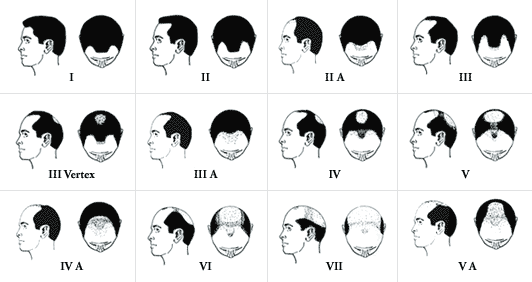
Let me clarify what I see as your misunderstanding. The Norwood chart is not to be seen as a progression of hair loss chart, but rather the final patterns seen in a large male population.

Some people do seem to go from a Norwood class 3 to a 4 and then to a 5 pattern, but you may just “settle in” to your Norwood 3A state, as an example. There is really no 100% certainty, but a good doctor with a good miniaturization study and examination can give you a better assessment of what hair may go with time. Here’s the Norwood chart so we’re all on the same page:

Norwood

Your “fate” was sealed in your genetic code when you were conceived many, many years ago. Very few patients become a Norwood class 7 pattern, and even the balding patients who start as a class 5 may not go much further, even at the age of 100 or so. So for example, there’s no “point of no return” that says if you reach class 4 by this certain age, you’re guaranteed to be a class 7 later in life.

Exclamation Point Hair — Isn’t That Miniaturization?

I have a question concerning today’s blog post. you mentioned that “exclamation point” hair is a sign of a disease but isn’t that what happens when miniaturization occurs in general? doesn’t the shaft get smaller, generally at the root first? that’s what’s happened to me. does this mean i have a disease? i doubt it. i got my thyroid checked when i first noticed hair loss and everything seems fine. i guess what i’m asking is, what’s the difference? thank you!

The term “exclamation point hair” is a term of medical art (see more info and a diagram at American Academy of Family Physicians). You are correct that as the miniaturization progresses (it would have to be rapid progression) one could theoretically see the reduction of shaft size, which is normally a very, very gradual process. It rarely can be picked up visually as you report.

Sexual Side Effects from Topical Finasteride (from Reddit)

With regard to sexual side effects, we have been led to think that topical Finasteride is safer than systemic Finasteride (the pill). However, from this post, that is clearly not the case. Stopping the medication should solve the problem. From what I gather reading your post, you are still using topical Finasteride. I would call your doctors and ask them about it.

How to and how long to recover from fin sides. from tressless


2018-07-19 05:48:45Sexual Side Effects from Topical Finasteride (from Reddit)

I Had an Eyebrow Transplant and Much of the Hair That Was There Fell Out. What Should I Do?

I am sure that this possibility was discussed in your informed consent document, and it should have been discussed with by your doctor. If it does not come back in 12 months or so after the eyebrow transplant, I would assume that it is lost. If I were your surgeon, I would bring you back to surgery and make it right with you at no charge, as I always attend to complications that occur as part of any surgery I do.

Is this a failure of my hair transplant? (photo)

I had 2000 grafts into my two corners and now, 8 months later, it all looks thin. Is this a failure of the surgery?

Certainly, if each side received 1000 grafts, then this is not reflective of such a number of grafts. I would return and see your doctor as most doctors will ‘make things right’ and redo the hair transplant assuming that you still trust the doctor


2018-01-08 01:43:07Is this a failure of my hair transplant? (photo)

Shock Loss at 7 Months

I also experienced shock loss behind the native grafts (even with using Fin before, during, and still on now as a preventative measure). I think this hair is growing back, but there is still significant shock loss apparent. Online I’ve seen reports that shock loss hair should come back anywhere from 3, 6, 9, to even a year after. Should I still be optimistic that this shock loss hair will grow back, if there still needs to be more regrowth at 7 months out? Thanks.

The hairs that are lost from the shock loss depend upon what type of hairs. Those hairs that were miniaturizing will usually not return even at a year. If you are on finasteride prior to the transplant, shock loss can often be prevented, but normal hairs that might be lost will come back usually in 6-8 months.


2020-05-07 07:56:42Shock Loss at 7 Months