Hair Loss After Testosterone Replacement Therapy

I have been on testosterone replacement therapy for 6-12 months, dose recently increased about 4 months ago. I have not noticed any significant change in sex drive (which is low to medium, functioning OK, 44 years old). I have however been experiencing a lot of hair loss and thinning.

This adverse effect is not desirable to me and I plan to stop the testosterone. Will my hair grow back if this is cause? What about hair regrowth if this is also combined with heredity?

Thank You

Testosterone (an androgen) is a known cause of hair loss if you carry the hair loss gene (androgenic alopecia). Much of what you lost, if there is no hair in that portion of the scalp, will not grow back.

Without examining you I can not tell you where your hair loss is in the hair ‘death’ cycle (called apoptosis) that goes with male pattern balding.

Transitioning From Hairpiece to FUE Surgery

I currently wear hairpiece that I’ve had for about 25 years (I’m 50 now). it’s a bonding tape/glue kind. my shop in phila is closing and I’m wondering if it’s time to consider transplantation. however, how would i transition to that w/o everyone knowing? do you have anyone that is/was in this situation

closet
We’ve transitioned many patients from a wig/ hair piece to hair transplant and SMP.
If you choose the SMP method, you can still have the hair piece during the process and when complete, have a “coming out” party and show the world you decided to shave it all off.
If you choose the hair transplant method, you can have the FUE surgery and still wear the hair piece (without the glue) and over the course of several weeks to months, have the hair piece made with thinner looking hair.

This a of course a very simple way of explaining a delicate process. You would need to sit down and discuss the plan with a doctor in detail.


2015-09-05 23:10:35Transitioning From Hairpiece to FUE Surgery

Hair Loss Article in El Paso Times

Lots of people have a lot to say about hair loss and solutions. The article is a bit one sided, talking about the high costs of transplants. Did you know that hair pieces (wigs) can run in the thousands and thousands of dollars in your lifetime? When I met with Hair Club some years ago, they told me that they would expect about $12,000 from each client for a 5 year time-frame. That was about 8 years ago, so taking inflation into account… hmmm…..

Not much on that in this article, but worth reading anyway.

Transplanted Female Hairline (with Photos)

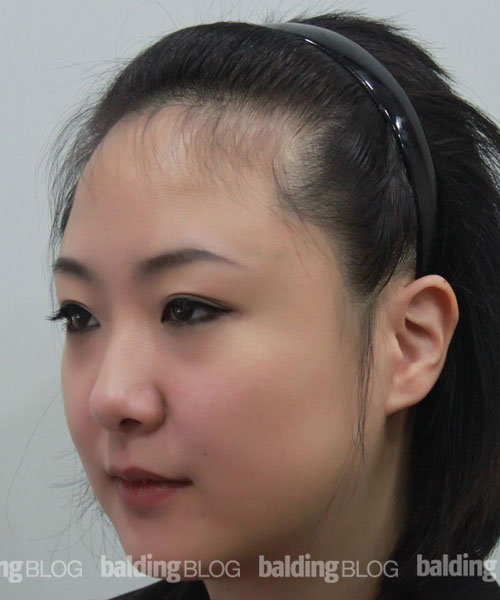
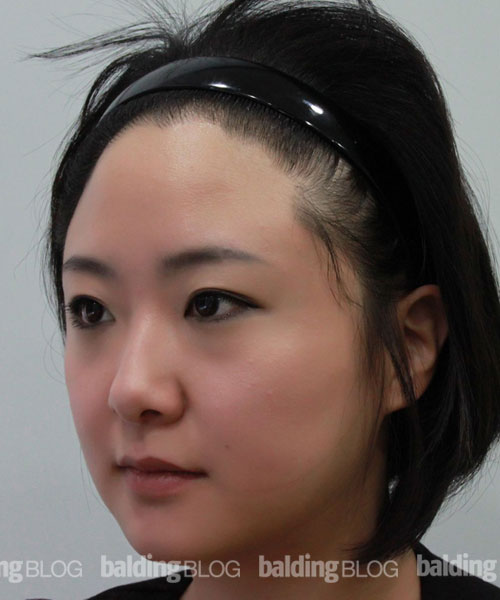
Some women develop changes in their hairlines as they age that make them look more masculine due to receding corners. These defects are very evident in women with very dark hair and light skin (like the Asian patient below), more so than in women with blonde hair and white skin or brown hair with olive skin tones.

These changes occur with many women who undergo plastic surgery, as their hairlines are often negatively impacted by face lifts and brow lifts. The changes tend to become noticeable rapidly after their plastic surgery is done, while others who did not have any such cosmetic procedure will barely notice the changes as they occur very slowly over the years. There are many women who show miniaturization in the corners of the hairline that may eventually lead to the type of changes shown here.

We love doing these surgeries as the patients are most grateful.

The before photo is below on the left, the after photo is on the right. This was done in a single procedure of 1800 grafts, mostly in the corners with some work in the frontal hairline. The after photo was taken about 18 months after her surgery. Click to enlarge.


Hair Loss from Anesthesia?

I am 27 years old and female, and I have always had really thick hair. Around 6 months ago, I started noticing my hair was coming out a lot when I washed, or brushed it. My hairstylist also noticed, and asked me if I had surgey, and if I had anestisia? I did about 10 months ago. I was wondering if that could be linked to it? I have also noticed that my eye on one side feels like it is straining if I look side to side or up or down, and I have expierinced migraines frequently lately. So, maybe it is stress. Either way, your imput would be greatly appreciated.

Yes, the stress from anesthesia and surgery itself can cause hair loss, but it is temporary most of the time, particularly for women. In term of anesthesia, I am not certain if the anesthetic chemical itself causes direct hair loss or just the stress associated with the surgery, although I think that the stress may be a more significant factor in predisposed women. You may have female genetic hair loss and mapping out your scalp and hair for miniaturization might help establish or rule out this diagnosis with objective measurements. Repeating the analysis may have value after 6 months has passed if the first measurements are not definitively able to make the diagnosis.


2006-01-19 12:29:40Hair Loss from Anesthesia?

Transplanting Chest, Leg, and Thigh Hair

I have read some doctors preaching the use of chest and leg hair for hair transplants. I have also read your comments and general lack of enthusiasm for this. What is behind your strong opinions against this?

Scalp hair is better understood and tested for over 50 years. Although the art form has only been reasonable for the past decade or so, the facts concerning hair growth from a scalp source as donor hair are well understood. It is always important for me to inform patients about their risks, expected growth rate, and reasonable results that they should target. We have no body of evidence that hair taken from body or leg parts will work to any reasonable degree, but there seems to be (as P.T. Barnum said) a sucker born every minute. I do not want to be part of such a process, at least until it is clarified as something real.

In the book by Elise A. Olsen, Disorders of Hair Growth, the rest cycles of hair are stated. Although I can not attest for the science of these figures, let’s take them at face value for a moment and see what it means if correct. All hair cycles go through various growth phases, so the length of these growth phases are critically important to understand. For head hair, growth cycles range from 2-7 years, with a sleep period of 3-6 months. Generally it is believed that head/scalp hair is in its resting phase for about 10% of the hair population, which means that of all hairs growing on the head, another 10% is lying dorment awaiting its growth phase.

  • Leg hair has a cycle between 7-12 months, but between 62-88% of these hairs are in their dormant phase.
  • Thigh hair has a cycle of 3-5 months, but between 64-83% of these hairs are in their dormant phase.
  • Arm hair have a cycle of 3-7 months, but between 72-86% of these hairs are in their dormant phase.

With chest, arm, and body hair, the above numbers suggest that there is a large number of sleeping follicles at any one time. If this is true, then there will be questionable value from a hair transplant using these body parts from fullness or coverage point of view. Add to that the pain of hundreds or thousands of small wounds created all over your body might produce. I wonder about the doctors who are routinely performing this type of surgery and ask about their motives. I have concluded that any doctor who offers this must let his patient know that this is not a tested procedure, falling in the experimental rather than the clinical hair transplant offerings. I’d also hope they reveal the figures related to sleep cycle of the hairs from the various body parts as discussed above so that their patients are well informed.


Hair Loss from Propecia

Hey. I’m 20 years old and I have also had a further back hairline, but only on the side. it looked fine. A year ago i asked my doctor about it because it was a little thin on the right side and he prescribe propecia. Well i had been taking propecia for about 8 months every other day, when all of the sudden my hair was coming out like 15 hairs at a time. when i ran my fingers through my hair tons came out. I lost about an inch and a half on my hairline in 2 to 3 months. My hairline was fine before but it was just thin on the right side. It crazy its bother me alot. So i quit taking the propecia a little less then a month ago. I mean i cant even grow facial hair. so it feels weird that im losing my hair. PLease help. Could this be temporary?

Dealing with someone like you over the internet is very difficult or almost impossible. As I have said many times on this blog, you first need a working diagnosis. Getting your hair and scalp mapped out of miniaturization should at the least establish a proper diagnosis. Having someone with my experience, for example, is critical in making the judgments you need. Questions that stand out for me include:

  1. Are you going through accelerated hair loss?
  2. Do you have other causes of hair loss?

I would want to go through an extensive history on your overall health and the family tree in terms of balding, hair growth (when and where), etc. Get a good doctor and do not treat yourself. It has been said that “A person who treats himself, has a fool for a doctor”.

Transplanting Just the Temples?

First of all i would say that i appreciate your website and the information you give.

Im am 33 years old and still have a fair amount of hair. Lately I am bother by my temples, its not bald but it’s not what it used to be.

Last year (september) I started to take propecia to keep the hairs I have. I am now thinking of taking a hairtransplant to insert some hairs in the temples to make it full again. I don’t think I will need a lot of hairs or grafts. What is your opinion about a hairtransplant for the temples? I am afraid that if I do it now maybe later on the hairs ‘behind’ the temples will fall out. Of course I dont want a hairtransplant to make me look like 20 again but just some hairs added to the temples. Do you think its wise to do that considering im now 33 years old?

First, I want to make sure you’re talking about the temple peaks on the sides of the head, and not the corners of the hairline (many people refer to the corners of the hairline as the “temples,” but that isn’t right). So assuming you’re talking about the temple peaks (the prominences above your ears), then I’d have no problem transplanting those if you didn’t show miniaturization on the top of the scalp. If you meant the corners of the hairline, I’d need to see what your loss pattern is looking like.

Your question is a good one, because sooner or later you will bald behind the hair transplants if your hair loss pattern is still progressing, which is why the Master Plan is created by you and your doctor with the primary focus of keeping you always looking good. Really, the best way to answer this question is to be seen by a good hair transplant doctor who doesn’t just want to take your money.

Hair Loss History – Dr. Scott’s Electric Hair Brush

I’m always receiving emails about weird hair loss products that claim to do things they can’t possibly do. I’m sure most of you know this isn’t a new phenomenon, and so I decided to search for some historical hair loss “cures”. Turns out, the scams that exist today aren’t that much different from the quackery of 100 years ago.

In the late 19th century, Dr. George A. Scott was an advertiser of brushes for teeth, skin, and hair that claimed to cure everything from hair loss to headaches. I found a couple of ads for his Electric Hair Brush with some outrageous and ridiculous assertions that I thought the readers of this site would get a kick out of. But first, I wanted to learn more about the man behind the “inventions” and about the actual brush itself. For that, I turned to a fantastically informative site called American Artifacts.

From the American Artifacts site —

Dr. Scott’s Electric Hair Brush. One of the more famous quack devices of the 1880’s, advertised in Harpers Weekly and other popular magazines. Dr. Scott’s 1881 patent claimed merely several magnets embedded in a plastic material and a mold for holding the bristles, which are also embedded in the hard rubber. There is the usual crack across the handle – the metal rods embedded in the thermoplastic material and running the entire length of the brush prevent the handles from breaking. Marked “No 5” and “Dr. Scott’s Electric” on the underside of the handle, and “The Germ of all Life is Electricity”.

The image above is one advertisement I came across from 1882. There’s a larger and more detailed version available here.


2011-01-20 16:35:05Hair Loss History – Dr. Scott’s Electric Hair Brush

Travel for Hair Transplant Surgery?

Hello Dr. Rassman,

As you seem to be the leader in your industry (in my opinion, at least), I assume many patients travel from afar to see you. Do you treat Canadian residents? I am in the eastern part of Canada, and while there seem to be some good surgeons in my area, I feel a visit to you is my best option. Any thoughts about this? Thank you.

Yes, I can treat any patient that sees me from any part of the world. We also offer a travel discount for surgical patients. Before we arrange that we should have a telephone consultation and that works best if you send me photos so I can see what your problem areas are. If you’d like to setup a phone consult, you can fill out this form so that someone on my staff can get back to you to schedule it and get those photos.

Here’s the info about the travel discount from our website:

    If you live more than 150 miles from the office where your surgery is performed, you are eligible to participate in our travel program. NHI will reimburse you for up to 5% of your net procedure cost for reasonable transportation expenses incurred while traveling to one of our facilities for a seminar, consultation or procedure. If you drive to one of our facilities, you can choose to be reimbursed for either mileage or gasoline expenses. If you fly to one of our offices, please note that frequent flyer miles are not reimbursable. NHI can only reimburse you for your flight-related out-of-pocket expenses. In all cases, please remember to provide receipts. In addition, you will receive one night’s stay at a pre-selected area hotel at our expense. This program is based on a minimum procedure fee of $3,000.00.