Why Don’t You Completely Restore a Head of Hair in a Transplant?

Dear Doctor,

Great blog. Why is it not possible to do many hair transplant surgery till your hair is completly restored.

You can’t completely restore a head of hair in one surgery unless you are not very bald. Technically, you can’t completely restore a head of hair at all, but you can create the illusion of fullness. You’ve got a limited number of hairs on your head to start with. For a person who lost 8,000 hairs only in the front, it is possible to restore it back to about 50% of the original density, which may work with reasonable hair thickness. If you lost 60% of your original hair (60,000 hairs) then the amount of hair that you can move will be limited to possibly 7,000-10,000 hairs per session as long as the supply of donor hair lasts.

I tell people that they need a Master Plan because the future of your hair loss may not be clear and your worst case needs to be planned for. Once you start losing your hair, transplantation enables us to move some of the remaining hairs to other areas of the scalp.

How to quantify your donor area hair supply?

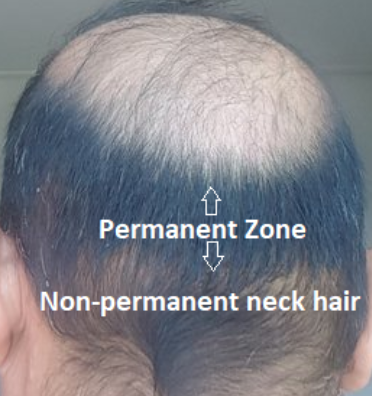
Here is a picture of the donor area of a man who asked me: How much donor hair do I have? He asks: You have talked about the Donor Bank in your writings, so I would like to know how many grafts are in my Donor Bank and what will be my lifetime supply of grafts for hair transplants in case I should become very bald?

First let’s see where the permanent zone of hair can be found. It is called the permanent zone because even the baldest of men, never lose hair in this zone (see photo below). The zone measured from 2.5-3 inches in height and extends around the entire head from temple prominence on the right side to temple prominence on the left side. We generally assume (safely so) that this hair will always remain (regardless of the balding pattern a man develops). Back in the late 1950, a doctor ‘Orentriech’ discovered that if this hair is moved anywhere on the body, even into a bald area of the scalp, it would grow as it would have grown in its home location in this permanent zone. That is why it is called the permanent zone of hair.

There are two important numbers to determine from the hair in this zone (1) the hair count per follicular unit (these are the groups of hairs that contain one or more hairs each in them) and the thickness of the hair shafts of this permanent hair (never look at the hair you are losing as normal hair as it often gets thinner and thinner). I quantify the thickness of each hair shaft in the permanent zone by feel (experience helps here) or with a micrometer as Fine (~40 microns or less in thickness), Average (~60 microns in thickness) or Coarse (70+ microns in thickness).

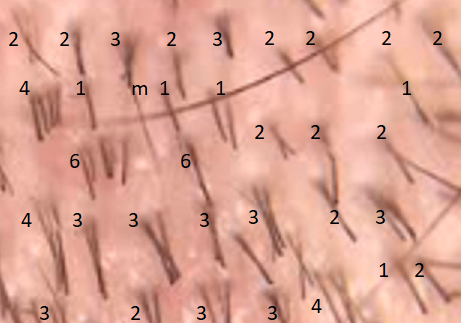
I generally take a picture of the donor area with the hairs cut short enough that I can count the number of follicular groups in the field of view and how many hairs are in each group (see below). This field of view of the donor area of one of my patients was taken with a purchased lens as an attachment for my cell phone (https://www.amazon.com/gp/product/B07S5YPPQX?pf_rd_p=ab873d20-a0ca-439b-ac45-cd78f07a84d8&pf_rd_r=CCSSMZGDS79G6AG31TT9) at a cost of $16, something you should consider purchasing.

First let’s do some simple math: There are 34 individual hair groups (in the area shown in the photo) which contain from one to 6 hairs each (each are counted and labeled for you). The total hair count in this field is 85 hairs. If we divide the number of hairs by the number of groups 85/34= 2.5 hairs per Follicular unit (a Follicular Unit is essentially what we call a Graft in a hair transplant surgery). The average Caucasian has 2.2 hairs per Follicular Group so the man shown here has a hair count that is 13% higher than average. I can tell from this number that this man has 125,000 birth hairs on his head regardless of how much hair he has already lost. I felt his hair for thickness and measured it. It measured 60 microns which is essentially an average weight hair.

Now let’s look at more detail at this picture. There is a single hair shown that I labeled ‘m’ for a miniaturized hair. So this man had approximately 1% miniaturized hairs. The number of miniaturized hairs can be as high as 20% and the donor area is still considered healthy. As we get older (into your 50-90s) these hair groups may drop hairs so that the count could be slightly lower and the hairs that we often drop will often be miniaturized before they fall out. Everyone experiences hair changes with age, as donor area hairs may get ‘finer’ so that they contain less hair bulk per hair shaft. If these hairs are used for a hair transplant, whatever happens in this permanent zone, will happen in the hair transplanted hairs as well.

The calculations of his total donor bank supply is a bit more complicated. Each person has a fixed number of Follicular units (about 50,000 for an average sized head). Generously assuming that the size of the donor area is between 20-25% of the total hair baring scalp (let’s use 25% as a number for calculations here), this patient has 31,250 hair in his permanent zone or 12,500 follicular units (grafts) of which he can transplant theoretically no more than 60% of these hairs (follicular units or grafts). The 60% number is based upon an average hair count, but because this man has 13% more hair, he can actually move 13% more grafts bringing his total available lifetime hair to 7,500 * 1.13 = 8,475 grafts available during his lifetime.

Experienced surgeons like me who have been measuring hair densities since I first entered the practice and defined it in the literature, have learned when they can increase even this number safely. This is where surgical judgment comes in. I would like you to try to make this important assessment of your Donor Bank so that you will be able to (1) test the doctor’s knowledge of what he says about your donor supply, (2) be confident that your donor quality and quantity is adequate to meet your short and long term hair transplant needs.

2019-12-17 11:59:26How to quantify your donor area hair supply?

Why Is There a Dormant Phase After a Hair Transplant?

Hi Dr Rassman

I was just wondering if you could explain why grafts enter a dormant phase immediately after being transplanted, and only start recovering after 8-10 months?

I’d also be interested to know why they initially grow back much finer, and then thicken up later. Essentially the follicle itself hasn’t changed, so why does the hair diameter it produces fluctuate in this way?

Many thanks

I do not know why there is a dormant phase after a hair transplant. To put it simply, when you have hair transplant surgery, your follicle was removed from your body, handled, cut, manipulated, put in solutions, manipulated some more, and put back into another new location on your body. If I was that follicle and I survived all of that, I’d be traumatized and go dormant for awhile. In all seriousness though, I do not have a professorial explanation.

The simple fact is that most follicles go dormant (telogen) and start to regrow in a period of 3 to 12 months. Most patients see results starting on the 6th month to 12th month. Some lucky minority of patients (< 5%) see results within a month! This is what we have observed over the last 20 years in thousands of patients.
[tags]dormant phase, hair transplant, hairloss, hair loss, telogen, hair cycle[/tags]

Human Hair Density

i am a student at State University of New York College at Geneseo. i am doing a reseach and it requires me to find out the density of human hair, in terms of kg/m^3.

i know that human hair density might have a range. if you have that stat., please also give me.

thank you very much for your concern.

In the Caucasian, human hair density averages 2.2-2.3 hairs/mm square. In Asians, the density averages approximately 1.6 hairs/mm square and in Africans, is averages apprxomately 1.3 hairs/mm square. In the head of an average male with a hair bearing area of approximately 80 square inch area, the density is approximately 1250 hairs per square inch (rounded) bringing the total count to 100,000.

You must keep in mind that this is center point in a Bell Curve, and standard deviations overlap heavily between the races. The highest densities I have measured were in Caucasians at 4 hairs per mm square and the lowest numbers are not trustworthy because they may reflect diseases or some form of genetic balding.


2005-07-20 08:34:21Human Hair Density

Why Was I Born With a Bald Spot That Won’t Regrow Hair?

Ive had a bald patch on the left side of my head since birth. It has decreased in size over the years but my doctor has said it will never fully grow hair. I was wondering what caused this and what other alternatives there are.

I cannot tell you why you have a bald patch that you were born with, but think of it like a birth mark. It is what it is.

In most cases, the easy solution to this is with a small hair transplant to the area.

I am 20 years old, what should I do about my hair? (photos)

Fortunately, you supplied just barely enough of a view of your hair in the two most important areas (front and crown) to show that you have thinning in both areas. You have a strong forelock in the center of your thinning frontal area and this forelock may stay even if the hair around it disappears. The best treatment at your age with this condition is the drug finasteride which may reverse it at your age. Also look at this post for more direction: https://baldingblog.com/haircheck-test-how-it-is-done-video/


2019-05-10 12:18:39I am 20 years old, what should I do about my hair? (photos)

Will Buzzing My Miniaturized Hairs Pull Them Out?

I have been diagnosed with miniaturization through-out the scalp.(30%) Was told it wasn’t dupa though. It is advised that those with this type of hair loss pattern keep their hair very short. Buzz cut! My hair looks horrible grown out but am afraid buzzing it every few weeks will speed up the loss. In a past question you mentioned friction on weak miniaturized hair can pull it out. What should I do?

Thanks

Buzzing hair that has miniaturization will not impact that hair unless it is poorly cut with non sharp instruments that pull. In other words, I do not believe that buzzing your hair will help it or hurt it. My advice is to style your hair any way you like it.

I Am Certain I Will Lose My Hair Because of Genetics

My maternal grandfather was bald and my father, who’s almost 60, has substantial thinning around his crown and a receded hairline. I just turned 27, and I don’t seem to have much if any thinning. The temples of my hairline have receded an inch or so in the last couple of years but everything else seems to be in place.

How long can my luck hold out? I have plenty of friends my age who have already lost substantial hair but I have not even though I’m certain I’ll lose substantial hair because of genetic inheritance.

As a general rule, you may follow your family pattern not only with balding but with the onset date. When did your dad start balding? You can have your scalp mapped out for miniaturization to see if you have early signs of genetic hair loss, but if you do not see it, I would not even go that far.

Will finasteride reverse my miniaturizing hairline?

Hey I’m 19 and In thinning around the hairline I’m now on 0.5g finasteride since 2 weeks and me question is will finasteride thicken these fine hairs on the hairline or do I need to Derma roll?

Provided you are not talking about the loss of your juvenile hairline in developing a maturing hairline, a 19 year old with early genetic Class 3 type hair loss may reverse the process on finasteride. Finasteride will not help you hold on to a juvenile hairline or bring it back.


2020-12-09 22:19:49Will finasteride reverse my miniaturizing hairline?

I am now 8 months and am disappointed in my hair transplant (photo)

It looks like the transplants grew but if you have fine hair, a second hair transplant could have been predicted but based upon these photos, it may be needed anyway. More length will help it look fuller. I always tell my patients that a second transplant may be needed if there is not enough fullness present, something almost always the case in people with fine hair and not uncommon even with people with medium weight hair (about 30% of the time).


2020-09-08 09:45:02I am now 8 months and am disappointed in my hair transplant (photo)