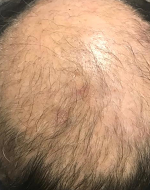
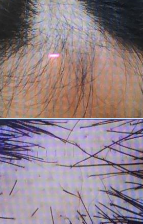
Trichotellomania (pulling disorder of the hair from the scalp) Photos

Taken from Wikipedia:

Trichotillomania (TTM), also known as hair pulling disorder, is a mental disorder characterised by a long term urge that results in the pulling out of one’s hair.[2][4] This occurs to such a degree that hair losscan be seen.[2] Efforts to stop pulling hair typically fail.[1] Hair removal may occur anywhere; however, the head and around the eyes are most common.[1] The hair pulling is to such a degree that it results in distress.[1]

The disorder may run in families.[1] It occurs more commonly in those with obsessive compulsive disorder.[1] Episodes of pulling may be triggered by anxiety.[1] People usually acknowledge that they pull their hair.[1] On examination broken hairs may be seen.[1] Other conditions that may present similarly include body dysmorphic disorder, however in that condition people remove hair to try to improve what they see as a problem in how they look.[1]

Hair makes the world of difference in bringing out the ‘Younger You’ (photos)

What a difference a single hair transplant makes. Now the man in the mirror is young looking because he has a frame to his face with a natural looking hairline from the single hair transplant procedure. He had a bit more than half of his head covered from his first procedure of 2800 grafts. A second hair transplant will fill up the crown which he has now scheduled to have done very shortly.


2019-09-25 08:36:53Hair makes the world of difference in bringing out the ‘Younger You’ (photos)

Trying to lose weight and losing hair

I started noticing this like a month ago. I think I’m starting to lose my hair. I’ve been working out heavily and cutting my calories since Jan. That’s the biggest change in my lifestyle. My goal is to go from 245 -> 175-185. I’m doing like a 1000 cal deficit but honestly my eating hasn’t been on point sometimes I do a meal a day or a bunch at once.

A 1000 calorie diet can cause hair loss if you have the genes for hair loss


2019-05-10 12:25:00Trying to lose weight and losing hair

Hair Pull Test

Dr. Rassman,

If propecia has been successful treating my Diffused Patterned Alopecia, should I still have a positive result from the Hair Pull Test (i.e., still find hairs after conducting the Test in the balding areas)?

Thanks.

The hair pull test should be done by the physician, and not by the patient, as it is more complex than the name makes it out to be. Just pulling on some hairs and seeing clumps of hair fall out does not mean you have a positive hair pull test. The hair pull test is performed by taking a few strands of hair between the thumb and forefinger and pulling on them gently. Hairs in anagen (growing) should remain rooted in place while hairs in telogen should come out easily. You then figure out what percent of the hair is in the telogen stage. For more information on the cycles of hair growth, see Hair Follicle Cells Growth Stages.

Shedding of hair can be variable from day to day and is greater in certain seasons (spring and autumn). Washing you hair prior to having a hair pull test can also affect the results. Genetic hair loss does not cause a positive hair pull test. And it should go without saying, but the image to the right is NOT the actual hair pull test, and you shouldn’t have to worry about your doctor doing this to your head when conducting the test.

Two months on minoxidil (photos)

There is a suggestion of early results on the photos as they are, I assume, taken from the same place with a comb-over on the 2 month photo. It is always best to style the hair the same to see the differences clearly.

Hair systems for thinning hair

Hair system for someone who still has hair but diffused thinning like me, will they work well?

Hair systems work well, but they almost always accelerate the hair loss because of the various attachments that are used. Men who use hair systems find that they get balder by the number of years they use them.

Understanding When a Hair Transplant is Appropriate

Hello,

I am a 21 year old male and for the last year or so I have began to notice that my hairline is receding. In an attempt to control my hair loss I have purchased Procerin and minoxidil 5% and I am considering going to my doctor to ask for his opinion on using Propecia. I have also been reading up on the subject of hair transplants but have came to understand that I am too young to consider this sort of option. However, this brings me to my questions:

  1. If I add Propecia to my current regime (Minox, Procerin) will my doctor or dermatologist still be able to map my hair loss and estimate when it would be wise to consider a hair transplant?
  2. Or will I have to stop my regime, for a period of time, to allow the regrown (if there is any) hair to fall out, thus allowing my doctor to see the natural recession of my hair line?
  3. Or would I have to stay on a course of Propecia forever, so to stop any hair loss behind the hair transplant?

I am answering your questions in the order you asked:

  1. The available FDA approved medications for hair loss can help slowing down or in some occasions stopping the process of hair loss. Early 20s is the period that most physicians don’t want to rush into performing a hair transplant, because it is hard to predict the progress of the hair loss and final hair loss pattern at this age. Considering the family history of baldness, hair loss medication use and degree of miniaturization can help establish a Master Plan for a young patient like you. So, you need to find a good doctor for a thorough evaluation and only after considering all above factors should atime table be tailored for your hair transplants.
  2. The effect of these medications on your hair growth is gradual and I don’t recommend stopping them to find out your natural degree of hair loss. You will end up losing more hair unnecessarily by doing that. I have no information about Porcerin, but Propecia is the most appropriate medication to control progression of genetic hair loss in young men.
  3. I recommend that you develop a Master Plan for the treatment and stick to it, being monitored with yearly miniaturization studies to follow the progression of the hair loss. Most of the patients need to continue their treatment for the rest of their lives, so it is wise to do your research before starting such treatments.

Hair Transplant Before Face Lift?

I have a question about possible future hairloss. I have a list of procedures I want to have done and thought I knew the best ordering of them. I plan on having a hair transplant first, this so my hair has time to regrow. About 6 to 7 months later I would have a SMAS Facelift. However, I have been reading about the hairloss common to post face lifting and now I am perplexed. Bear in mind, my eyebrows are to be lifted with a method that doesn’t go near my hairline on top, however, it is the sides of my hairline, the temple region that has me stressed. A facelift will deal in that area and quite truthfully, I can’t afford to lose hair there. It is already thinned out considerably as it is. But, I need to have the facelift. So, is it possible to have a “temple” hair transplant? I don’t see any way around this. Help me by imparting your knowledge so I make an educated choice. I think I can proceed with the transplant on top, to be scheduled in early december, but what about the temples and future facelift?

Thanks so much for taking the time to answer my question and solve this.

Generally, I like to do hair transplants after face lifts, because if there are any problems to the hair caused by the face lift or brow lift, they can be addressed at the time of the hair transplant. A good deal of my practice is this type of surgery. Clearly, the newer face lift procedures spare some, but not all of the problems. You can follow your facelift with a hair transplant after a few weeks to a few months. If there are hair problems following the facelift, they will be evident by month three.

Ursolic acid for male-pattern hair loss?

Any idea if ursolic acid can help with male-pattern hair loss? In the study below, it says it reduced DHT.

https://pubmed.ncbi.nlm.nih.gov/22266360/

Ursolic acid appears to be an interesting possible treatment for a variety of conditions including an enlarged prostate, inflammatory diseases and some cancers however it is not approved for clinical use. Although it is easy to extrapolate its effects on prostate hypertrophy and its relationship to hair loss, there is no proof that this has value nor that it is safe for the treatment of hair loss.

See https://www.ncbi.nlm.nih.gov/pmc/articles/PMC5928337/

Hair Transplant in 21 Year Old Woman is Criminal

I had a transplant in August, 2007. Needless to say it has been over a year and a half, and to my sadness and distress, I have yet to see ANY results. I had a full head of hair going into the surgery, and I went to Mexico with the doctors of a medical institute there, maybe that was my first mistake.. I was 21, and I am a female, and now I find I might not even have been a good candidate to begin with. The doctor just looked at me and told me that I was a good candidate. My hair had a diffuse thinning, but still there was quite a bit of hair stil left, something I wish I would have appreciated before. After the surgery, my hair fell out. I was patient, thinking it was shock loss and it would be temporary, but it has been more than a YEAR and the hair never came back. Fortunately I can use powders like Topikk all over my head to fake a full head of hair, something not necessary before, and my hair is much thinner than before. Does this seem like shock loss and is it permanent? I am upset over this and stressed out, but I would like to know what the future holds for me. Any help given would be greatly appreciated. Thank you.

This is quite unfortunate. Hair transplantation on a 21 year old woman is usually performed by doctors who want the money and do not care about the patient’s welfare. Indeed, about 80% of women with hair loss are not candidates for hair transplants and may suffer the same outcome that you did. You should have had a full medical work-up to include many blood tests for medical conditions that could cause female hair loss. There is even a genetic test for the inherited form of genetic hair loss. This remains a buyer beware market.

It might be worthwhile visiting me in my Los Angeles office. I could then confirm for you what may be going on and possibly give you some insights into what may happen to you in the future. I may even be able to suggest treatments for your hair loss. As your surgery was over 20 months ago, you should’ve seen some growth by now if the surgery was successful.