
2019-10-17 05:14:302019-05-10 12:15:07Treated with minoxidil, finasteride and the Dermapen over three months (with photos)
Hey, thank you for keeping this blog – it’s a great help! I’m an 18 year old male with a little bit of paranoia (nobody else thinks I’m losing hair). I’ve been reading about miniaturization. I noticed that some of the hair that comes out when I’m washing my head is finer than other hair. I have no idea if this is normal or not – what do you think?
It is normal to lose around 100 hairs every day as new ones grow in. If you have product in your hair (hair spray, gel, wax, etc), it may keep some of those hairs trapped until you shower, and then appear to have a bunch of hairs coming out at once… when in reality, it was just your normal daily hair cycling.
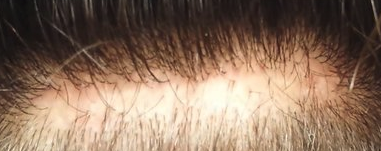
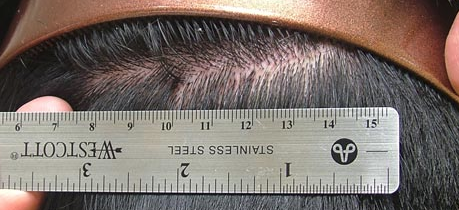
There are many types of trichophytic closures, and I don’t know which type you had done. Many just don’t work well. The ones that do work well create a 4 mm shelf on the lower edge of the wound, and this area is buried below the skin. So, when the hair grows, it grows through the scar to the 4mm distance. You can have a scar revision with a properly done trychophytic closure, or you can have scalp micropigmentation which will effectively hide the scar.
Below is an example of a properly done Trichophytic closure (right of your photo).
I am a 46 year old balding man presently at class 5. I have tried minoxidil up to the 12.5% concentration (Xandrox) but has not worked for me. I also have had one transplant session of about 400 grafts (not NHI) but most of the grafts are gone and obviously am not happy with the result. I just wanted to know if you would recommend my continuing the 12.5% minoxidil or even try the 15% treatment just to slow down the balding process and keep me from going to class 6 or class 7.
Your question is troubling me. Transplanted hairs are permanant and very successful so if yours failed, something is wrong. It is also troubling that you only had 400 hair grafts when you state you are a Norwood Class 5. That would hardly have an impact on your appearance. If your hair transplant was a failure, it is my opinion that you should follow-up with your original hair transplant doctor to discuss the failure with him/her. There are instances where patients believe their hair transplant was a failure because they also had ongoing hair loss. Could that be your situation?
Furthermore, if minoxidil 5% or 12.5% didn’t work for you, what makes you think 15% will work? Minoxidil, like all drugs, has its limitations and higher concentrations may have adverse side effects. Depending on your medical history and a good diagnosis of hair loss, I would also consider finasteride (Propecia) as another option.
I am a male and I did a bad job of bleaching my hair and it burned my scalp. When I used the bleach I used it only on the top of my head. The hair on the top of my head seems to be growing slower than the back and sides where I applied the bleach. I am only 18 so can the hair loss be due to the bleach?
It would be unusual for any long term damage from a single bleaching episode on your hair. Assuming that you wait a year or so, everything should resolve. Make sure that you do not have male genetic hair loss, by getting your head mapped out for minaturization. If you do have genetic hair loss, thinning could have been precipitated by the bleaching and proper medications may be in order (like Propecia). Get a good doctor to evaluate you.
2005-12-19 08:28:262005-12-19 08:30:29Hair Problems from Bleaching
2020-06-22 04:00:552020-06-23 15:20:06Two Interesting Articles Discussing Finasteride and Its Side Effects
How fussy do you have to be with placement of it though? If you have a hair system or only applying in certain spots you can’t be too consistent?
You have to be fussy! If you apply the hair system, make sure that the clips are never in the same place or you will end up with traction alopecia.
2021-01-13 02:21:492021-01-14 09:58:25Hair Systems and how to avoid hair loss from them
Part 1:
I really enjoy the website and find it very informative. I have read on this website many times, that many individuals who are destined to be a norwood 6 or 7 and eventually do become either of those stages, are typically men under the age of 30. Moreover, the final balding pattern is established or completely stops typically between the ages of 40-50.
So, how come there is so much uncertainty regarding hair loss between the ages of 30-40 and what will happen and if further progression of hair loss will occur? I would think if an individual has reached their 30’s with a significant amount of hair, then balding should stop.
Part 2:
My situation is like this, I started balding at 19 and am currently 33. I have been on finasteride for the past the 14 years and have remained a norwood 2-2A. I don’t have much body hair or facial hair and have always felt I have low testosterone. What am I a destined to become then, any ideas?

Thank you for following BaldingBlog!
There is no firm rule on what age you will lose your hair. For most men, genetic male pattern hair loss occurs in their 20s and30s. But it can also happen in their 30s, 40s, and 50s. Hair loss does not completely stop. We don’t necessarily fit neatly into a box. This is why patients go to doctors for an examination.
If your hair loss is a Norwood 2 there would be questions of why you would have needed to be on Propecia in the first place. A Norwood 2 hair loss pattern do not progress to a Norwood 6. Norwood classification is not a chart for “progression” of hair loss. It is merely a pictorial description of your genetic hair loss trait. In the end only your doctor can tell you about your treatment plan. If you suspect a low testosterone level you should discuss your concerns with your doctor and have a test to confirm this (…if it is an issue). Testosterone levels have nothing to do with genetic male pattern balding. You can have a very high testosterone level and have no balding and no beard. You can have a very low testosterone level and be completely bald with a full beard. There is no correlation with facial hair and testosterone levels.
Hi. Yesterday i was diagnosed with Hypohidrotic ectodermal dysplasia. I was wondering if you know anything about having this disease and hair transplants. Since I was born with this can insurance cover it? I have spots and places where my hair will not grow. It requires me to wear hair extentions , and im thinking about a wig. Anyway , i was wondering if you knew anything about this.
Thank you
Yes, I do know about ectodermal dysplasia. It is a genetic trait which can affect hair (among other things). I do not know how insurance coverage plays a factor in this, but I doubt that hair transplantation will be an option. With ectodermal dysplasia there are defects in the hair and skin that may make hair transplants not possible.
2010-11-02 08:48:592010-10-29 14:18:06Hair Transplant and Hypohidrotic Ectodermal Dysplasia